Samsung Electronics Expands System Semiconductor Investment Plan from 133 Trillion to 171 Trillion by 2030
Completion of Pyeongtaek Cluster in Second Half of 2022... Solidifying DRAM Super-Gap
Fostering Semiconductor Ecosystem, Strengthening Win-Win Investment and Cooperation with SMEs
Vice Chairman Kim Ki-nam: "Semiconductor Industry in Major Transformation... Long-Term Investment Vision Needed"
[Asia Economy Reporter Su-yeon Woo] Samsung Electronics is significantly increasing its investment plan from the original 133 trillion won to 171 trillion won to achieve the 'System Semiconductor Vision 2030,' accelerating research and development of advanced foundry processes and the construction of production lines. This aims to achieve balanced development of Korea's semiconductor industry, which has been concentrated on memory semiconductors, and to increase market share in the next-generation system semiconductor market with unlimited potential.
On the 13th, Samsung Electronics announced this additional investment plan in the system semiconductor sector at the 'K-Semiconductor Belt Strategy Report Conference' held at the Pyeongtaek campus.
The report conference was attended by President Moon Jae-in, Deputy Prime Minister and Minister of Economy and Finance Hong Nam-ki, Deputy Prime Minister for Social Affairs Yoo Eun-hye, as well as minister-level officials from related agencies including the Ministry of Trade, Industry and Energy, Ministry of Land, Infrastructure and Transport, Ministry of Science and ICT, Ministry of Employment and Labor, Ministry of SMEs and Startups, and the Financial Services Commission. Industry representatives such as Vice Chairman Kim Ki-nam of Samsung Electronics, Vice Chairman Park Jung-ho of SK Hynix, Chairman Jung Chil-hee of Nepes, and CEO Park Sung-hyun of Rebellion also gathered in one place.
'System Semiconductor Vision 2030' Investment Plan Expanded from 133 Trillion Won to 171 Trillion Won
Samsung Electronics announced that it will invest a total of 171 trillion won by 2030, adding 38 trillion won to the 133 trillion won investment plan established when the 'System Semiconductor Vision 2030' was announced in April 2019 to secure early leadership in system semiconductors.
In April 2019, the government held the 'System Semiconductor Vision Proclamation Ceremony' at Samsung Electronics' Hwaseong plant and announced plans to become a comprehensive semiconductor powerhouse through fostering system semiconductors. Over the past two years since the vision proclamation, mutual cooperation among key members of the domestic semiconductor ecosystem?including semiconductor manufacturers such as Samsung Electronics, fabless companies, core material, parts, and equipment suppliers, and academia responsible for nurturing talented personnel?has been activated, steadily laying the foundation for achieving the vision.
Samsung Electronics expects that this expansion of system semiconductor investment will contribute to further elevating the status of the 'K-Semiconductor' amid an unprecedented semiconductor shortage and competition among governments worldwide to attract semiconductor supply chains.
Completion of Pyeongtaek Line 3 in the Second Half of 2022... The Most Advanced and Largest Semiconductor Cluster in the World
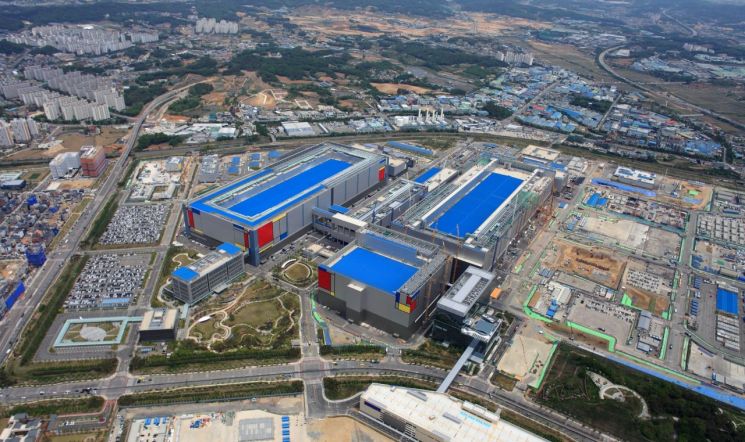
The cleanroom size of Pyeongtaek Line 3, to be completed in the second half of 2022, is equivalent to 25 soccer fields. It will mass-produce 14-nanometer DRAM and 5-nanometer logic products using extreme ultraviolet (EUV) technology. As a factory applying the most advanced technology currently available, all processes are fully automated and managed by a smart control system.
Samsung Electronics' Pyeongtaek campus is expected to strengthen its leading role as the world's largest semiconductor cluster, serving as an advanced product mass production base and a global semiconductor supply hub.
Going forward, Samsung Electronics plans to lead the application of EUV technology to next-generation DRAM and accelerate the development of future memory solution technologies such as 'HBM-PIM,' which integrates memory and system semiconductors, and 'CXL DRAM,' which can overcome the capacity limits of DRAM, thereby reinforcing its position as the world's number one with a super-gap.
At the event, Vice Chairman Kim Ki-nam of Samsung Electronics emphasized, "In the memory sector, where Korea has consistently maintained a leading position, competition is intensifying. Rather than focusing on defense, Samsung will take the lead in proactive investment to create an insurmountable 'super-gap.'"
Fostering the Semiconductor Ecosystem... Strengthening Win-Win Cooperation, Support, and Investment
Through this strategy, Samsung Electronics will also expand win-win cooperation, support, and investment for the development of the domestic semiconductor ecosystem.
To foster the system semiconductor ecosystem, Samsung Electronics plans to expand various win-win activities such as reciprocal provision of core intellectual property (IP) to fabless companies, support for prototype production, and technical education for partners, while strengthening cooperation with core material, parts, and equipment suppliers in the supply chain as well as academia for nurturing talented personnel.
In particular, the foundry sector's growth will increase the growth potential of domestic fabless companies, encourage many fabless startups, and have the added effect of upgrading the overall technological capabilities of the system semiconductor industry. Therefore, Samsung Electronics' expansion of its foundry business is expected to serve as a foundation for Korea's future industries such as 5G, AI, and autonomous driving.
Vice Chairman Kim emphasized, "Korea's semiconductor industry stands at a major turning point, and now, amid great upheaval, is the time to draw a long-term vision and investment blueprint. Although the challenges we face are great, we will boldly move beyond the present toward the future."
© The Asia Business Daily(www.asiae.co.kr). All rights reserved.
![Clutching a Stolen Dior Bag, Saying "I Hate Being Poor but Real"... The Grotesque Con of a "Human Knockoff" [Slate]](https://cwcontent.asiae.co.kr/asiaresize/183/2026021902243444107_1771435474.jpg)
















