Decrease in Cases of Counseling and Handling of Teacher Rights Violations but Increase in Cyber Teacher Rights Violations
Damage Such as Personal Information Leakage and Verbal Abuse During Remote Classes
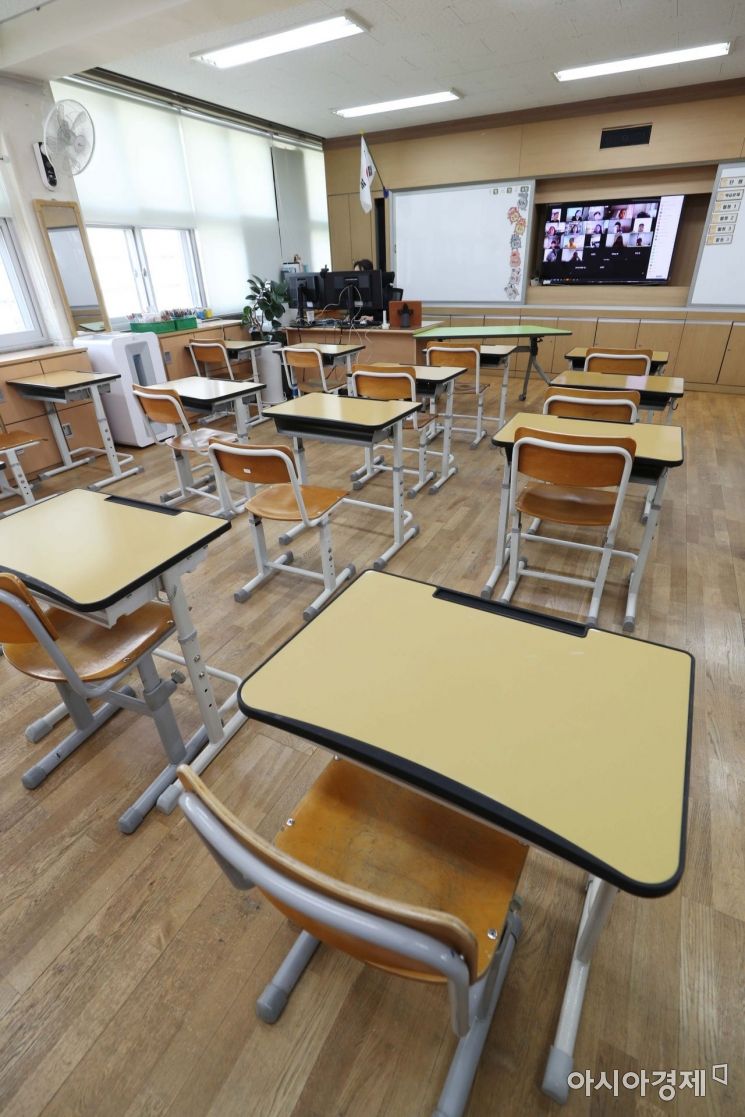 A teacher is conducting an online class at an elementary school in Seoul. The photo is unrelated to the article content. Photo by Mun Ho-nam munonam@
[Asia Economy Reporter Han Jinju] #A comment saying "My phone number is OOO" was posted on EBS's learning site bulletin board. The mobile phone number of a teacher at A Elementary School was exposed as is. The teacher could not shake off the anxiety of what would happen if their personal information was stolen and spread on SNS.
#A teacher at B High School warned a student who was driving a car not to drive. A few days later, the student took a photo of the teacher eating and posted it along with abusive language on SNS. The parent filed a complaint with the school and the education office, claiming their child was abused. The teacher reported the student to the police for defamation, but the case was eventually settled.
As remote classes increased due to COVID-19, 'cyber teacher rights violations' also increased. Although overall teacher rights violations decreased, damages such as verbal abuse or personal information leaks during remote classes have emerged.
According to the '2020 Teacher Rights Protection and Counseling Activity Guidelines' announced on the 13th by the Korea Federation of Teachers' Associations (KFTA), the number of consultations and cases handled last year was 402, a decrease of 111 cases compared to the previous year (513 cases). As the number of school days decreased, school violence also decreased, and teacher rights violations experienced by teachers also decreased.
The number of consultations regarding cyber teacher rights violations such as personal information leaks and defamation through SNS was about 30 cases. The KFTA pointed out, "New forms of teacher rights violations are increasing, such as teachers' faces being posted on SNS without permission and parents filing excessive complaints about remote classes."
Last year, cases of teacher rights violations caused by school staff were more numerous than those caused by parents or students. ▲Damage caused by school staff: 143 cases (35.57%) ▲Damage caused by parents: 124 cases (30.85%) ▲Unfair status damage by decision-makers: 81 cases (20.15%) ▲Damage caused by third parties: 30 cases (7.46%) ▲Damage caused by students: 24 cases (5.97%). In 2019, cases caused by parents and students were 238 and 87 respectively, but in 2020, they decreased to 124 and 24 cases.
Among damages caused by school staff, 'interference in school operations such as personnel and facilities' was the most common with 60 cases (41.96%). This was followed by ▲defamation (40 cases, 27.97%), ▲interference in school or class management (31 cases, 21.68%), ▲invasion of privacy (8 cases, 5.59%), and ▲interference in student guidance (4 cases, 2.80%). It was especially found that private schools experienced more damages caused by school staff than national or public schools.
The KFTA stated, "Institutional improvements and support are needed in response to changes in types of teacher rights violations in the non-face-to-face era," and added, "Since cyber teacher rights violations are difficult for schools and teachers to even recognize the occurrence of, and it is also difficult to identify or investigate perpetrators, countermeasures at the education authority level must be established, and prevention and response manuals should also be prepared."
© The Asia Business Daily(www.asiae.co.kr). All rights reserved.
![Clutching a Stolen Dior Bag, Saying "I Hate Being Poor but Real"... The Grotesque Con of a "Human Knockoff" [Slate]](https://cwcontent.asiae.co.kr/asiaresize/183/2026021902243444107_1771435474.jpg)















