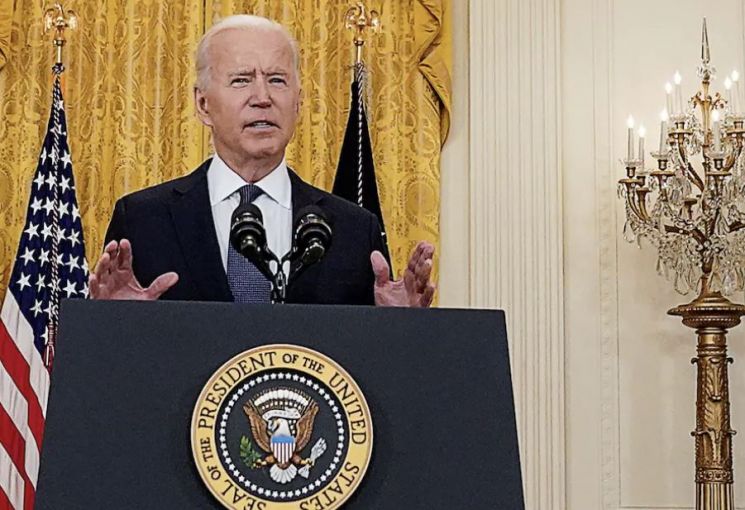
[Asia Economy Reporter Yujin Cho] U.S. President Joe Biden signed an executive order on the 12th (local time) to strengthen cybersecurity capabilities following the hacking incident targeting Colonial Pipeline, the largest pipeline operator in the United States.
According to major foreign media including CNN and The Washington Post (WP), the executive order directs the U.S. Department of Commerce to establish standards that raise cybersecurity benchmarks for both the federal government and the private sector.
In a statement released that day, the White House emphasized, "Since most infrastructure systems supplying oil, water, and electricity are operated by the private sector, this pipeline hacking incident reminds us that federal government actions alone are insufficient to prevent cyberattacks."
The 34-page executive order includes provisions requiring reporting to the Department of Commerce within three days of a major cyber incident, removing information-sharing barriers between public and private sectors forming the board, and strengthening cybersecurity program capabilities.
Software companies contracting with the federal government must meet and maintain certain cybersecurity standards for their products and report if their products have been compromised by hacking, according to the order.
A source familiar with the matter explained, "This order will require new standards for software used by the federal government, including multi-factor authentication," adding, "Considering the government's vast purchasing power, it appears to also include provisions encouraging private companies to raise their cybersecurity standards."
Additionally, the order establishes a cyber incident investigation organization similar to the U.S. National Transportation Safety Board (NTSB), which reviews major transportation and aviation accidents, and appoints co-leaders from both public and private sectors for this organization.
President Biden stated, "The U.S. federal government must undertake bold efforts and significant investments to defend essential institutions that support the lives of Americans."
Besides the pipeline hacking incident, federal agencies and private companies in the U.S. have been targeted by hacking groups exploiting vulnerabilities such as those in Microsoft's Exchange Server earlier this year.
In December last year, a hacker group suspected to be linked to Russia hacked into the computer networks of nine U.S. federal agencies and hundreds of companies.
The chairman of the U.S. Senate Intelligence Committee pointed out, "The U.S. has simply been unprepared to prevent cyberattacks from nations or criminal organizations seeking benefits and intelligence," and added, "Congress must also take stronger measures to address cybersecurity vulnerabilities."
Meanwhile, on the 7th, Colonial Pipeline, the largest pipeline operator in the U.S., was hit by a cyberattack from the international hacker group DarkSide, causing the pipeline transporting 2.5 million barrels of fuel daily over 8,850 km from the Gulf of Texas to eastern New Jersey to remain shut down for six days. As a result, the shutdown has led to a panic over gasoline shortages in the southeastern U.S. for six consecutive days.
© The Asia Business Daily(www.asiae.co.kr). All rights reserved.
![Clutching a Stolen Dior Bag, Saying "I Hate Being Poor but Real"... The Grotesque Con of a "Human Knockoff" [Slate]](https://cwcontent.asiae.co.kr/asiaresize/183/2026021902243444107_1771435474.jpg)















