Reflecting People Power Party's Opinion, Bill Amended
Strengthening Consent Requirements for Designating Autonomous Commercial Zones
Business Restrictions Applied Only to New Town Areas
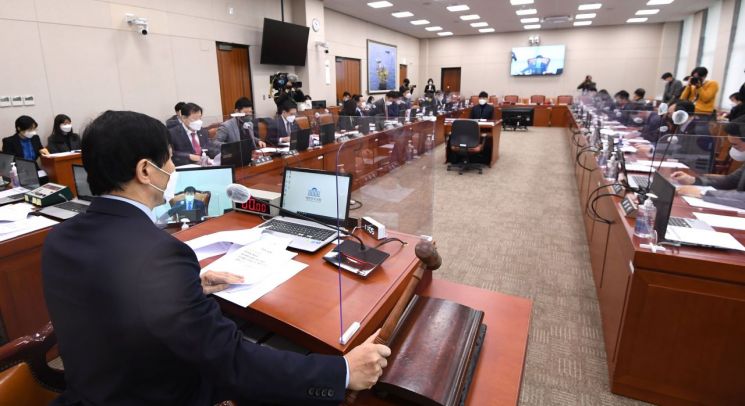 The National Assembly's Industry, Trade, Energy, Small and Medium Venture Businesses Committee held a plenary session on the morning of the 13th and passed the "Act on Coexistence and Revitalization of Local Commercial Districts (Local Commercial District Act)."
 [Image source=Yonhap News]
[Asia Economy Reporter Lim Chun-han] The ruling and opposition parties have agreed on a bill that designates regional coexistence zones to limit rent increases and block the entry of large corporate stores. Although the requirements for designating regional coexistence zones have been strengthened and industry restrictions will only apply to new urban areas, significantly easing the regulations, controversy is expected as the entry of large corporate directly operated stores will be completely blocked.
The Industry, Trade, and Small and Medium Venture Business Committee held a plenary session on the morning of the 13th and passed the "Act on the Coexistence and Revitalization of Regional Commercial Districts (Regional Commercial District Act)." This bill, which was shelved in April due to opposition from the opposition party, was revised and agreed upon by both parties. Lee Cheol-gyu, the People Power Party's secretary of the committee, said in a phone interview with Asia Economy, "The bill was revised to reflect the opinions of the People Power Party, and an agreement was reached between the ruling and opposition parties," adding, "The application requirements for regional coexistence zones were strengthened, and for old urban areas, the ban on store openings was excluded to reflect practical considerations."
Originally, the bill was proposed to prevent gentrification (displacement within commercial districts) of small business owners caused by rent increases. However, the opposition party's criticism that completely blocking large corporations from entering commercial districts would excessively infringe on consumer choice and potentially depress local commercial districts was partially accepted, leading to the preparation of a revised bill.
Once the Regional Commercial District Act is enforced, large corporations will be effectively restricted from opening stores in regional coexistence zones designated by local governments. If two-thirds of small business owners in the designated zone oppose the opening, directly operated stores by large corporations will not be allowed to enter. Companies that operate only directly managed stores, such as Starbucks, Olive Young, and Daiso, must obtain permission from small business owners to open stores in the area. For large corporate franchises, only directly operated stores by the franchise headquarters will be restricted. However, the regulation will apply only to new urban areas, excluding old urban areas where commercial districts have already declined.
An official from the distribution industry said, "Although the bill has been partially revised, it will not only infringe on consumer choice but also shrink the local commercial districts," adding, "It is unfortunate that the political sphere perceives large corporations as the cause of gentrification."
© The Asia Business Daily(www.asiae.co.kr). All rights reserved.
![Clutching a Stolen Dior Bag, Saying "I Hate Being Poor but Real"... The Grotesque Con of a "Human Knockoff" [Slate]](https://cwcontent.asiae.co.kr/asiaresize/183/2026021902243444107_1771435474.jpg)















