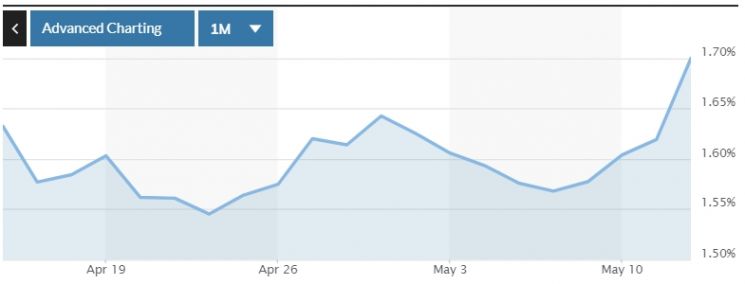
[Asia Economy Reporter Byunghee Park] The yield on the U.S. 10-year Treasury note surged on the 12th (local time), marking the largest increase in about two months.
According to financial services firm Tradeweb, the yield on the U.S. 10-year Treasury note closed at 1.693%, the Wall Street Journal (WSJ) reported on the same day. This is a 0.07 percentage point rise from the previous day's closing yield of 1.623%. The daily increase was the largest since March 18.
The sharp rise in U.S. Treasury yields came as U.S. consumer prices surged significantly in April. Growing inflation concerns led to expectations that the U.S. central bank, the Federal Reserve (Fed), might accelerate its tightening schedule, which in turn pushed Treasury yields higher.
The U.S. Department of Labor announced that the Consumer Price Index (CPI) for April rose 4.2% compared to the same month last year. This far exceeded Wall Street analysts' forecast of 3.6%, marking the largest increase since September 2008.
On a month-over-month basis, prices rose 0.8%, the largest monthly increase since 2009. The monthly rise also significantly exceeded experts' expectations of 0.2%.
Core consumer prices, which exclude the volatile energy and food sectors, also rose 0.9% from March, surpassing market expectations of 0.3%. The core CPI increase was the highest since 1982.
Despite growing concerns about inflation recently, Fed officials have maintained that inflation risks are not significant, showing a divergence from market views. In particular, Fed officials have consistently held the view that the recent price increases are temporary and unlikely to persist.
On the same day, Fed Vice Chair Richard Clarida said at the National Association for Business Economics (NABE) symposium that although prices rose sharply in April, it would not affect the Fed's economic stimulus policies. Vice Chair Clarida stated that it will take quite some time for the economy to heal and for the Fed's monetary policy to change accordingly.
He added, "I still believe that the temporary nature of the price increases will be proven," and said, "The previously weak April employment data made the job recovery more uncertain and demonstrated that the current accommodative monetary policy stance is wise."
© The Asia Business Daily(www.asiae.co.kr). All rights reserved.
![Clutching a Stolen Dior Bag, Saying "I Hate Being Poor but Real"... The Grotesque Con of a "Human Knockoff" [Slate]](https://cwcontent.asiae.co.kr/asiaresize/183/2026021902243444107_1771435474.jpg)















