[Asia Economy Honam Reporting Headquarters Reporter Park Seon-gang] The Gwangju Metropolitan City Comprehensive Construction Headquarters announced on the 12th that it is promoting zero-energy certification for all public buildings of a certain scale (total floor area of 1000㎡ or more) ordered through design competitions in line with the ‘Green New Deal’ and the ‘2045 Carbon Neutrality Policy.’
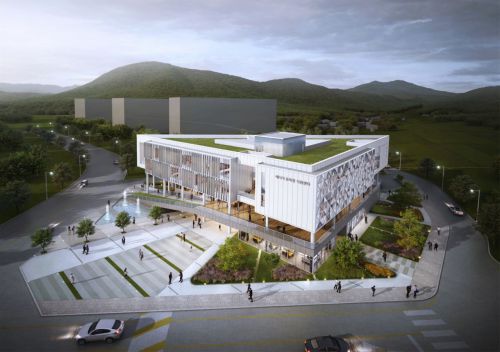
In particular, the ‘Energy Convergence Complex Comprehensive Support Center’ planned to be built in Apchon-dong, Nam-gu, and the ‘Sinchang-dong Relics Prehistoric Experience Learning Center’ in Buk-gu are being developed as zero-energy grade 1 buildings (self-sufficiency rate of 100% or more), where the energy produced on-site is equal to or greater than the energy consumed.
The ‘Energy Convergence Complex Comprehensive Support Center,’ which will carry out research and development, workforce training, industry promotion, and one-stop projects related to energy industry convergence, will be located in the Nam-gu Urban High-tech Industrial Complex with a total floor area of 5600㎡, consisting of one basement floor and four above-ground floors.
By increasing the supply ratio of renewable energy such as building-integrated photovoltaic systems (BIPV) and indoor louver-type daylighting, and establishing energy-saving systems, it is expected to become a pilot model for the ‘Gwangju-type Green New Deal’ and the ‘2045 Energy Self-Reliant City Realization.’
The ‘Sinchang-dong Relics Prehistoric Experience Learning Center,’ planned to be built in Sinchang-dong, Buk-gu, will have a total floor area of 2200㎡ and one above-ground floor. Unlike conventional visual exhibition halls, it will be a complex exhibition and experience center where visitors can feel prehistoric artifacts through all five senses.
Solar panels will be installed on the parking lot and building roof, and a passive system with enhanced insulation performance, as well as high-efficiency energy-grade heating, cooling, and lighting equipment, will be installed. The energy self-sufficiency rate is evaluated at 157%, and it received preliminary zero-energy grade 1 certification from the Korea Energy Agency in December last year.
In addition, the Comprehensive Construction Headquarters is exploring various methods to achieve energy self-sufficiency on-site by appropriately utilizing active technologies, passive technologies, and renewable energy considering the characteristics of buildings and sites for all public buildings ordered by the headquarters.
Park Geum-hwa, head of the Architectural Equipment Department, said, “To proactively respond to climate change, we plan to construct public buildings that apply various renewable energies, passive systems, and energy management systems starting with public buildings to increase energy self-sufficiency rates and reduce greenhouse gases, thereby supporting the Green New Deal and carbon neutrality.”
© The Asia Business Daily(www.asiae.co.kr). All rights reserved.
![Clutching a Stolen Dior Bag, Saying "I Hate Being Poor but Real"... The Grotesque Con of a "Human Knockoff" [Slate]](https://cwcontent.asiae.co.kr/asiaresize/183/2026021902243444107_1771435474.jpg)















