First Inclusion of Local Large Cities as Candidate Sites... Zero Among 39 Applications from Gyeonggi and Incheon
Expectations for First Supply Plan After Presidential Real Estate Policy Failure Fade
Only 6 Out of 34 First and Second Candidate Sites Exceed 10% Resident Consent Rate
Long Way to Project Start and Completion... Concerns Over Loss of Momentum in Remaining 1 Year Term
[Asia Economy Reporters Kangwook Cho, Mune Won] The government’s key plan to expand housing supply, the ‘Urban Public Housing Complex Project,’ appears to be faltering already. This is because only four sites in local areas such as Daegu and Busan were selected as candidates for the third phase, while the Seoul metropolitan area?where supply-demand instability is a major concern?was excluded.
Among the 34 candidate sites announced in the first and second phases, only six have surpassed the minimum 10% resident consent rate required for preliminary district designation. There are even concerns that the government’s supply measures may lose momentum toward the end of its term and end up as a ‘flash in the pan.’
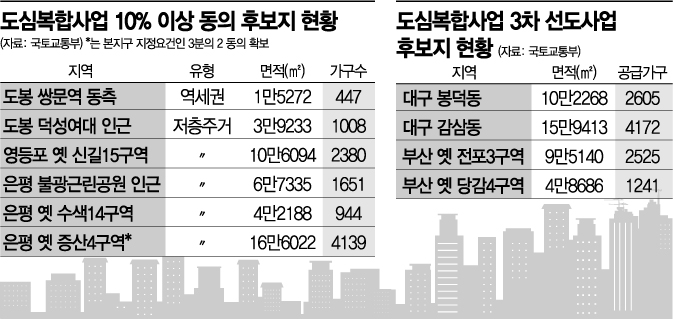
◇ Despite 39 applications from Gyeonggi and Incheon, not a single site was selected = On the 12th, the Ministry of Land, Infrastructure and Transport announced that among 20 candidate sites proposed in Daegu and Busan, one site each in Nam-gu and Dalseo-gu in Daegu and two sites in Busanjin-gu, Busan, were selected as third-phase urban complex project candidates. The target project sites are △ low-rise residential area in Bongdeok-dong, Daegu (2,605 households) △ low-rise residential area in Gamsam-dong, Daegu (4,172 households) △ former Jeonpo 3 district in Jeonpo-dong, Busan (2,525 households) △ former Dangam 4 district in Dangam-dong, Busan (1,241 households), with a total supply scale of about 10,600 households.
According to the Ministry, if these four candidate sites are developed publicly, the floor area ratio will increase by an average of 65 percentage points compared to private development. The number of supply units will also increase by about 727 units (38.1%). Accordingly, the sale price is expected to be measured at an average of 74.0% compared to market prices, and the landowners’ profit rate is projected to improve by an average of 13.9 percentage points.
These four sites are the first candidates designated in local areas under the urban complex project, which is one of the core measures of the 2·4 supply plan. Previously, all 34 candidate sites announced in the first and second phases?21 and 13 sites respectively?were located in Seoul. No candidate sites have yet emerged in Gyeonggi or Incheon, despite a total of 39 candidate sites applied for by local governments in these areas.
◇ Only 6 out of 34 sites in Seoul exceed the 10% consent rate = More serious is the fact that among the 34 candidate sites announced so far in Seoul, only six have exceeded the minimum resident consent rate of 10% required for preliminary district designation.
The Ministry completed resident briefings last month in six Seoul districts where the first and second phase candidate sites are located: Dobong, Yeongdeungpo, Geumcheon, Eunpyeong, Dongdaemun, and Gangbuk. However, only two sites in Dobong-gu (east side of Ssangmun Station, near Deoksung Women’s University in Ssangmun 1-dong), one site in Yeongdeungpo-gu (former Shingil 15 district), and three sites in Eunpyeong-gu (near Bulgwang Green Park, former Susaek 14 district, former Jeungsan 4 district) secured 10% consent. The remaining districts?Geumcheon, Dongdaemun, and Gangbuk?have yet to meet the designation requirements at any site. Notably, only one site, Jeungsan 4 district in Eunpyeong-gu, has secured the two-thirds consent required for main district designation.
According to the project schedule, a 10% consent rate must be secured by August for preliminary district designation, and after designation, the project is confirmed only if two-thirds of landowners (or half by area) agree within one year. Failure to secure the consent rate within the period will result in automatic cancellation of the project.
◇ Long road to project success... Will it end as a flash in the pan? = As the government’s supply measures show sluggish progress, doubts about the project’s success are emerging. Eunhyung Lee, senior researcher at the Korea Construction Policy Institute, pointed out, “This plan is merely an announcement of candidate sites. There is still a long way to go before actual project commencement and completion.”
Especially, the fact that the current government has only about one year left in its term intensifies concerns about loss of trust and momentum for the policy. This is also cited as one reason why securing resident consent is difficult.
Kwon Daejung, professor of real estate at Myongji University, said, “Since the current government has only about a year left, the project’s success cannot be guaranteed. It is uncertain how things will change once the administration changes. Because the complex project involves a full purchase method, resident opposition may be greater than expected. The government has announced the plan, so it should proceed according to government will, but how vigorously it will be pushed forward remains to be seen.”
© The Asia Business Daily(www.asiae.co.kr). All rights reserved.
![Clutching a Stolen Dior Bag, Saying "I Hate Being Poor but Real"... The Grotesque Con of a "Human Knockoff" [Slate]](https://cwcontent.asiae.co.kr/asiaresize/183/2026021902243444107_1771435474.jpg)
















