'Surgery Room CCTV Law' to Hold Public Hearing This Month for Reconsideration
Debate Over CCTV Location...Inside vs Entrance
Patient Side "To Prevent Illegal Acts and Protect Patients, It Must Be Installed Inside"
Medical Community "Installing Inside Causes Issues Like Treatment Inhibition and Privacy Invasion"
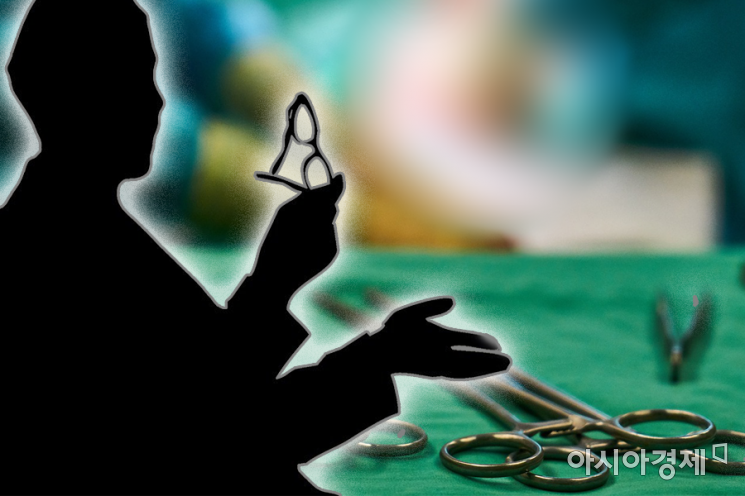 There is a growing call to install CCTV cameras inside operating rooms due to issues such as ghost surgeries and proxy surgeries.
[Asia Economy Reporter Jumi Lee] The bill mandating the installation of closed-circuit television (CCTV) in operating rooms has once again failed to pass the National Assembly. With the installation of CCTV in operating rooms still a distant prospect, voices are growing louder that related legislation must be passed to protect patients' rights.
On April 29, the Medical Service Act amendment mandating the installation of CCTV in operating rooms was submitted for review by the National Assembly's Health and Welfare Committee subcommittee. The bill requires mandatory installation of CCTV in operating rooms to prevent proxy surgeries and ghost surgeries.
Although the bill was deferred in the National Assembly in February due to strong opposition from the medical community, the re-examination concluded that social consensus on detailed regulations is necessary. A public hearing is planned for this month to hear opinions from both supporters and opponents.
The main issue is the location of the CCTV installation in operating rooms. The consensus so far has been to mandate installation at the operating room entrance and leave internal installation to hospital discretion. However, due to strong opposition from patient groups and civil society organizations urging internal installation, it is analyzed that a procedure to gather opinions is being pursued.
There are two main reasons for the call to install CCTV inside operating rooms. One is to prevent crimes such as proxy surgeries and patient sexual harassment within the operating room, and the other is that to prove the surgical process in medical disputes, CCTV must be placed inside rather than just at the entrance.
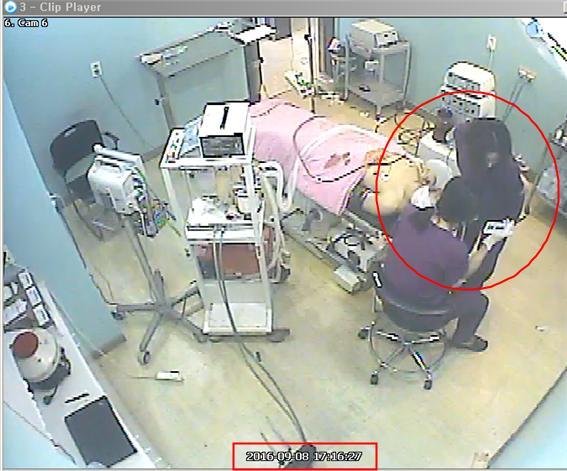 CCTV footage from the surgery when the late Kwon Dae-hee died in a factory-style ghost surgery in 2016. Nursing assistants are looking at their cell phones in front of Mr. Kwon, who is lying on the operating table. Photo by Patient Rights Research Institute
◆ Proxy Surgeries and Ghost Surgeries Continue... Internal Installation Needed to Prevent Them
Cases where unlicensed individuals perform surgeries in place of doctors or completely unknown doctors operate without patient consent are not uncommon.
The late Kwon Dae-hee is a representative victim of ghost surgery. In 2016, Kwon died from excessive bleeding during facial contouring surgery. It was revealed that the doctor in charge of Kwon’s surgery was conducting 'factory-style ghost surgeries' by opening four operating rooms simultaneously and moving between rooms, causing a major scandal.
In January, an orthopedic surgeon who had proxy surgeries performed by medical device sales staff received a suspended sentence. From 2015 to 2017, this doctor was tried for involving the sales manager and other employees of medical device companies in spinal and shoulder surgeries. These non-medical personnel performed medical acts such as inserting stainless steel rods into surgical sites at the doctor's request.
Patient groups and civil society organizations argue that installing CCTV only at the operating room entrance cannot prevent proxy and ghost surgeries. On April 28, before the CCTV bill review, the Korea Patient Organization Federation held a press conference stating, "There is a continuous suggestion to install CCTV at the entrance rather than inside the operating room," and insisted, "To achieve the legislative purpose, CCTV must be installed inside, not just at the entrance."
◆ Difficult for Laypeople to Prove Medical Negligence... CCTV Helps Prove Harm
There is also a growing voice that internal CCTV in operating rooms is the minimum device to protect patients when legal disputes over medical accidents arise.
Currently, patients bear the burden of proving medical accidents, but in reality, it is nearly impossible. Due to the specialized and closed nature of medical procedures, it is difficult for patients or their guardians to accurately understand the treatment.
Moreover, clarifying the causal relationship of medical negligence based on what happened in the operating room is difficult for laypeople with no medical knowledge. In this case, internal CCTV recording the surgical process can help prove the damage.
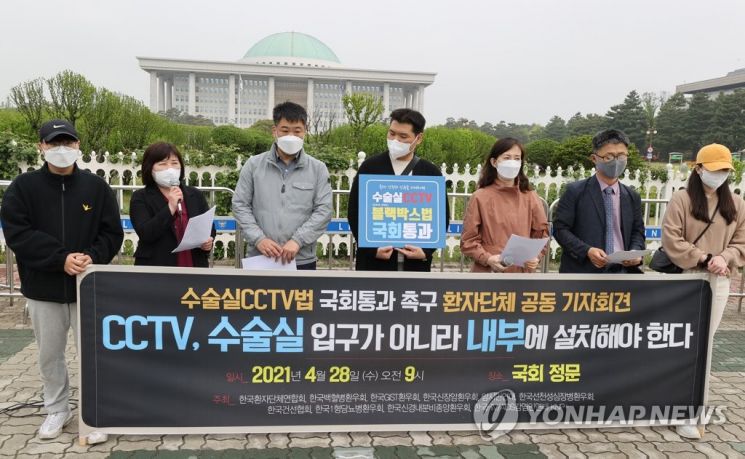 In front of the National Assembly building in Yeouido, Seoul, civic groups such as the Korea Patient Organization Federation and the Korea Leukemia Patient Association are urging the National Assembly to pass the 'Operating Room CCTV Act.' [Image source=Yonhap News]
For example, last August, a petition titled "Report on Medical Accident Due to Forced Induction Delivery" was submitted to the Blue House, demanding investigation of the incident, punishment of medical staff, and mandatory CCTV installation.
The petitioner stated, "During childbirth, the hospital attempted forced natural delivery, resulting in the loss of the baby, but the medical staff manipulated charts to hide their negligence," and added, "There is no CCTV installed in the delivery room, making it difficult to prove the entire delivery process." The petitioner called for mandatory CCTV installation and strong legislative measures. Over 200,000 people agreed with this petition at the time.
Experts emphasize the need to install CCTV inside operating rooms. Professor Kim Yoon of Seoul National University’s Department of Healthcare Management said on MBC's 'News Outside' on April 29, "With cases of proxy and ghost surgeries occurring, there have been calls to install CCTV inside operating rooms," and added, "If installed outside, it is impossible to know exactly what happened inside the operating room."
Regarding the medical community's opposition that internal CCTV installation may inhibit medical staff's treatment or infringe on privacy, Professor Kim said, "Issues such as passive treatment and privacy invasion should be resolved through other institutional improvements," and emphasized, "Therefore, we should not hesitate to install CCTV inside."
© The Asia Business Daily(www.asiae.co.kr). All rights reserved.
![Clutching a Stolen Dior Bag, Saying "I Hate Being Poor but Real"... The Grotesque Con of a "Human Knockoff" [Slate]](https://cwcontent.asiae.co.kr/asiaresize/183/2026021902243444107_1771435474.jpg)

















