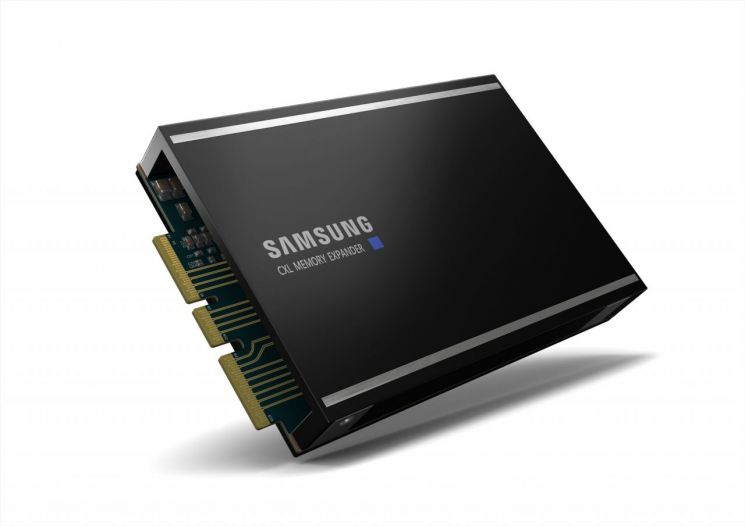
[Asia Economy Reporter Jeong Hyunjin] Samsung Electronics, the "memory semiconductor powerhouse," has developed the world's first Compute Express Link (CXL)-based DRAM memory technology, marking a significant breakthrough in overcoming the physical limitations of existing interface-based DRAM. As the volume of data to be processed is exploding, Samsung Electronics has secured semiconductor technology leadership by developing memory technology based on next-generation interfaces used in data centers and other applications.
Why Did the World’s First CXL-Based DRAM Emerge?
CXL-based DRAM was developed in response to the growing need for significantly expanded capacity and improved computing system performance. As applications utilizing artificial intelligence (AI), big data, and other fields increase, the amount of data to be processed grows, but the existing DDR interface limits the DRAM capacity that can be installed in systems, prompting calls to resolve this issue. Currently, typical enterprise servers can use up to 16 DRAM modules per central processing unit (CPU), and physically installing more than that is impossible. Additionally, bottlenecks occur in the interface due to tasks that check data processing status between the CPU and accelerators.
To address these issues, Intel launched the "CXL Consortium" in 2019 to research open interconnect technology aimed at improving CPU and accelerator performance. Participants include CPU industry leaders such as Intel and AMD; memory industry players like Samsung Electronics, SK Hynix, and Micron; GPU companies such as NVIDIA; server companies including HP, Dell, IBM, Amazon, Google, and Facebook; and software companies like Microsoft.

An industry insider explained, "Currently, computing systems use multiple interfaces centered around the CPU, and there have been discussions about similar interfaces over time," adding, "Recently, these are converging around CXL."
Samsung Electronics and Global Companies Collaborate to Commercialize ‘Ultra-High-Capacity DRAM’
Samsung Electronics plans to cooperate with global companies to ensure timely commercialization of the world’s first developed CXL DRAM memory technology. Industry experts expect the CXL interface to be integrated into CPUs launching as early as the end of this year. With the demand for data center construction and expansion rapidly increasing due to the impact of COVID-19, securing ultra-high-capacity DRAM has become crucial, and global companies are expected to continue expressing strong interest.
Devendra Das Sharma, Intel’s head of I/O technology and standards, said, "Data center systems are rapidly evolving to support increasing demand and workloads for AI and machine learning, and CXL memory is expected to expand memory usage in data centers and beyond," adding, "We will continue to collaborate closely with Samsung Electronics to build a strong memory ecosystem centered on CXL."
Dan McNamara, Senior Vice President of AMD’s Server Business Unit, also stated, "The development of next-generation memory like CXL is a critical factor in realizing such performance improvements, and through cooperation with Samsung Electronics, we expect to provide advanced interconnect technology to data center customers."
Samsung Leading Next-Generation Memory Standardization
Samsung Electronics, which has been leading the memory market with its "super-gap" strategy, has been unveiling products and technologies that lead next-generation standards one after another in the first half of this year. In February, it announced mass production of the PM9A3 E1.S, a high-performance, low-power SSD dedicated to data centers that meets the standards of the Open Compute Project (OCP), an organization where global data center-related companies establish hardware and software standards necessary for efficient data center development and operation.
In the same month, Samsung also developed the world’s first HBM-PIM, which combines memory semiconductors and AI processors into one. This product integrates an AI engine into HBM memory semiconductors used for ultra-high-speed data analysis in supercomputers and AI, maximizing performance and system energy efficiency.
Additionally, in March, Samsung developed the industry’s largest capacity 512GB DDR5 memory module using the HKMG process for the first time in the industry, and in the following month, it launched the PM1653, an enterprise server solid-state drive (SSD) supporting the SAS-4 standard.
© The Asia Business Daily(www.asiae.co.kr). All rights reserved.
![Clutching a Stolen Dior Bag, Saying "I Hate Being Poor but Real"... The Grotesque Con of a "Human Knockoff" [Slate]](https://cwcontent.asiae.co.kr/asiaresize/183/2026021902243444107_1771435474.jpg)

















