Joint Research by GIST Professor Hong Seok-won and ICL Research Team Led by Kim Ji-sun
 Solar cell. Stock photo. Not related to the article.
[Asia Economy Reporter Kim Bong-su] A material that enhances the efficiency and stability of next-generation solar cells has been developed by a domestic research team.
The Gwangju Institute of Science and Technology (GIST) announced on the 11th that Professor Hong Seok-won’s team from the Department of Chemistry, in collaboration with Professor Kim Ji-sun’s research team from Imperial College London (ICL), UK, developed a new cathode interfacial layer material (which selectively transports negatively charged electrons) to improve the performance and stability of non-fullerene organic solar cells, which are attracting attention as next-generation solar cells. Non-fullerene organic solar cells use electron-donating photoactive materials (materials that provide electrons and emit light themselves) rather than fullerene structures composed of 50 to 60 carbon atoms connected in a soccer ball shape.
Non-fullerene organic solar cells are gaining attention as next-generation solar cell materials with an energy conversion efficiency close to 20%. However, existing cathode interfacial layer materials have difficulties with low-temperature processing or stability issues, posing obstacles to the development of high-functionality solar cells such as flexible organic solar cells.
The research team identified the cause of instability in existing cathode interfacial layer materials and succeeded in simultaneously improving the performance and stability of non-fullerene organic solar cells by developing a new cathode interfacial layer material. First, through two-dimensional nuclear magnetic resonance experiments and isotope labeling experiments, they clearly identified the chemical reaction between polyethyleneimine, known as a representative cathode interfacial layer material, and the non-fullerene acceptor. This confirmed that the amine group of polyethyleneimine interferes with the role of the non-fullerene acceptor used as a photoactive material.
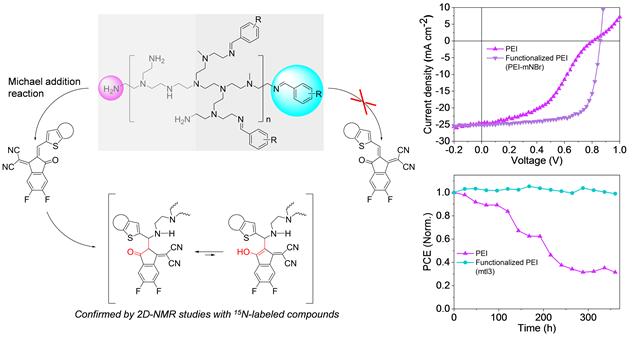
The research team developed a new cathode interfacial layer material by preserving the advantage of polyethyleneimine, which allows low-temperature solution processing, replacing the highly reactive amine group with an imine group to eliminate reactivity with the non-fullerene acceptor, and introducing a chemical structure that enhances the dipole moment. In particular, when the newly developed cathode interfacial layer material was applied to solar cells with various photoactive materials, it demonstrated a high energy conversion efficiency of over 15% and high stability, maintaining almost the initial performance for more than 360 hours under harsh conditions exceeding 100 degrees Celsius.
The research team stated, "Through the development of a new cathode interfacial layer material, we were able to simultaneously improve the energy conversion efficiency and stability of non-fullerene organic solar cells," adding, "We expect that the development of cathode interfacial layer materials through the introduction of various substituents will greatly contribute to the advancement of high-functionality solar cells such as flexible solar cells."
The research results were published online on the cover of the world-renowned scientific journal in the field of materials chemistry and energy materials, Journal of Materials Chemistry A, on the 15th of last month.
© The Asia Business Daily(www.asiae.co.kr). All rights reserved.
![Clutching a Stolen Dior Bag, Saying "I Hate Being Poor but Real"... The Grotesque Con of a "Human Knockoff" [Slate]](https://cwcontent.asiae.co.kr/asiaresize/183/2026021902243444107_1771435474.jpg)















