[Asia Economy Reporter Jeong Hyunjin] The average annual increase rate of South Korea's minimum wage over the past five years was 9.2%, ranking first among 18 Asian countries, according to an analysis by the Federation of Korean Industries (FKI) on the 11th.
The FKI stated that based on global labor statistics from the International Labour Organization (ILO) and market research firm Trading Economics, they analyzed changes in minimum wages among 18 Asian countries, including five Northeast Asian countries and eight ASEAN countries, since 2011. The average annual increase rate of minimum wages in these 18 Asian countries over the recent five years (2016?2020) was 4.63%, indicating that South Korea's increase rate was twice as high.
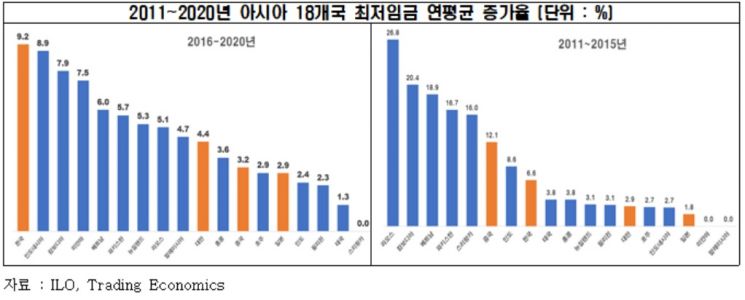
The country with the second highest average annual minimum wage increase rate during the same period was Indonesia at 8.9%, followed by Cambodia (7.9%), Myanmar (7.5%), and Vietnam (6.0%). The FKI explained, "This rate is 3 to 6 percentage points higher than China and Vietnam, which recorded double-digit rapid minimum wage increases in the early 2010s, and more than twice as high compared to regional manufacturing competitors such as Japan and Taiwan."
From 2011 to 2015, South Korea's average annual increase rate was 6.6%, placing it in the middle among the 18 Asian countries, ranking eighth. During the same period, rapid minimum wage increases in Laos, Cambodia, and Vietnam led the average annual minimum wage increase rate among the 18 Asian countries to reach 8.3%. China also recorded 12.1% due to policies aimed at improving incomes for low-income groups.
The FKI cited an ILO report stating that South Korea's absolute minimum wage in 2019 was $2,096 based on Purchasing Power Parity (PPP), and $1,498 in dollar terms (approximately 1.67 million KRW), ranking third among the 18 Asian countries. Excluding Australia and New Zealand, which have low manufacturing shares, the FKI emphasized that South Korea is effectively ranked first. The FKI added, "South Korea has surpassed Japan, whose GDP is 3.1 times and per capita GDP is 1.3 times higher," attributing this to the income-led growth strategy implemented since the current government took office in 2017, which resulted in more than a 10% increase in South Korea's minimum wage in 2018?2019."
The gap between the real minimum wage increase rate, adjusted for inflation by country, and labor productivity growth rate from 2010 to 2019 was 3.3 percentage points in South Korea. A positive value indicates that wages increased more than labor productivity improvements. Among the 18 Asian countries, Vietnam had the largest gap at 6.2%, followed by Laos at 4.5 percentage points, Cambodia at 4.2 percentage points, and Thailand at 3.5 percentage points. South Korea's gap was more than twice as high compared to major competitors such as Japan, China, and Taiwan, meaning wage growth exceeded labor productivity improvements.
Kim Bongman, Director of International Cooperation at the FKI, said, "While most Asian countries including China, Japan, and Vietnam froze their minimum wages last year due to COVID-19, the Domestic Minimum Wage Commission decided in July last year to raise the 2021 minimum wage (hourly) by 1.5% to 8,720 KRW." He added, "The Minimum Wage Commission should ultimately freeze next year's minimum wage and enhance the international competitiveness of our companies by applying regional and industry-specific minimum wage differentials and expanding the scope of minimum wage inclusion, similar to Asian competitors."
© The Asia Business Daily(www.asiae.co.kr). All rights reserved.
![Clutching a Stolen Dior Bag, Saying "I Hate Being Poor but Real"... The Grotesque Con of a "Human Knockoff" [Slate]](https://cwcontent.asiae.co.kr/asiaresize/183/2026021902243444107_1771435474.jpg)















