President Moon Jae-in's 4th Anniversary Inaugural Speech
'Speculation Blockade' and 'Supply Expansion' Emphasized
Moon Promised Housing Price Stability but Prices Soared to Historic Highs
Remaining One Year Makes Housing Price Stability Difficult
Repeated Policy Failures... Side Effects Increase, Trust Declines
Experts "Master Plan Needed Even Now"
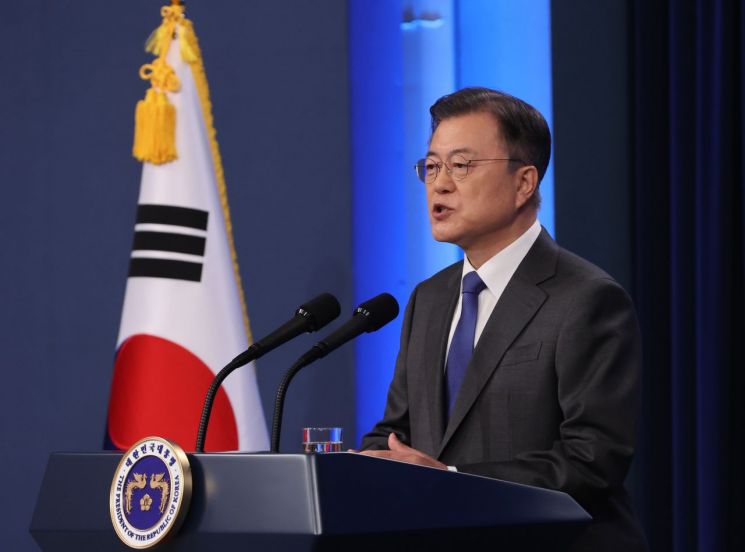 President Moon Jae-in is delivering a special speech on the 4th anniversary of his inauguration at the Chunuchu-gwan Grand Briefing Room in the Blue House on the 10th. [Image source=Yonhap News]
[Asia Economy Reporter Moon Jiwon] With one year left in his term, President Moon Jae-in emphasized 'speculation prevention' and 'supply expansion' as the key themes of real estate policy in his 4th anniversary inaugural speech on the 10th. However, with only one year remaining before the end of his term, housing prices in Seoul and the metropolitan area still show instability, leading many to analyze that the originally promised housing price stabilization has become practically difficult. Since most of the available policy cards have already been played through multiple real estate measures and the leadership of state affairs is shifting to the National Assembly at the end of his term, it is pointed out that resolving real estate issues in the remaining year will not be easy.
Real estate policy is considered the biggest Achilles' heel of the Moon Jae-in administration. Although a total of 25 major real estate measures have been announced so far, most have ended in failure, resulting in apartment prices soaring to 'record highs' within four years of the administration. Due to side effects of policies such as the Three Lease Laws, jeonse (long-term deposit lease) prices have also skyrocketed, worsening the housing environment for ordinary citizens.
Industry insiders point out that the government lacks clear plans to stabilize housing prices in the remaining year. This is because the side effects and damages caused by the 24 failed policies, excluding the currently underway 2·4 Housing Supply Plan, are significant. A real estate industry official who wished to remain anonymous said, "The government's failure in real estate policy is very extensive and deep," adding, "This is a clear example showing that policy failure is scarier than market failure."
The government's shift toward increasing housing supply through the 2·4 Plan is positive, but even this is difficult to guarantee success. Since the related enabling legislation has not yet been completed in the National Assembly, the government finds it hard to confidently promise incentives to residents for public development, and residents are also reluctant to engage in public development projects without assured profitability based solely on government assurances. According to the government, since the announcement of the 2·4 Plan, the amount secured so far is only 177,700 households, which is 21% of the total.
The deepened distrust in policies following the land speculation scandal involving Korea Land and Housing Corporation (LH) employees in new towns is also cited as a problem. In particular, controversies over multi-homeownership involving former Presidential Chief of Staff Noh Young-min and former Senior Secretary for Civil Affairs Kim Jo-won, as well as former Policy Chief Kim Sang-jo's rent increase, and speculation allegations against ruling party lawmakers have caused the credibility of government policies to plummet to rock bottom.
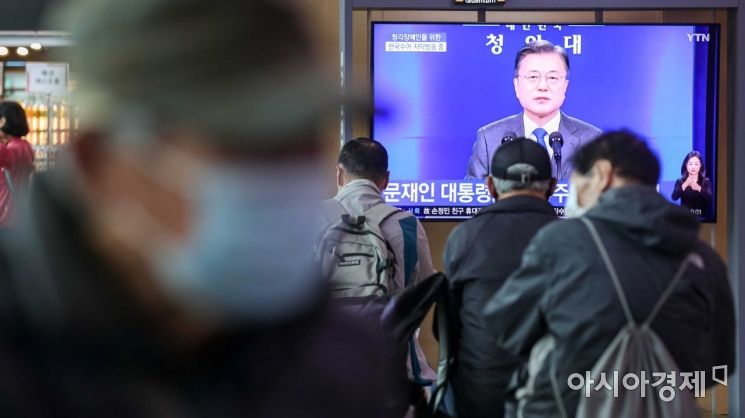 On the 10th, citizens are watching President Moon Jae-in's special speech on the 4th anniversary of his inauguration in the Seoul Station waiting room. Photo by Jinhyung Kang aymsdream@
In the actual market, despite the government's signals of increased holding taxes and successive supply expansions, high buying sentiment continues. According to statistics from Asil, a real estate big data company, the number of apartment sale listings in Seoul is about 47,400, a 1.5% decrease compared to ten days ago. Considering that to avoid the holding tax confirmed in June, the balance payment must be made by the end of this month at the latest, it is interpreted that the market has effectively chosen holding over selling.
Multi-homeowners have entered a 'holding' stance because they judged that, despite the immediate burden of higher taxes, holding onto their homes is beneficial in the long term. It is analyzed that this is influenced by the fact that policy decision-making authority at the end of the term has effectively shifted from the government to the National Assembly. Already, within the industry, expectations are spreading that "with the presidential election next year, discussions on easing real estate regulations will intensify in the political sphere, inevitably causing Seoul housing prices to rise further."
Experts advise that to prevent housing prices from rising further in the remaining year, a more concrete 'master plan' should be prepared, moving away from the public-led housing supply policy. Ko Jong-wan, president of the Korea Asset Management Research Institute, said, "Even now, a master plan specifying when, where, and how much supply will be released must be formulated," adding, "Without revitalizing reconstruction and redevelopment, the goals cannot be achieved, so in-depth discussions related to deregulation, taxes, and loan easing must continue."
© The Asia Business Daily(www.asiae.co.kr). All rights reserved.
![Clutching a Stolen Dior Bag, Saying "I Hate Being Poor but Real"... The Grotesque Con of a "Human Knockoff" [Slate]](https://cwcontent.asiae.co.kr/asiaresize/183/2026021902243444107_1771435474.jpg)
















