Korea Research Institute of Chemical Technology-Bukyung University Joint Research Team, "Overcoming 'Fatigue Phenomenon' in Foldable Phone Screens"
 A scene from the movie "Terminator Genisys," which depicts a battle between machines and humans. Many people still fear that machines could pose a threat to the future of humanity.
[Asia Economy Reporter Kim Bong-su] The sci-fi movie 'Terminator 2' featured a robot villain that continuously regenerates even after being shot, delivering a 'future technology shock' to audiences. Now, Korean researchers have attracted attention by developing a material that hardens upon impact to protect itself and then restores its original structure and function through self-healing capabilities.
The Korea Research Institute of Chemical Technology, in collaboration with Pukyong National University, announced on the 10th that they have developed a self-healing material that can recover on its own even when cut at room temperature, with toughness comparable to that of shoe soles. Notably, this material has the highest mechanical strength among all self-healing materials developed to date.
Self-healing materials refer to intelligent materials that, like real skin which heals wounds on its own, can detect damage caused by external environments and repair their molecular structure to restore their original function. In sci-fi movies like Wolverine and Terminator, protagonists possess self-healing superpowers that allow their bodies to recover from tears or cuts, stimulating viewers' imaginations. In reality, if products such as clothing, shoes, tires, automobiles, and coatings for rollable and foldable displays?which suffer damage over long-term use and thus have reduced lifespans?were equipped with such functions, they could be used longer as if they were new.
Accordingly, efforts to develop self-healing materials are ongoing worldwide. The problem is that self-healing materials developed so far have relatively low tensile strength (the force required to pull them until they break). For effective self-healing, molecular bonds need to be loose and molecules must move freely, which requires the material to be soft like jelly rather than a hard solid. Existing self-healing materials are thus soft and pliable. However, like jelly that breaks apart when stretched, these materials struggle to withstand external friction or pressure.
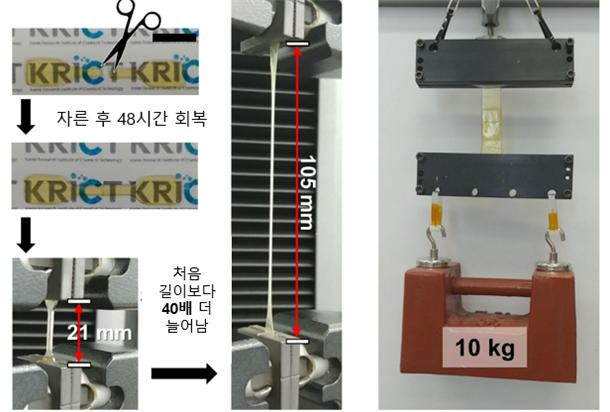
Inspired by this, the research team developed a new material that is both tough and hard while possessing excellent self-healing abilities. They used thermoplastic polyurethane, an existing self-healing material, as the basic framework and added a special carbonate compound that forms hydrogen bonds to harden upon external impact and softens when the impact is absent. The newly created material instantly strengthens molecular bonds upon external friction or impact, transforming into a hard crystal that protects itself from damage. After the impact, it returns to a soft state with freely moving molecules to self-repair any damage. This is the first reported application of a material that chemically changes depending on the presence or absence of external impact.
The tensile strength of this material was measured at over 43 MPa, comparable to polyurethane materials used for shoe soles. It is six times stronger than the material developed by the team in 2018 and sets a new world record. The previous record was about 20-30 MPa, achieved by the University of Tokyo and RIKEN in Japan. Additionally, the material's hardness varies according to the intensity of external pressure. It switches between solid and jelly states depending on the pressure, regulating shock absorption and self-repairing damage.
Dr. Oh Dong-yeop of the Korea Research Institute of Chemical Technology explained, "Next-generation advanced devices like rollable and foldable smartphones weaken as fatigue accumulates from repeated folding and unfolding, causing the screen or body to gradually turn white and become fragile. Applying this material can continuously repair damage caused by folding and unfolding, eliminating such weaknesses." The research findings were published in the January issue of 'Nature Communications,' one of the most prestigious journals in the scientific field.
© The Asia Business Daily(www.asiae.co.kr). All rights reserved.
![Clutching a Stolen Dior Bag, Saying "I Hate Being Poor but Real"... The Grotesque Con of a "Human Knockoff" [Slate]](https://cwcontent.asiae.co.kr/asiaresize/183/2026021902243444107_1771435474.jpg)















