Despite Loan Regulations, Jeonse Listings Scarce and Prices Rising
[Asia Economy Reporters Kangwook Cho and Taemin Ryu] It has been revealed that one out of every two houses traded in Seoul last month was a ‘gap investment,’ where buyers purchase homes with jeonse deposits. Despite the government’s stringent loan regulations, the continued surge in jeonse prices and instability in the real estate market following the implementation of the three laws under the Housing Lease Protection Act have fueled the rapid increase in gap investments.
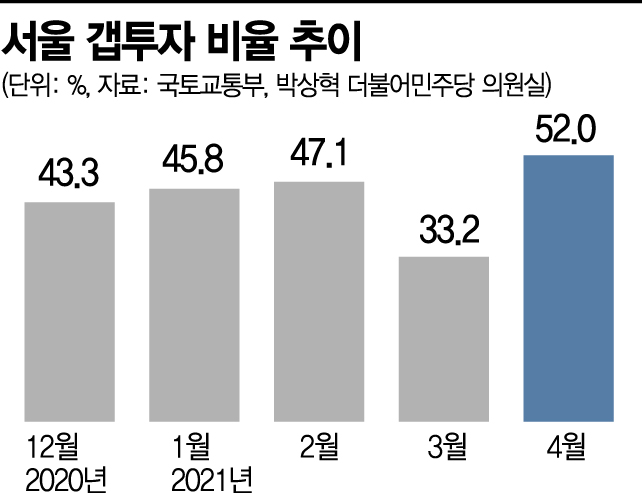
According to data submitted by the Ministry of Land, Infrastructure and Transport to Park Sang-hyuk, a member of the National Assembly’s Land, Infrastructure and Transport Committee from the Democratic Party, among 4,254 housing transaction funding plans submitted last month in Seoul, 2,213 transactions (52.0%) were gap investments. The Ministry classifies gap investments as transactions where there is a transfer of the jeonse deposit on the funding plan, but the property is not occupied by the buyer and is instead traded for rental purposes.
Last month marked the first time since January of last year that the proportion of gap investments in Seoul’s housing transactions exceeded 50%. From January last year to March this year, the gap investment ratio in Seoul fluctuated between a low of 20.4% in September last year and a high of 47.1% in February this year, but never surpassed 50%. The ratio was in the mid-40% range in December last year (43.3%), January (45.8%), and February (47.1%) this year, before dropping to 33.2% in March.
Market observers believe that despite the government’s tight loan restrictions, the scarcity of jeonse listings and the recent rebound in jeonse prices?which rose sharply last year?have led to an increase in gap investments again. With new apartment supply slowing this year and jeonse prices rising significantly since the implementation of the lease law, demand for purchasing apartments with loans, even if it means stretching financially, is increasing.
Professor Jin-Hyung Seo of Gyeongin Women’s University pointed out, "Recently, with loan regulations including the Debt Service Ratio (DSR), gap investments through loans have become difficult. Nevertheless, the increase in gap investments is primarily due to the narrowing gap between jeonse prices and sale prices caused by the rise in jeonse prices."
According to the KB Real Estate monthly housing price trend time series data, the average nationwide apartment jeonse price rose 20.03% from 255.54 million KRW in July last year, when the lease law was implemented, to 306.74 million KRW in April this year. In Seoul, the price increased by 22.19%, from 499.22 million KRW to 610.04 million KRW. This surge is more than four times the 5% increase in nationwide apartment jeonse prices over the three years following the inauguration of the Moon Jae-in administration (May 2017).
In particular, the housing market in Seoul is showing signs of renewed activity, centered around redevelopment complexes in Mokdong and Gangnam. Although Seoul designated areas such as Apgujeong, Yeouido, Seongsu, and Mokdong as land transaction permission zones on the 27th of last month to fundamentally block gap investments, a ‘balloon effect’ has already appeared, with overheating in other real estate areas. Among Seoul’s 25 districts, Yangcheon-gu had the highest gap investment ratio last month at 65.6%. Other districts with high ratios included Gangseo-gu (63.3%), Gangbuk-gu (61.3%), Yeongdeungpo-gu (61.1%), and Eunpyeong-gu (60.5%). In the Gangnam 3 districts, Seocho-gu (57.5%), Gangnam-gu (53.1%), and Songpa-gu (51.8%) all exceeded 50%. Outside Seoul, Sejong City showed the highest nationwide gap investment ratio, surpassing 60%.
Professor Joo-Hyun Cho of Konkuk University’s Department of Real Estate said, "The implementation of the lease law has significantly raised jeonse prices, reducing the available gap for investment. Expectations of rising housing prices, or the belief that ‘all-in’ financing is still effective, seem to have manifested as the concept of ‘let’s buy a house now.’"
© The Asia Business Daily(www.asiae.co.kr). All rights reserved.

















