No Official Discussion Yet on India Special Flight Formation... Doing Our Best for Safe Evacuation of Korean Residents
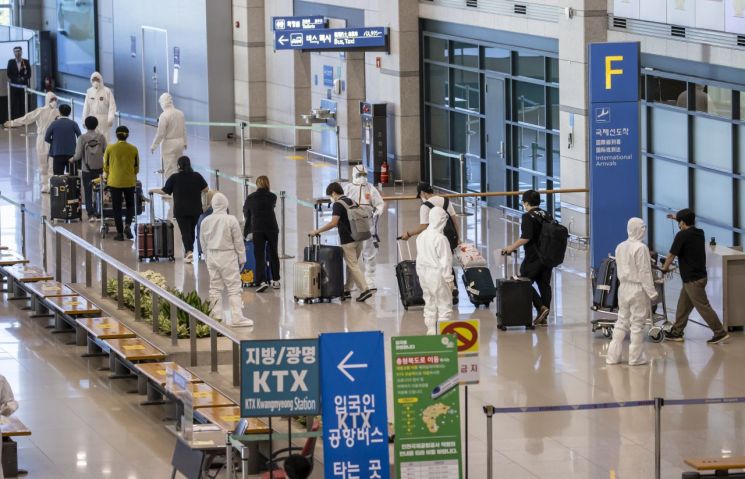
[Asia Economy Reporter Kim Ji-hee] The government has stated that imposing entry restrictions on travelers from India due to the spread of COVID-19 there is "an impossible and undesirable measure." It also drew a clear line on the ineffectiveness of restricting entry for foreigners except for nationals.
On the 9th, Son Young-rae, head of the Social Strategy Division at the Central Disaster and Safety Countermeasures Headquarters, said at the regular briefing of the Central Disaster and Safety Countermeasures Headquarters regarding entry restrictions from India, "First, restricting the entry of nationals relates to human rights and national identity," adding, "Because very few countries worldwide take such extreme measures, blocking entry even for nationals is neither possible nor desirable."
Regarding the possibility of restricting foreign nationals' entry, he pointed out, "When reviewing this issue, we always consider whether restricting foreigners' entry can be effective and what secondary impacts it might have on our country."
Son stated, "Even if measures to restrict foreigners' entry are taken, since nationals are still allowed entry, the effectiveness itself is significantly reduced," and added, "Based on experience over the past 1 year and 2 to 3 months, the current approach of mandating a 14-day quarantine for both nationals and foreigners and controlling infection spread into the community through that quarantine is actually more effective than countries that have fundamentally blocked foreigners."
Furthermore, Son said, "If restrictions on foreigners' entry begin, secondary repercussions on the domestic economy will arise. Especially since our country has a high dependence on external factors, trade relations, import-export activities, and various business channels with foreign countries will inevitably face disruptions," adding, "Ultimately, this will have a significant impact on the national economy and the overall economy of the people, so the benefits of such quarantine measures must be weighed against these costs."
He emphasized, "Overall, rather than banning foreigners' entry, continuing the current 14-day quarantine for both nationals and foreigners, and strengthening the quarantine process specifically for high-risk countries to block the domestic inflow of variant viruses as much as possible, is judged to be more effective and much more favorable for the national and common people's economy."
Recently, in India, it has been reported that a special flight is being planned to transfer and treat mild COVID-19 patients among the Korean community, centered on the local Korean Association. Regarding this, Son said, "I understand that related discussions are taking place centered on the local Korean Association, but official discussions between governments or within the government have not yet proceeded," explaining, "According to the International Health Regulations (IHR), mutual agreement is necessary, so the Indian government must apply to us, and upon approval, preparations for the incoming flight are usually made." He added, "If there is progress from the local Korean Association, the application through the Indian government or communication through the local diplomatic mission will proceed."
Meanwhile, as of midnight on the same day, the number of confirmed COVID-19 cases in Korea was 564. Among arrivals from India and Singapore, 12 confirmed cases each were identified, totaling 42 confirmed cases among overseas arrivals. Of the 12 confirmed cases from India, 5 were passengers on an irregular flight that arrived at Incheon International Airport from Bengaluru, India, on the 7th, and the remaining 7 entered Korea via other countries from India. Earlier, on the 4th, 2 confirmed cases were identified among 172 irregular flight arrivals from India. As of the 4th, the number of domestic infections with the Indian variant was counted at 33.
© The Asia Business Daily(www.asiae.co.kr). All rights reserved.
![Clutching a Stolen Dior Bag, Saying "I Hate Being Poor but Real"... The Grotesque Con of a "Human Knockoff" [Slate]](https://cwcontent.asiae.co.kr/asiaresize/183/2026021902243444107_1771435474.jpg)















