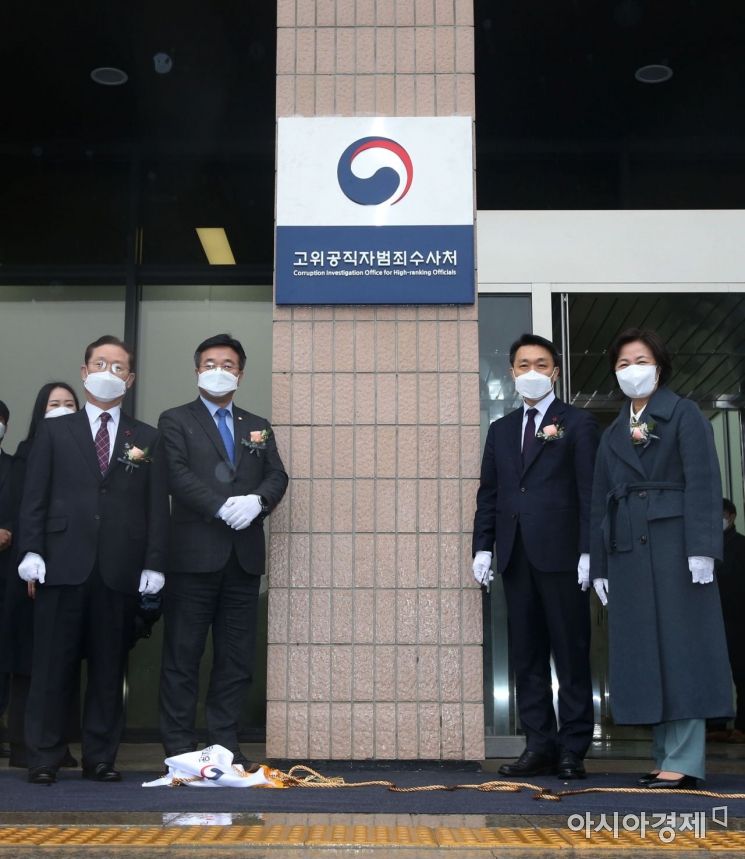
 On the afternoon of January 21, at the government Gwacheon complex, Nam Gi-myeong, head of the Preparatory Group for the High-ranking Officials' Crime Investigation Agency, Choo Mi-ae, Minister of Justice, Yoon Ho-jung, Chairman of the National Assembly Legislation and Judiciary Committee, and Kim Jin-wook, Chief of the High-ranking Officials' Crime Investigation Agency, are unveiling the agency's signboard during the inauguration ceremony. Photo by Moon Ho-nam munonam@
[Asia Economy Reporter Choi Seok-jin] The conflict over the division of authority between the High-ranking Officials' Crime Investigation Office (Gong-su-cheo) and the prosecution, which began over the scope of case transfers, is intensifying following the recent enactment and promulgation of the "Gong-su-cheo Case Handling Rules" (hereinafter referred to as the Case Handling Rules) by Gong-su-cheo.
While this can be seen as an inevitable phenomenon arising during the institutional establishment of the newly created Gong-su-cheo, there are also criticisms that Gong-su-cheo hastily included gaps created by the rapid passage of the law without sufficient public consultation during the legislative process into the rules, thereby inviting controversy.
Both Gong-su-cheo and the prosecution emphasize inter-agency cooperation externally, but since there seems to be little chance of narrowing differences during practical consultations, confusion is inevitable until authoritative interpretations of the "Act on the Establishment and Operation of the High-ranking Officials' Crime Investigation Office" (Gong-su-cheo Act) or the Case Handling Rules, which are currently controversial in courts or the Constitutional Court, are issued or the law is amended.
The most controversial provisions among the recently enacted and promulgated Case Handling Rules by Gong-su-cheo include: Article 14, Paragraph 3, Subparagraph 1, Item (b) and Article 25, Paragraph 2, which explicitly stipulate the "transfer with reserved prosecution rights" that caused the greatest conflict with the prosecution; Article 25, Paragraph 3, which assumes that the police can apply for arrest warrants to Gong-su-cheo instead of the prosecution; and Articles 28, Paragraph 2 and 31, Paragraph 1, which allow Gong-su-cheo to send cases to the prosecution for crimes where it only has investigative authority but no prosecution rights and permit non-prosecution decisions.
Prior to this, a major difference in perspective exists between Gong-su-cheo and the prosecution regarding the legal nature of the "Gong-su-cheo Rules," specifically whether Gong-su-cheo can regulate matters related to citizens' rights and obligations such as bodily freedom or relations with other state agencies through its rules.
The 'Transfer with Reserved Prosecution Rights' Controversy Triggered by the Lee Seong-yoon and Lee Gyu-won Cases
The conflict between Gong-su-cheo and the prosecution originated from the cases of Lee Seong-yoon, Chief Prosecutor of the Seoul Central District Prosecutors' Office, and Prosecutor Lee Gyu-won, who was dispatched to the Past Affairs Investigation Team of the Supreme Prosecutors' Office, related to the "Kim Hak-ui illegal deportation" under investigation by the Suwon District Prosecutors' Office.
Initially, the Suwon District Prosecutors' Office transferred the two cases to Gong-su-cheo following the enforcement of the Gong-su-cheo Act, which stipulates that Gong-su-cheo investigates crimes committed by prosecutors who are high-ranking officials. Article 25, Paragraph 2 of the Gong-su-cheo Act states, "If an investigative agency other than the investigation office discovers allegations of crimes committed by prosecutors who are high-ranking officials, the head of that investigative agency shall transfer the case to the investigation office."
However, Gong-su-cheo, at that time unable to appoint prosecutors for the investigation office, found it practically difficult to conduct direct investigations and thus re-transferred the cases back to the Suwon District Prosecutors' Office.
The problem arose in March when Gong-su-cheo re-transferred the cases to the Suwon District Prosecutors' Office but requested that the prosecution complete the investigation and then send the cases back to Gong-su-cheo for final prosecution decisions, a practice known as "transfer with reserved prosecution rights."
According to the Gong-su-cheo Act, Gong-su-cheo holds investigative, prosecution, and prosecution maintenance rights over crimes committed by prosecutors who are high-ranking officials, but due to practical circumstances, it cannot conduct investigations immediately and thus sends cases to the prosecution. Since prosecutors for the investigation office are expected to be appointed soon, Gong-su-cheo's position is that it will make the final prosecution decisions directly.
While this argument appears somewhat persuasive, it is somewhat detached from the legal principles regarding case "transfer" and the practical realities of frontline investigations.
The prosecution immediately opposed this. Lee Jeong-seop, Chief Prosecutor of the Criminal Division 3 at the Suwon District Prosecutors' Office leading the investigation team, sharply criticized Gong-su-cheo's claim by posting on the prosecution's internal network that "the Gong-su-cheo Chief did not transfer the 'case' but only the '(investigative) authority,' an unheard-of and absurd logic," and refuted Gong-su-cheo's argument point by point legally.
Article 24, Paragraph 3 of the Gong-su-cheo Act states, "The Chief may transfer a case to another investigative agency if, considering the suspect, victim, content, and scale of the case, it is deemed appropriate for another investigative agency to investigate crimes committed by high-ranking officials."
Here, the subject of transfer is the "case" (a point Gong-su-cheo has also acknowledged), and the prosecution's position is that the concept of transferring specific "authorities" such as investigative or prosecution rights is difficult to assume.
Furthermore, although the Gong-su-cheo Act grants prosecution rights to Gong-su-cheo for crimes committed by prosecutors who are high-ranking officials, this is merely an exception to the existing criminal law system where only prosecutors have exclusive prosecution rights. It does not exclude prosecutors' prosecution rights or grant exclusive prosecution rights over prosecutors or judges to Gong-su-cheo.
Neither the Criminal Procedure Act, the Prosecutors' Office Act, nor the Gong-su-cheo Act contains provisions restricting prosecutors' prosecution rights. Among cases where Gong-su-cheo has investigative authority, prosecutors retain prosecution rights for high-ranking officials excluding the Chief Justice and Justices of the Supreme Court, the Prosecutor General, judges and prosecutors, and police officers of rank Superintendent or higher. Thus, Gong-su-cheo's prosecution rights over judges and prosecutors are rather exceptional.
"The Greater Includes the Lesser"... Logic Cited by the Constitutional Court in Disputes with the Supreme Court but Rejected
Chief Kim Jin-wook's logic, as Gong-su-cheo explained, is based on the legal principle often used in jurisprudence that "the greater includes the lesser." The argument is that within the broad authority of case transfer, the right to transfer cases while reserving prosecution rights (i.e., partial or reserved transfer) is naturally included.
The "greater includes the lesser" logic was used by the Constitutional Court shortly after its establishment during intense conflicts with the Supreme Court over the Constitutional Court's "limited unconstitutionality" decisions on laws. At that time, the Constitutional Court argued that since it has the authority to declare the entire legal provision unconstitutional, it can also issue partial or limited unconstitutionality decisions on quantitative or qualitative parts of the law.
A limited unconstitutionality decision is a ruling that declares a specific legal provision unconstitutional "only insofar as it is interpreted in a certain way." However, the Supreme Court did not accept this argument from the Constitutional Court.
The Supreme Court held that Article 45 of the Constitutional Court Act stipulates that "the Constitutional Court shall decide only on the constitutionality of the law or legal provisions referred to it," and any other decisions constitute the Constitutional Court's "excess of authority." Furthermore, Article 47 of the Constitutional Court Act states that "decisions on unconstitutionality of laws bind courts and other state agencies and local governments," so decisions other than unconstitutionality, such as limited unconstitutionality, do not bind courts.
While the Constitutional Court has the authority to adjudicate whether a law violates the Constitution and inevitably needs to interpret the law during this process, the Supreme Court's position is that the authority to interpret laws fundamentally belongs to the courts.
Ultimately, the Supreme Court clearly stated that "the Constitutional Court's limited unconstitutionality decisions merely express an opinion on legal interpretation and do not affect the courts' authority to interpret and apply laws," and did not provide relief to parties subject to the Income Tax Act where the Constitutional Court issued limited unconstitutionality decisions.
Subsequently, the Constitutional Court issued a limited unconstitutionality decision on Article 68, Paragraph 1 of the Constitutional Court Act, which prohibits constitutional complaints against judgments, and annulled the Supreme Court ruling and the original tax disposition for not following the Constitutional Court's decision. However, the parties were not ultimately relieved, and the Constitutional Court eventually abandoned the limited unconstitutionality decision.
Controversial 'Transfer with Reserved Prosecution Rights' Codified in Rules... Primary Judgment Expected in Court
Despite Chief Kim's request for re-transfer, the Suwon District Prosecutors' Office has already indicted Prosecutor Lee.
This action shows that the prosecution refuses to comply with Gong-su-cheo's request for "transfer with reserved prosecution rights" due to lack of legal basis.
However, Gong-su-cheo recently codified this in Article 14, Paragraph 3, Subparagraph 1, Item (b) of the Case Handling Rules, stating, "When the Chief transfers a case to another investigative agency under Article 24, Paragraph 3 of the Act, for cases where the investigation office holds investigative and prosecution rights under Article 3, Paragraph 1 of the Act, and requests that after the other agency completes the investigation, the case be transferred back to the investigation office so that it can decide on additional investigation and prosecution."
Additionally, Article 25, Paragraph 2 of the rules states, "If the Chief deems it appropriate for another investigative agency to investigate a case under Paragraph 1, the Chief shall transfer related documents and evidence to that agency according to Form No. 8 of the appendix. However, in cases corresponding to Article 14, Paragraph 3, Subparagraph 1, Item (b), the Chief may request that the case be transferred back to the investigation office after the other agency completes the investigation." This clearly shows the intention to institutionalize the "transfer with reserved prosecution rights."
However, even with the enforcement of these rules, the prosecution denies their validity and is expected to exercise prosecution rights directly over cases re-transferred by Gong-su-cheo, as in Prosecutor Lee's case, making it difficult for the two agencies to resolve conflicts through consultation.
At the first preparatory hearing last week, Prosecutor Lee's defense counsel predictably challenged the prosecution's indictment, requesting the court to dismiss the indictment on the grounds that the prosecution's indictment violates the Gong-su-cheo Act and thus lacks prosecution rights.
Prosecutor Lee also filed a constitutional complaint with the Constitutional Court, but before the court's decision or legal amendments, the trial court handling Prosecutor Lee's case is expected to make a primary judicial ruling on whether prosecutors can prosecute cases re-transferred despite Gong-su-cheo holding prosecution rights, and whether the Gong-su-cheo Chief can reserve prosecution rights when transferring cases to the prosecution.
© The Asia Business Daily(www.asiae.co.kr). All rights reserved.

















