UNIST-International Joint Research Team Publishes Paper in International Journal on the 6th
[Asia Economy Reporter Kim Bong-su] A next-generation electric vehicle battery material that is inexpensive and high-performance has been developed.
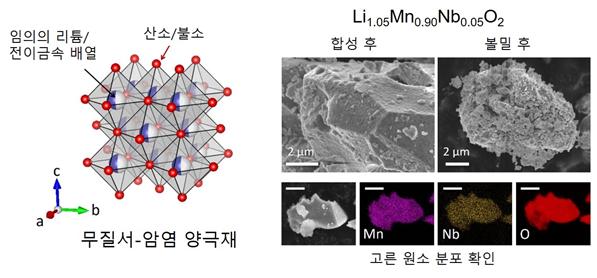
Ulsan National Institute of Science and Technology (UNIST) announced on the 9th that an international joint research team led by Professor Seo Dong-hwa of the Department of Energy and Chemical Engineering revealed that next-generation electric vehicle battery materials can maintain high performance and long lifespan using "disordered rock-salt materials" such as manganese and iron instead of expensive rare metals like cobalt and nickel.
The research team was the first to discover that the "lithium excess composition" principle, considered a design rule for high-performance disordered rock-salt electrodes, does not apply to certain disordered rock-salt materials. While lithium excess composition?designing lithium content at least 35% higher than expensive transition metals?was known to enhance electrode performance but shorten battery lifespan, they found materials that overturn this principle.
Cathode materials containing large amounts of expensive rare metals like cobalt and nickel account for more than 20% of the cost of electric vehicle battery (lithium-ion battery) cells. Therefore, disordered rock-salt materials containing abundant and inexpensive manganese and iron are attracting attention as new cathode materials. Compared to commercial materials, their capacity is 30-50% higher, making them suitable not only for electric vehicles but also as large-capacity battery materials for storing renewable energy power.
However, the short lifespan of disordered rock-salt cathode materials has been an obstacle to commercialization. According to previous studies, to achieve high-capacity performance of these cathode materials, lithium content had to be designed higher than in conventional cathode materials. But high lithium content in the material causes unstable oxygen to escape from the electrode, reducing battery lifespan.
According to the joint research team, certain metal-based disordered rock-salt materials such as manganese and vanadium can maintain high-capacity electrode performance even with reduced lithium content, and their lifespan improved more than twice compared to previous materials. In contrast, nickel- or cobalt-based disordered rock-salt materials show better electrode performance as lithium content increases, consistent with existing theories.
The researchers revealed this contradiction to existing theory through experiments using two types of manganese-based disordered rock-salt materials with different lithium contents and quantum mechanical modeling based on density functional theory.
Professor Lee Jin-hyuk, first author and co-corresponding author, explained, "The discovery of disordered rock-salt materials that maintain high performance while reducing lithium content opens the way to replace expensive battery cathode materials with inexpensive disordered rock-salt materials."
Professor Seo Dong-hwa said, "Interest in inexpensive and large-capacity battery materials is increasing not only for electric vehicles but also due to the growth of renewable energy generation," and added, "If disordered rock-salt materials are commercialized, they will be able to meet such demand."
The research was conducted with support from the Basic Science Research Program in Science and Engineering and the Overseas Excellent Research Institution Attraction Project of the National Research Foundation of Korea, and was carried out using supercomputers provided by the Korea Institute of Science and Technology Information.
© The Asia Business Daily(www.asiae.co.kr). All rights reserved.
![Clutching a Stolen Dior Bag, Saying "I Hate Being Poor but Real"... The Grotesque Con of a "Human Knockoff" [Slate]](https://cwcontent.asiae.co.kr/asiaresize/183/2026021902243444107_1771435474.jpg)















