[Asia Economy Reporter Hwang Yoon-joo] Did you know that electric vehicles were invented before internal combustion engine vehicles? The first electric vehicle is said to have been created in 1824 by Hungarian ?nyos Jedlik, who applied an electric motor.
From the early 1800s, several inventors began experimenting with electrically powered vehicles. Robert Anderson of the United Kingdom developed the first electric carriage in 1832, and in 1859, French physicist Gaston Plant? invented the rechargeable lead-acid battery capable of storing electricity for transportation, which accelerated the development of electric power sources. The Plant? battery (lead-acid battery), named after him, is still used in internal combustion engine vehicles today.
Later, in 1884, Thomas Parker of the UK developed a rechargeable electric vehicle using accumulators and succeeded in commercializing it for the first time, becoming the officially recognized first electric vehicle.
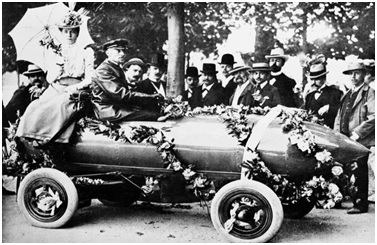
Research on electric vehicles continued to advance, and in 1899, Camille Jenatzy of Belgium developed an electric vehicle named "La Jamais Contente" (meaning "Never Satisfied"), which was the first to exceed a speed of 100 km/h.
Electric vehicles, developed before internal combustion engine vehicles, enjoyed a boom until the early 1900s, and in fact, more than one-third of the vehicles on American roads in the 1900s were electric vehicles.
At that time, electric vehicles, like today, had less odor and noise compared to internal combustion engine vehicles, and starting them was much easier than turning a crank for internal combustion engine vehicles. For these reasons, electric vehicles were very popular among upper-class women and were nicknamed "Madam Cars."
However, these electric vehicles gradually disappeared from the market over time. Although automobile king Henry Ford and inventor Thomas Edison tried to make affordable electric vehicles, they gave up mass production due to drawbacks such as the inconvenience of charging and the weight of the batteries, failing to reach the stage of practical use.
Decisively, with the discovery of crude oil in Texas in the 1920s, gasoline prices dropped significantly, and in 1913, Ford introduced the conveyor system to mass-produce internal combustion engine vehicles, causing electric vehicles to lose their competitiveness in the market.
However, in the 1980s, air pollution problems caused by internal combustion engine vehicles emerged, and as public interest in the environment increased, electric vehicles began to regain attention. Major global automobile companies jumped into developing eco-friendly vehicles, and electric vehicles started to reappear in the 2000s.
The reason electric vehicles could reemerge in the world is that the previously pointed-out drawbacks?cumbersome charging, heavy battery weight, and short driving range?were improved. This was achieved by overcoming the limitations of lead-acid batteries with lithium-ion batteries.
The core battery technology for electric vehicles is led by Korea, China, and Japan. LG Energy Solution and China's CATL are competing for the world’s number one position. Following them, Samsung SDI, China's BYD, and Japan's Panasonic are increasing their market shares, and SK Innovation has made large-scale investments in the US and Europe, rapidly advancing. It seems the day is near when the three domestic battery companies fiercely competing for leadership in the electric vehicle market will stand together as the global top three companies.
[Reference: Samsung SDI Homepage]
© The Asia Business Daily(www.asiae.co.kr). All rights reserved.
![Clutching a Stolen Dior Bag, Saying "I Hate Being Poor but Real"... The Grotesque Con of a "Human Knockoff" [Slate]](https://cwcontent.asiae.co.kr/asiaresize/183/2026021902243444107_1771435474.jpg)

















