 On the 6th, Professor Seokyeongdeok from Sungshin Women's University posted a poster on his social networking service (SNS) targeting Japanese Deputy Prime Minister Taro Aso, who stated, "It is safe to drink Fukushima contaminated water."
 [Photo by Instagram capture]
[Asia Economy Reporter Sumi Hwang] Professor Seokyungdeok from Sungshin Women's University sharply criticized Japanese Deputy Prime Minister Taro Aso, who said "Fukushima contaminated water is safe to drink," by saying, "You should demonstrate first."
On the 6th, Professor Seokyungdeok posted a poster featuring a photo of Deputy Prime Minister Taro Aso on his social media (SNS) along with this criticism.
The poster shows Taro Aso holding a glass of water and staring straight ahead, with the words "YOU DRINK FIRST" written above the photo.
Professor Seokyungdeok targeted Deputy Prime Minister Taro Aso, saying, "Making such reckless remarks without the courage to (drink the contaminated water) is disrespectful to people around the world." He also urged, "The Japanese government should promptly withdraw the decision to discharge contaminated water and contribute to protecting the global environment."
He translated this message into English, Korean, Spanish, Chinese, and Japanese in order and posted it on his Facebook page. He also announced plans to produce and distribute an English video explaining why Fukushima contaminated water is problematic.
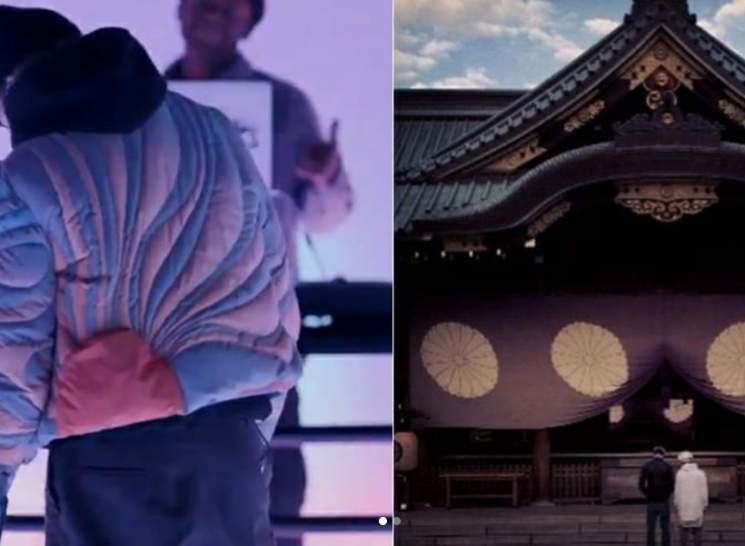 On the 29th of last month, Professor Seokyeongdeok from Sungshin Women's University posted on his social media (SNS) that he sent a protest email to Justin Bieber, who wore a padded jacket with the Rising Sun flag pattern while singing.
 [Photo by Facebook capture]
Earlier, on the 13th, Deputy Prime Minister Taro Aso sparked significant criticism by saying, "It's okay to drink that water," after the Japanese government decided to discharge contaminated water from the Fukushima nuclear power plant into the ocean. He has also made numerous other controversial remarks in the past.
In June last year, regarding COVID-19 response, he said, "The level of Japanese people is high, so the number of COVID-19 deaths is low," and made a gaffe by saying, "Japan does not use coercion, so please do not treat us like Korea." Notably, he also made controversial remarks such as "The Japanese-style forced name change (Changsi Gaemyung) happened because Koreans asked for surnames," and "Japan contributed to the spread of Hangul."
Meanwhile, on the 29th of last month, Professor Seokyungdeok sent a protest email to pop star Justin Bieber, who appeared on a Japanese music program wearing a padded jacket with the Rising Sun Flag pattern, asking him to refrain from such acts as the Rising Sun Flag is a war criminal flag.
On that day, he stated on his social media (SNS), "As part of the 'Global Campaign to Eradicate the Rising Sun Flag,' I sent a protest email to the world-famous pop star Justin Bieber explaining that the Rising Sun Flag is a war criminal flag."
On the 13th, the Japanese government held a ministerial meeting to decide on the treatment method for contaminated water from the Fukushima Daiichi Nuclear Power Plant and decided on "ocean discharge," which was proposed as the most likely treatment method by an expert subcommittee under the Ministry of Economy, Trade and Industry.
The Japanese government claims there is no problem as the contaminated water will be diluted to a level that has no impact on the human body and discharged sequentially. The "treated water," filtered through the Advanced Liquid Processing System (ALPS) before discharge, will be diluted more than 100 times with seawater, reducing the tritium concentration to about 1/40 of the national standard and about 1/7 of the World Health Organization (WHO) drinking water quality guidelines.
However, even after purification with ALPS, it is reported that radioactive substances such as tritium cannot be removed, leading to ongoing domestic and international opposition from local fishermen, civic groups, and neighboring countries over safety concerns.
© The Asia Business Daily(www.asiae.co.kr). All rights reserved.
![Clutching a Stolen Dior Bag, Saying "I Hate Being Poor but Real"... The Grotesque Con of a "Human Knockoff" [Slate]](https://cwcontent.asiae.co.kr/asiaresize/183/2026021902243444107_1771435474.jpg)
















