One Month Left Until the End of the Individual Consumption Tax Cut Policy That Holds the Fate of Domestic Car Sales
The Automotive Industry Holds a Significant Share in the Domestic Economy, and the Recovery Trend Must Continue with the Individual Consumption Tax Cut
[Asia Economy Reporter Changhwan Lee] Amid difficulties in the domestic automobile market due to COVID-19 and supply issues with automotive semiconductors, attention is focused on whether the scheduled expiration of the individual consumption tax (ICT) reduction for automobiles at the end of next month will be extended.
The government is currently analyzing the effects of the ICT reduction and is reportedly carefully considering an extension. Economic experts advise that the government should not view the automobile ICT reduction simply as a tax issue but rather as a measure to revive the domestic economy and respond to the semiconductor parts crisis.
The Automobile Industry Accounts for Over 10% of the Korean Economy... Extension of ICT Reduction is Urgent
When considering the share of the automobile industry in the domestic economy, the effect of extending the ICT reduction becomes clearer. According to the Ministry of Trade, Industry and Energy, as of 2018, the automobile industry accounted for about 13% of total domestic manufacturing output and 12% of employment, indicating a significant share. It is called one of the two pillars supporting the Korean economy along with semiconductors.
The ICT reduction policy has actually been a great help to domestic automobile sales. Sales of domestically produced passenger cars showed an increasing trend after the ICT rate was lowered to 1.5% in March last year, but the sales growth rate slowed from July when the ICT rate rose to 3.5%.
Looking at the entire last year, the number of vehicles sold in the domestic automobile market recorded 1.89 million units, an increase of 5.8% compared to the previous year. Despite the economic downturn caused by COVID-19, vehicle sales increased as the government drastically lowered the automobile ICT to 1.5%.
Accordingly, voices from the automobile industry are growing stronger, calling for the extension of the ICT reduction policy to support the recovery of the domestic economy. Although domestic automobile sales in the first quarter increased by 11.3% compared to the previous year, sales decreased again by 6.6% in April (based on five domestic completed car manufacturers), showing that a full recovery has not yet been achieved.
In particular, as the supply shortage of automotive semiconductors has recently worsened, not only completed car manufacturers and their partners but also customers are suffering significant damage. Manufacturers are experiencing reduced profits due to the inability to sell vehicles properly, and customers are suffering as waiting periods lengthen despite having contracts.
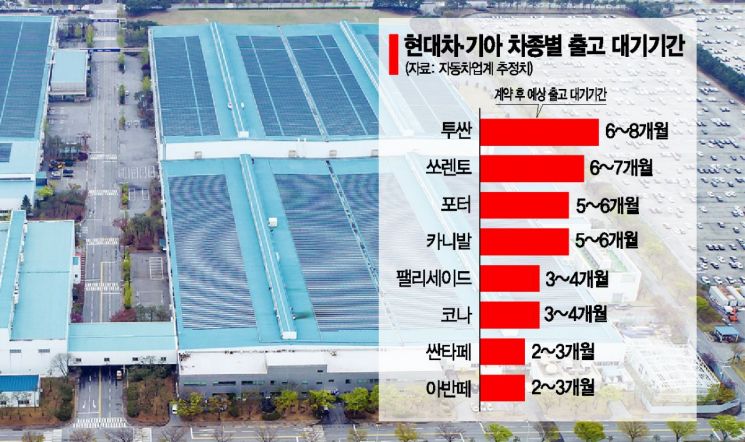
In the case of Hyundai Motor Company, some popular models such as Tucson and Porter are reported to have waiting periods of up to more than six months. Kia is also experiencing continuously lengthening waiting periods for models such as Sorento and Carnival. As waiting periods lengthen, customers who receive their vehicles after the ICT reduction benefit ends in June are likely to have to pay higher taxes.
The industry expects the semiconductor parts supply shortage to continue until the second half of this year. This is why there are calls to consider extending the ICT reduction as a countermeasure to the semiconductor crisis.
The Ministry of Economy and Finance, the relevant government department, is reportedly currently deliberating on whether to extend the reduction. A ministry official said, "It is not yet at a stage where we can say whether the ICT reduction period will be extended or not," adding, "If an extension is decided, the discussion will come out by early next month at the latest."
Calls to Completely Abolish Automobile ICT as It Is Not a Luxury Item
There are also voices calling for the complete abolition of the ICT imposed on automobiles in the long term. The argument is that the ICT contradicts its original legislative purpose in an era where automobiles have become essential goods.
The ICT originated from a special consumption tax established in 1977 to curb consumption of expensive luxury goods, but since automobiles are no longer luxury items, the purpose of the ICT has disappeared. At that time, automobiles, refrigerators, washing machines, color TVs, and air conditioners were subject to taxation, but refrigerators, washing machines, TVs, and air conditioners were excluded from the ICT in 2015.
Korea is also criticized for having excessively high automobile-related taxes compared to other countries. In Korea, a basic value-added tax (VAT) of 10% and an ICT of 5% are applied when purchasing a vehicle. In contrast, European Union (EU) member countries impose only VAT and registration tax without a separate ICT. Japan also does not impose a separate ICT.
Dongwon Lim, a senior researcher at the Korea Economic Research Institute, explained, "Compared to Japan, which only imposes environmental performance ratio tax and consumption tax when acquiring a vehicle, Korea imposes individual consumption tax, education tax, VAT, and acquisition tax, resulting in taxes that can be about 1.9 times higher than in Japan. In particular, Korea imposes double taxation on vehicle acquisition through VAT and individual consumption tax, making the tax burden excessive."
© The Asia Business Daily(www.asiae.co.kr). All rights reserved.
![Clutching a Stolen Dior Bag, Saying "I Hate Being Poor but Real"... The Grotesque Con of a "Human Knockoff" [Slate]](https://cwcontent.asiae.co.kr/asiaresize/183/2026021902243444107_1771435474.jpg)















