Transaction Amount Hits 2.6 Trillion in Q1 This Year, Up 70% Year-on-Year, Gaining Popularity
Number of Transactions Also Soars 63.2% to 307 Cases
Investment Floods Commercial Building Market to Avoid Housing Regulations Like Loans and Taxes
Prices Rise Sharply, High Liquidity Drives Popularity in Gangnam 3 Districts
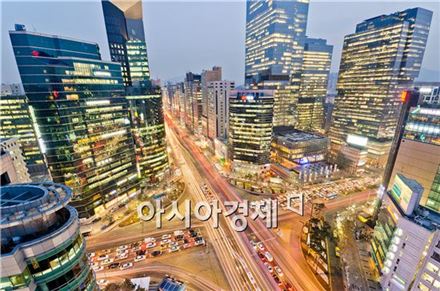 High-rise buildings line up around Gangnam Station area.
 [Photo by Asia Economy DB]
[Asia Economy Reporter Ryu Tae-min] The market for small and medium-sized buildings priced under 100 billion KRW is heating up. With housing market regulations tightening and growing concerns over currency value depreciation due to inflation, major investors are actively purchasing small and medium-sized buildings.
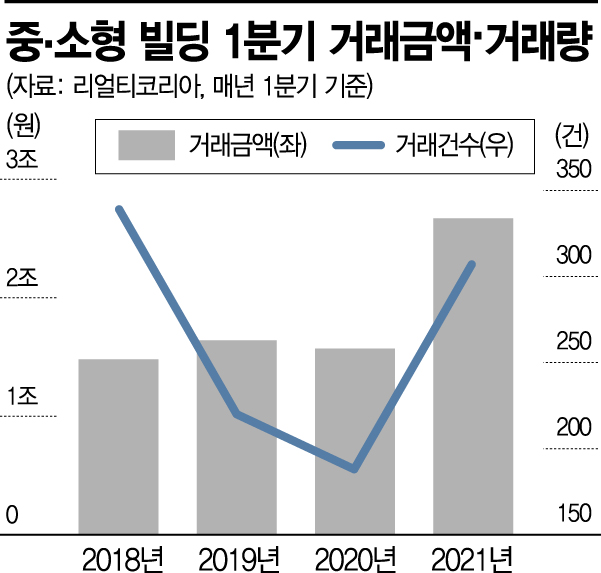
According to a report released on the 7th by real estate consulting firm Realty Korea, the transaction amount for small and medium-sized buildings in the first quarter of this year reached 2.67 trillion KRW. This represents a 70% increase compared to 1.57 trillion KRW in the same period last year. It is the highest quarterly transaction amount since 2017.
The number of transactions also increased. The number of transactions in the first quarter of this year was 307, up 63.2% from 188 in the same period last year. Realty Korea expects the final transaction volume to reach around 320 transactions once unreported deals are included.
The scale of small and medium-sized building transactions grew to 9.32 trillion KRW annually in 2018 but dropped to the 7 trillion KRW range in 2019. In the second quarter of 2020, quarterly transaction volume even shrank to the 1 trillion KRW level. However, starting from the third quarter of last year, the market reversed as the amount surpassed 3.17 trillion KRW for the first time. In the fourth quarter, it increased to 3.63 trillion KRW, pushing the annual transaction amount for small and medium-sized buildings beyond 10 trillion KRW for the first time. Lee Jae-guk, team leader at Realty Korea, explained, "During the first and second quarters of last year, which were the early stages of COVID-19, the market was cautious. But from the third quarter, investment activity picked up again due to expectations of a prolonged pandemic."
Regionally, transactions were prominent in the Gangnam 3 districts of Seoul: Gangnam, Seocho, and Songpa. In the first quarter, Gangnam district recorded 40 transactions of small and medium-sized buildings, the highest among Seoul’s 25 districts. It was followed by Mapo district (29 transactions), Songpa district (26 transactions), and Seocho district (20 transactions). In terms of transaction amounts, Gangnam district led all categories: 5 billion to 10 billion KRW, 10 billion to 20 billion KRW, and over 20 billion KRW. However, buildings priced under 5 billion KRW were most frequently traded in Mapo district.
The sharp increase in small and medium-sized building transactions is interpreted as a balloon effect caused by strengthened housing market regulations. Seo Jin-hyung, professor at Gyeongin Women’s University and president of the Korean Real Estate Society, said, "As loan and tax burdens on high-priced housing increase, abundant liquidity in the market is flowing into commercial building markets. Especially buildings in the Gangnam area are popular due to high land price appreciation rates and ease of future disposal."
© The Asia Business Daily(www.asiae.co.kr). All rights reserved.
![Clutching a Stolen Dior Bag, Saying "I Hate Being Poor but Real"... The Grotesque Con of a "Human Knockoff" [Slate]](https://cwcontent.asiae.co.kr/asiaresize/183/2026021902243444107_1771435474.jpg)
















