Minister of National Defense at Economic Group Meeting: "Not a Single Day Without Pressure"
[Asia Economy Reporter Kim Suhwan] The United States has pressured Taiwan to prioritize supplying semiconductors to the U.S. in order to overcome the severe semiconductor supply shortage.
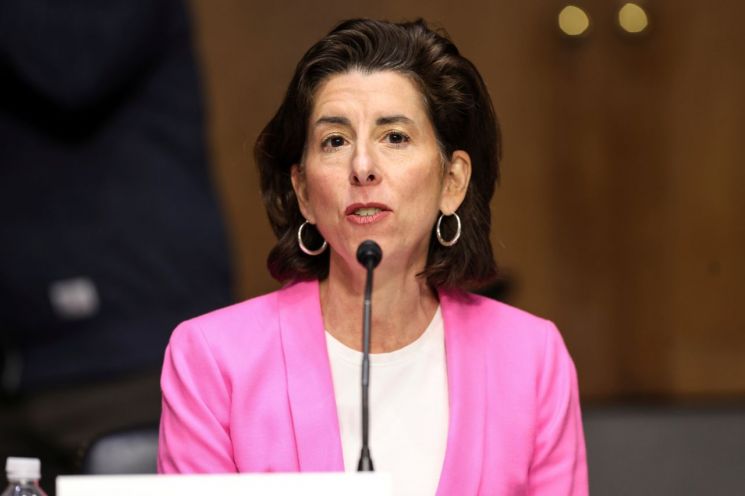
According to Bloomberg on the 4th (local time), Gina Raimondo, U.S. Secretary of Commerce, said at an online meeting with economic organizations, "We are making every effort to ensure that Taiwanese semiconductor companies, including TSMC, can prioritize supply to U.S. automakers." She added, "There has not been a single day when we stopped applying pressure."
As the economy unexpectedly recovered quickly after the COVID-19 pandemic, industries in the U.S., including the automotive sector, have been suffering from a severe semiconductor shortage.
In fact, major automakers in Detroit, including Ford, which announced it would cut its second-quarter production by half, are reducing production volumes.
AFP also pointed out that the production of electronic products such as game consoles and tablets is unstable.
It is interpreted that the U.S., suffering from this semiconductor shortage, has started pressuring Taiwanese companies such as TSMC, a foundry company with significant influence in the global semiconductor market, to supply semiconductors.
In addition, with China's aggressive semiconductor industry development, the Joe Biden administration is responding by elevating the semiconductor issue to a national security level.
At the event, Secretary Raimondo emphasized, "Currently, the U.S. produces 0% of the most advanced semiconductors, but to meet demand, this ratio must be raised to 30%," and stressed, "Supply chain recovery is absolutely necessary."
President Biden has already repeatedly expressed his determination to revitalize the semiconductor industry by taking the lead.
Earlier, on the 13th of last month, President Biden convened 19 global companies from IT and automotive sectors, including Samsung Electronics, at the White House to directly preside over a 'semiconductor virtual meeting,' openly demonstrating his aggressive semiconductor investment intentions.
In his first joint address to Congress on the 28th of the same month, one day before his 100th day in office, he emphasized the need to foster the battery and semiconductor sectors, stating, "We must develop and dominate future products and technologies such as advanced batteries, biotechnology, computer chips, and clean energy."
© The Asia Business Daily(www.asiae.co.kr). All rights reserved.