[Direct Talk - Asia Invitation] An Junhyung, CEO of Oasis Market
Last year's sales 238 billion KRW, 10 times growth in 5 years... 25,000 daily orders
Profit maintained through direct purchase from production areas... Logistics centers in Uiwang following Seongnam
Opened lowest price brand mall... Zero-base margin attracts continuous store inquiries
Covers some areas beyond Seoul metropolitan area including Chungcheong region... Company valued at 315 billion KRW
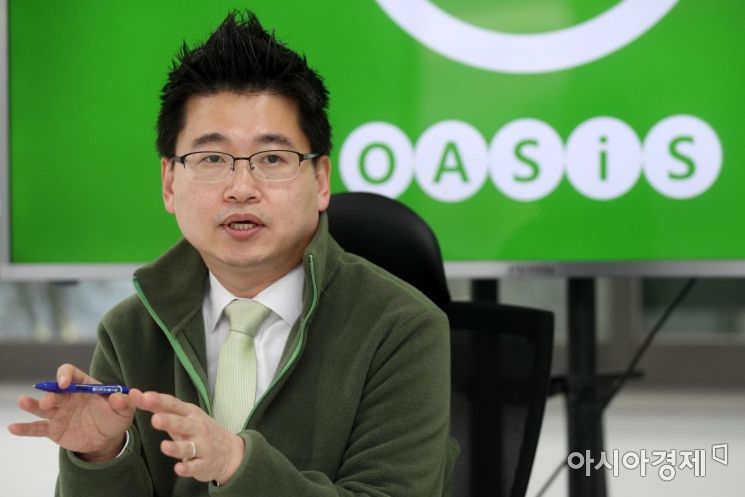 Ahn Jun-hyung, CEO of Oasis Market, is being interviewed by Asia Economy at the headquarters in Jungwon-gu, Seongnam-si, Gyeonggi-do on the 19th of last month. / Photo by Kim Hyun-min kimhyun81@
"When we recommend regular fresh food products that are not organic or antibiotic-free to our customers, they tend not to buy them. However, they show interest in other necessary products such as clothing or home appliances. Our goal this year is to expand customers' purchasing power beyond fresh food to non-perishable items as well."
Oasis Market, which has penetrated the dawn delivery market with organic food, is rapidly growing as we move past the 'With Corona' era. Online sales in December last year increased by more than 300% compared to the end of 2019, and the company's operating profit surged tenfold from 961 million KRW in 2019 to 9.684 billion KRW in 2020. The number of items handled, which was around 2,000 in 2018, exceeded 6,000 for directly purchased products alone by the end of last year. This year, Oasis Market has also entered the open market by launching brand malls such as Samsung Electronics and Nike. Additionally, they are steadily expanding their presence as an e-commerce market player by building fulfillment centers to expand delivery areas. They have attracted large-scale investments exceeding 56 billion KRW between last year and this year, raising expectations for a future stock market listing.
On the 19th of last month, we met with CEO Ahn Jun-hyung at Oasis headquarters located in Jungwon-gu, Seongnam-si, Gyeonggi Province. He explained, "Around February last year, when the nation began to mention the COVID-19 pandemic, customers started to shift their perception toward purchasing fresh food online." This was a change in the consumption paradigm where consumers who used to check ingredients offline with their own eyes moved online. CEO Ahn said, "Even during periods when the spread of COVID-19 temporarily subsided, word of mouth continued to increase membership, leading to a surge in orders and rapid sales growth." He cited 2015's offline store entry, 2018's online business and dawn delivery launch, and 2020 as the first turning point when Oasis Market achieved remarkable growth.
-You experienced rapid growth due to COVID-19 last year. Could you summarize the achievements?
▲With the rapid growth of the e-commerce market due to COVID-19, the number of members, sales, and profits all improved. As of the end of March this year, Oasis Market's membership exceeded 700,000, a 133% increase compared to the previous year. Sales, which were under 20 billion KRW in 2015, grew to 238 billion KRW in 2020, marking more than a tenfold increase over five years. This year, the average daily order volume exceeds 20,000, sometimes surpassing 25,000. Although the scale is still smaller compared to other dawn delivery companies like Coupang or Kurly, Oasis has maintained a continuous profit since its establishment.
-You maintained profitability even when competitors posted losses in the trillions.
▲The secret lies in the direct purchase structure from producers to lower product prices. Oasis reduces distribution stages by directly dealing with producers nationwide without intermediaries. Last year, 97% of sales were from direct transactions. This allows Oasis to sell organic and antibiotic-free products such as Jeju clean milk, bean sprouts, tofu, and free-range eggs at prices lower than other companies' regular fresh food. The sourced products are also sold at about 40 offline stores, minimizing product waste and creating synergy effects.
During COVID-19 last year, many dawn delivery companies sold meal kits and ready meals, but Oasis achieved better-than-expected sales by selling side dishes made directly from organic ingredients. Based on this, they plan to diversify side dishes and meal kits preferred by customers.
-Who are your main customer groups?
▲Previously, many female customers preferred organic and antibiotic-free products, but the age range has diversified since COVID-19. Previously, women in their 30s and 40s accounted for 60% of total members, but last year, middle-aged customers in their 50s and 60s and male customers increased significantly, lowering that proportion. As the customer base diversified, Oasis Market opened brand malls so customers can purchase clothing, home appliances, and daily necessities alongside organic fresh food.
-How is the performance of the brand mall?
▲Oasis aims to sell the best products at the lowest prices through its brand mall. To achieve this, they do not charge sellers any separate entry fees except for about a 3% card payment fee. They boldly forgo Oasis's margin, hoping to return discounts to customers. After the zero-base margin policy became known, inquiries for entry poured in, and within less than two months of launching the brand mall, about 40,000 products were listed and sold. After opening the Samsung Electronics mall in mid-last month, sales exceeded 60 million KRW in just the first weekend. The large transaction size per order compared to regular fresh food is the charm of the open market. Although it has only been about a month since the start, customer response is very positive and encouraging.
-Do you plan direct purchase and direct delivery in the brand mall business as well?
▲Some products from sellers will be directly purchased and delivered. In February, the parent company, GeoSoft, invested 5 billion KRW to establish an affiliate called 'Silk Road' responsible for the fulfillment business. They are currently building a logistics center in Uiwang, Gyeonggi Province, and plan to start a service that allows dawn delivery of non-perishable products as early as the second half of this year.
In the fresh food dawn delivery business, which has a high entry barrier, cost-minimized logistics systems are as important as product price competitiveness. Unlike most competitors who operate separate logistics centers for room temperature, refrigerated, and frozen goods, Oasis collects all products at one logistics center. The Seongnam 1 logistics center, which currently processes 25,000 orders daily, can handle over 60,000 orders if necessary through the logistics IT system called 'Oasis Route' developed by GeoSoft. The second logistics center, located 100 meters away, will open next month, and the Uiwang logistics center operated by Silk Road will be more than three times larger. They have secured sufficient logistics centers to cover delivery in Seoul and Gyeonggi Province metropolitan areas. The Uiwang logistics center is expected to enable dawn delivery to some areas in the Chungcheong region, and they are also considering logistics center sites in other regional areas such as Busan, Ulsan, and Gyeongnam.
-What is the status of the company's public offering?
▲In March, we received an additional investment of 15 billion KRW from external institutional investors. Oasis was valued at 315 billion KRW. When receiving a 5 billion KRW investment from Kakao Investment at the end of last year, the company was valued at 223 billion KRW, so expectations for the company increased by 50% in just three months. The cumulative investment amount combining GeoSoft and Oasis reached 56.6 billion KRW last year and this year. Regarding the listing, they have selected an underwriter and completed basic preparations. However, internally, they are considering whether to pursue slow and stable growth or more aggressive expansion. Since the large-scale investment was recently completed, they plan to focus on strengthening their capabilities rather than seeking additional investments for the time being.
The e-commerce market will change very rapidly over the next decade. By the year after next, companies that survive and those that are eliminated will be distinguished, but a winner-takes-all system by a specific company will be difficult. Oasis will focus on solid sales growth by leveraging its unique strengths as stamina."
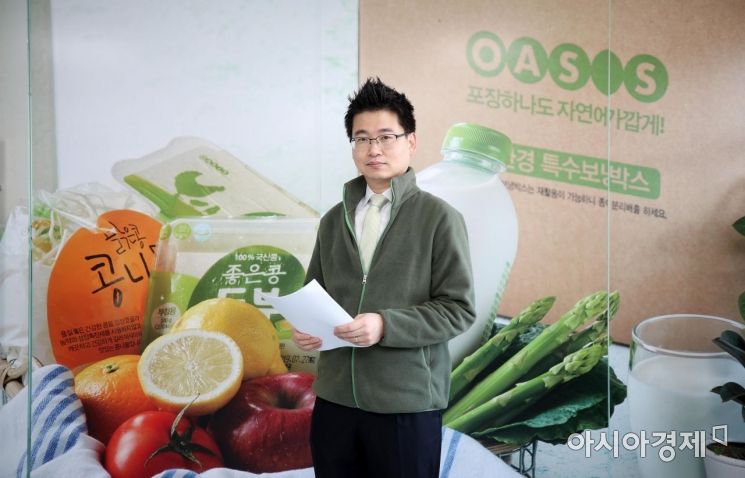
CEO Ahn Jun-hyung Profile
▶Born 1979 ▶Graduated from Yonsei University, Department of Business Administration, 2005; Certified Public Accountant ▶2005~2012 EY Hanyoung Accounting Corporation ▶2012~2014 CFO at Pytech Co., Ltd. ▶2015~2017 Head of Finance for Korea at GETECH SINGAPORE ▶January 2018~October 2020 CFO at Oasis ▶November 2020~March 2021 Vice President of Oasis and CFO of GeoSoft ▶April 2021~Present CEO of Oasis and CFO of GeoSoft
Interview / Myung Jin-gyu, Head of Consumer Economy Department
Summary / Reporter Jo In-kyung ikjo@
© The Asia Business Daily(www.asiae.co.kr). All rights reserved.
![Clutching a Stolen Dior Bag, Saying "I Hate Being Poor but Real"... The Grotesque Con of a "Human Knockoff" [Slate]](https://cwcontent.asiae.co.kr/asiaresize/183/2026021902243444107_1771435474.jpg)

















