[Asia Economy Reporter Hwang Yoon-joo] Among multinational companies operating in Korea, American companies have shown a relatively strong commitment to promoting gender diversity as a core corporate value. This is the first survey aimed at examining how the enterprise-wide Diversity & Inclusion (D&I) strategies of multinational companies are localized and implemented within Korea.
According to a survey on Diversity & Inclusion (D&I) conducted on the 29th by the American Chamber of Commerce in Korea (AMCHAM), in partnership with member company Morgan Philips Korea, 89% of respondents working for American companies answered that their companies showed a strong commitment to promoting gender diversity as a core corporate value. In contrast, only 72% of respondents from European companies and 38% from Korean companies agreed. This suggests that American companies are leading the pursuit of diversity and inclusion values more proactively compared to Korean companies. Additionally, 87% of respondents working for American companies agreed that prioritizing gender diversity values can lead to successful business outcomes.
There was also a significant difference in communication regarding diversity and inclusion values between global-level efforts and localization efforts within companies. While 48% of respondents strongly agreed that global programs are well communicated, only 19% strongly agreed that these global programs are smoothly localized.
When asked about improvements in gender equality awareness over the past five years, 69% of respondents answered affirmatively. However, there were perceptual differences between male and female respondents regarding the types of improvements.
Among men, 40% felt that all employees are treated fairly in promotions, while 28% of women felt the same. Regarding fair treatment in terms of compensation, 79% of men and 70% of women responded that they felt treated fairly.
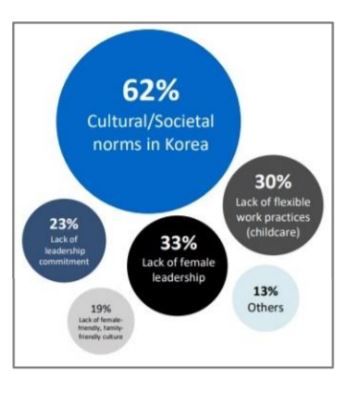
Regarding areas needing improvement and persistent barriers, 62% of respondents identified Korea’s cultural and social norms as the biggest barrier to women breaking the glass ceiling. Not only the absolutely low number of female leaders but also the lack of flexible work arrangements are perceived as obstacles to achieving gender equality in Korea.
© The Asia Business Daily(www.asiae.co.kr). All rights reserved.
![Clutching a Stolen Dior Bag, Saying "I Hate Being Poor but Real"... The Grotesque Con of a "Human Knockoff" [Slate]](https://cwcontent.asiae.co.kr/asiaresize/183/2026021902243444107_1771435474.jpg)
















