Construction on Yeongheungdo Site to Complete in 2025... Only Handles Incheon Waste
Average Daily Landfill Volume 161㎥, Usable for 40 Years
Sealed Air Dome Installed to Minimize Pollutants and Surrounding Environmental Damage
[Asia Economy Reporter Park Hyesook] In preparation for the closure of the Sudokwon Landfill Site (Seo-gu, Incheon) in 2025, Incheon City is accelerating the development of a new waste landfill facility. This facility will exclusively process waste from Incheon.
On the 29th, Incheon City announced that it has purchased 61.7 billion KRW worth of land measuring 894,860 square meters located at 248-1 Oeri, Yeongheung-myeon, Ongjin-gun, where the eco-friendly self-managed landfill tentatively named 'Incheon Eco Land' will be established, from a private corporation, and has applied for the transfer of ownership registration.
Accordingly, the city plans to steadily proceed with the self-managed landfill development project by conducting site feasibility studies and basic planning services. Furthermore, consultations with local resident groups opposing the landfill project on Yeongheungdo Island, as well as neighboring areas such as Ansan City and Siheung City, will be intensified starting next month.
Previously, last month, the city announced Yeongheungdo Island in Ongjin-gun as the final candidate site for Incheon Eco Land and, considering residents' opposition, promised the construction of the Second Yeongheung Bridge and annual support of 5 billion KRW for Yeongheung's development fund.
Incheon Eco Land, to be built on Yeongheungdo, will involve a project cost of 120 billion KRW and aims for completion by December 2025. Unlike the current direct landfill method that buries household waste as is, only incineration ash from household waste processed at local incinerators and non-combustible waste will be buried at a depth of 30 to 40 meters underground.
The average daily landfill volume will be 161 cubic meters, with fully enclosed vehicles transporting incineration ash only on weekdays. Considering the landfill volume, Incheon City estimates that Eco Land can be used for 40 years after completion.
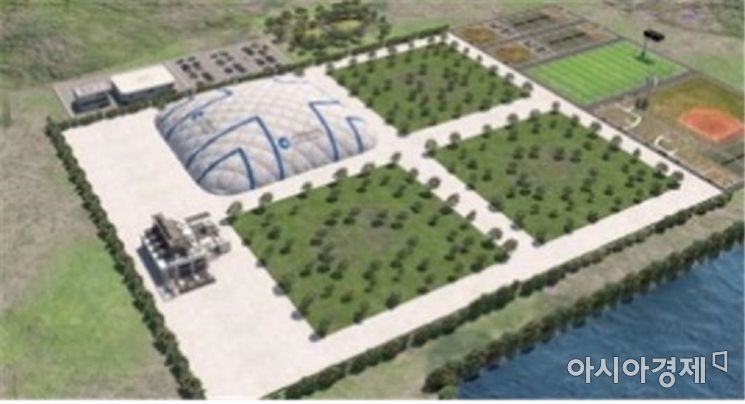
The city plans to create Eco Land by combining the advantages of advanced domestic facilities such as those in Namyangju, Gyeonggi Province, and Cheongju, Chungbuk. The top of Eco Land will be equipped with a sealed air dome to prevent pollutants and environmental damage to surrounding areas, and the landfill surroundings will be developed into a citizen rest area.
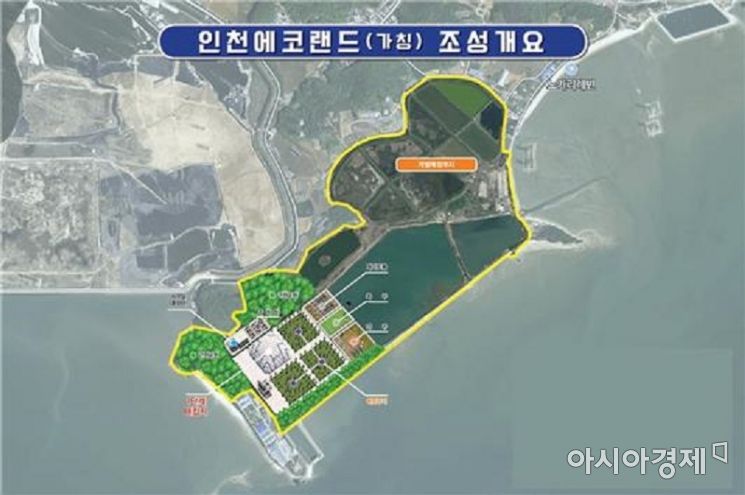 Plan for the creation of Incheon Eco Land. A waste landfill facility is scheduled to be built in the area marked in orange. [Provided by Incheon City]
The creation of Incheon's own landfill is being promoted in preparation for the closure of the Sudokwon Landfill Site in 2025.
Incheon City declared the closure of the Sudokwon Landfill Site, located in Baekseok-dong, Seo-gu, which has been operating since 1992 and has processed waste from Seoul and Gyeonggi Province for nearly 30 years, citing serious environmental issues and adverse effects on local development projects, based on the 2015 agreement of the 'Four-Party Landfill Council.'
The Four-Party Council agreed to extend the use period of the Sudokwon Landfill Site until the closure of Section 3-1 (1.03 million square meters), around 2025, in exchange for transferring the land ownership of the landfill site to Incheon City, originally scheduled to end by late 2016.
However, an annex clause in the agreement states that if an alternative landfill site is not secured by the closure time, an additional 15% of the remaining area (Section 3-2, 1.06 million square meters) can be used, which Seoul and Gyeonggi Province have cited to argue for extended use, causing conflict.
The Ministry of Environment, Seoul, and Gyeonggi Province held a public call for regions willing to host an alternative landfill site for three months starting January, but no applications were received.
These institutions plan to reissue the call for alternative landfill sites soon, but Incheon City intends not to participate as the organizing agency, just as in the first call.
This is to avoid giving any excuse to demand additional use of the current Sudokwon Landfill Site in case of failure to secure an alternative site. Incheon City's consistent position is to focus on creating its own landfill rather than an alternative landfill site, following the principle of processing waste where it is generated.
Oh Heung-seok, Incheon City's Transportation and Environment Coordinator, said, "With the acquisition of the project site for the self-managed landfill, a practical foundation has been established for the closure of the Sudokwon Landfill Site," adding, "We will also make every effort to develop Yeongheungdo as an eco-friendly special island and create 'Environmental Special City Incheon' based on residents' acceptance."
© The Asia Business Daily(www.asiae.co.kr). All rights reserved.
![Clutching a Stolen Dior Bag, Saying "I Hate Being Poor but Real"... The Grotesque Con of a "Human Knockoff" [Slate]](https://cwcontent.asiae.co.kr/asiaresize/183/2026021902243444107_1771435474.jpg)












