Next Year's Household Debt Growth Rate Managed at Pre-COVID Level of 4%
Youth and Low-Income Groups to Introduce 40-Year Mortgage
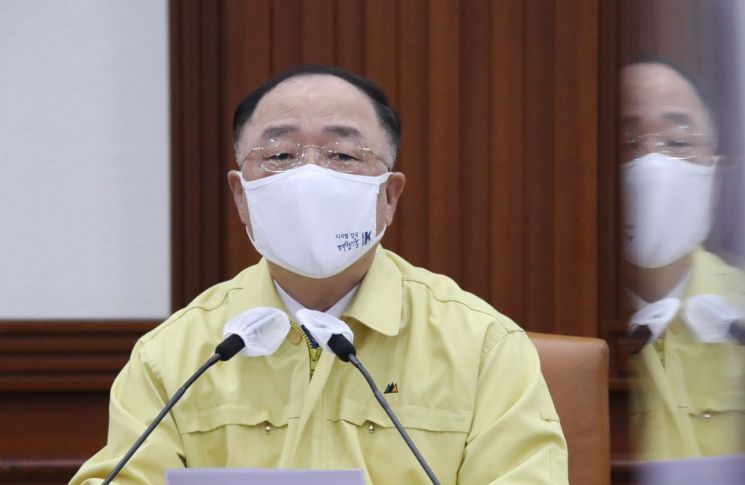
[Asia Economy Reporter Jang Sehee] Hong Nam-ki, Acting Prime Minister and Deputy Prime Minister for Economic Affairs, announced on the 29th, "To prevent excessive borrowing, we plan to gradually expand the application of the Debt Service Ratio (DSR) regulation on a borrower basis and fully implement it from July 2023."
At the Emergency Economic Central Countermeasures Headquarters meeting held at the Export-Import Bank on the same day, Deputy Prime Minister Hong stated, "As a follow-up measure to the real estate speculation eradication and recurrence prevention plan announced at the end of last month, we will fully introduce Loan-to-Value (LTV) regulations (from May 2021) and DSR regulations (from July 2023) for non-housing collateral loans such as land and officetels." He added, "To ensure that strengthened loan regulations do not exacerbate difficulties for low-income and young people, we will consider the future income growth potential of young borrowers when handling loans and introduce a 40-year early-stage mortgage to help reduce the burden of principal and interest repayments."
Regarding the increase in household debt, he added, "We will pursue a gradual soft landing by managing the household debt growth rate at 5-6% this year and around 4% next year, which is the pre-COVID-19 level."
Deputy Prime Minister Hong further stated, "The household debt issue is directly linked to the living conditions of ordinary citizens, such as jeonse (key money deposit) and housing funds, and at the same time, it could act as a major factor triggering financial system risks, so careful inspection and management are necessary." He explained, "While the qualitative structural improvement by increasing the proportion of fixed interest rate and installment repayment loans and the quantitative growth trend had been stabilizing downward, the growth trend inevitably expanded again during the COVID-19 crisis response last year." Additionally, he elaborated, "We will strengthen household debt management in four directions: improving the macroprudential management system, establishing loan practices based on repayment ability, supplementing systems for vulnerable management sectors, and expanding financial support for low-income and young people."
© The Asia Business Daily(www.asiae.co.kr). All rights reserved.
![Clutching a Stolen Dior Bag, Saying "I Hate Being Poor but Real"... The Grotesque Con of a "Human Knockoff" [Slate]](https://cwcontent.asiae.co.kr/asiaresize/183/2026021902243444107_1771435474.jpg)















