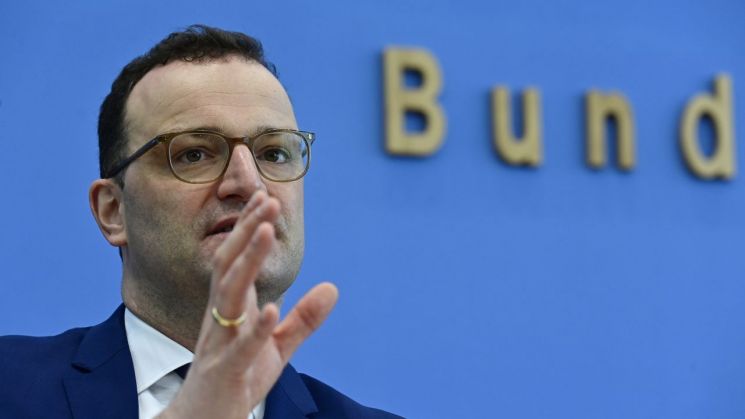
 Jens Spahn, German Minister of Health, is holding a press conference on COVID-19 response in Berlin on the 23rd (local time). Germany plans to implement an amendment to the Infection Protection Act from midnight on the 24th to enforce re-lockdowns, including nighttime curfews, in areas with increasing new COVID-19 cases to prevent the spread of the virus. (Photo by AP. Yonhap) [Image source=Yonhap News]
[Asia Economy Reporter Ryu Tae-min] Germany entered a strong re-lockdown including a nighttime curfew from midnight on the 24th (local time) to curb the third wave of COVID-19 spread.
The German government is implementing strong re-lockdown measures including a nighttime curfew from midnight on the 24th in areas where the 7-day average of new confirmed cases per 100,000 population has continuously exceeded 100 for three consecutive days, according to the Infection Protection Act. These areas account for about 85% of the entire country.
In these areas, nighttime movement is generally prohibited from 10 p.m. to 5 a.m. the next day. However, individuals jogging or exercising outdoors alone are allowed to move until midnight. Private gatherings are limited to one additional person per household. Theaters, operas, concert halls, museums, exhibitions, and memorial facilities are closed.
To shop at stores other than grocery stores, pharmacies, bookstores, and flower shops, reservations must be made and a negative COVID-19 test result must be presented. Stores must close if the number of new confirmed cases per 100,000 population exceeds 150 in the past week. Schools will suspend in-person classes if the number of new confirmed cases per 100,000 population exceeds 165 in the past week.
If the re-lockdown measures are violated, fines of up to 25,000 euros (approximately 33 million KRW) may be imposed. However, ZDF reported that this is an extreme case, and typically fines of 100 to 500 euros (135,000 KRW to 673,000 KRW) are expected.
German Chancellor Angela Merkel appeared on a national podcast that day and said, "From this weekend, emergency brake measures at the federal government level will be implemented according to the new Infection Protection Act," adding, "It is a harsh but urgently necessary measure to curb the third wave." She continued, "I hoped there would be a less burdensome way to curb the third wave, but there is none," emphasizing, "The speed of increase in new confirmed cases and severe patients is close to the peak level of last winter, and medical staff are crying out for help, so we need assistance."
Chancellor Merkel added, "No country has been able to control the third wave and begin easing lockdowns without strong measures including a nighttime curfew," and "If we succeed in clearly and quickly reducing the number of new confirmed cases, phased easing of lockdowns will soon be possible."
According to the Robert Koch Institute (RKI), Germany's equivalent of the disease control agency, the number of new COVID-19 cases in Germany the previous day was 23,392, with 219 deaths in one day. The number of new COVID-19 cases per 100,000 population over the past week reached 164.4.
© The Asia Business Daily(www.asiae.co.kr). All rights reserved.

















