Tmon to Maintain Negative Commission Policy in May
Wemakeprice Fixes Commission Rate at 2.9%... WemakepriceO's 'Fair Delivery'
Emphasizing Coexistence, Services Reducing Cost Burden Launched One After Another
[Asia Economy Reporters Kim Bo-kyung and Lee Jun-hyung] As e-commerce and non-face-to-face transaction markets expand, competition for dominance among platforms is intensifying. Recently, a race to lower commission fees has ignited. The strategy is to attract consumers by increasing the number of vendors through reduced sales commissions and enhancing price competitiveness. Alongside this, 'kind platforms' that reduce the cost burden on small business owners and self-employed individuals, who are facing existential crises due to the prolonged COVID-19 pandemic, are gaining popularity.
Tmon and Wemakeprice Successively Implement Commission Reduction Policies
According to industry sources on the 24th, Tmon has decided to maintain its 'negative commission' policy, which has been in effect since the 1st of this month, into next month. A Tmon representative stated, "The response from partners (vendors) to the -1% sales commission policy was better than expected." Tmon's negative commission policy is a groundbreaking marketing strategy that goes beyond commission reduction by refunding an additional 1%. This applies to products registered in single-item categories. Registering as a single product simplifies product searches and reduces consumer inconvenience caused by option price differences. Tmon also bears the payment gateway (PG) fees.
Recently, Wemakeprice announced it will introduce a policy fixing sales commissions at 2.9%. Currently, open market operators charge differentiated commissions by product category. For example, men's casual wear is 15.4%, books 11.6%, and digital devices 12.8% (according to the Fair Trade Commission). Wemakeprice declared that it will depart from the differentiated commission system by product category used by open market operators and adopt a flat-rate commission system like portals such as Naver and Kakao, setting the industry's lowest rate at 2.9%.
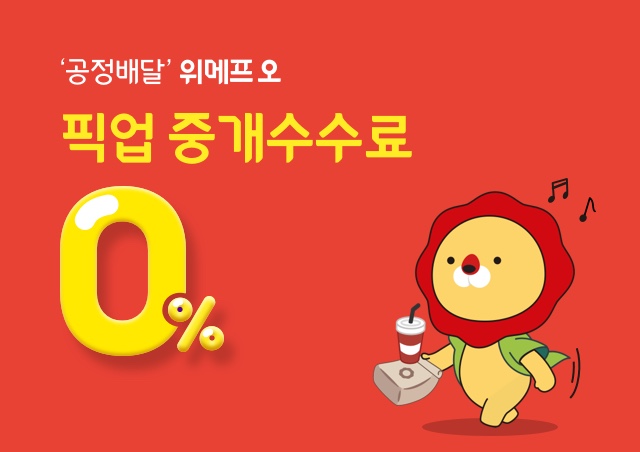
Delivery app Wemakeprice O is also promoting 'Fair Delivery.' Since September last year, it has implemented a zero brokerage fee policy, allowing store owners to choose a commission model based on their sales. The zero brokerage fee model requires only a server cost of 8,000 KRW per week (excluding VAT), with no additional charges based on order volume. If weekly sales are below 30,000 KRW, even the server cost is waived. Store owners can freely choose between a 5% flat-rate commission and weekly server costs depending on their weekly sales.
In December last year, a 2% commission model was introduced. By participating in the Seoul Zero Delivery Union and Gwangju Public Delivery App, small business owners with stores in Seoul and Gwangju who join Wemakeprice O receive a 2% brokerage fee.
Store owners registered with Wemakeprice O do not have to pay additional advertising costs. Existing delivery apps require advertising to feature stores prominently on the main page or search results. In contrast, Wemakeprice O determines priority automatically through algorithms based on order volume, number of reviews, ratings, and discount promotions.
Since January, brokerage fees for pickup orders have been reduced to 0%. Partners who only accept pickup orders without delivery and choose the flat-rate commission model do not have to pay any brokerage fees or server usage fees.
A Wemakeprice O representative explained, "Our goal is to attract store owners with a fair commission model, which naturally increases customers, leading to more stores and opportunities for sales growth, creating a virtuous cycle."

'Kind Accommodation App' Reducing Cost Burden... Services Increasing Restaurant Visitors
Kkulstay entered the market last August with the slogan 'Kind Accommodation App.' Although strong accommodation platform competitors like Yanolja and Yeogi Eottae dominate most of the market, the company emphasizes its competitiveness by having no reservation commissions or advertising fees. Business owners pay a monthly usage fee of 100,000 to 500,000 KRW depending on the number of reservations, allowing free use of the platform without additional costs. Unlike existing platforms where advertising fees paid by business owners increase the likelihood of appearing at the top of search results, Kkulstay does not operate this way.
Kkulstay originated from the difficulties faced by the accommodation industry in Daegu. In 2019, Daegu business owners were so concerned about reducing costs paid monthly to accommodation apps that they organized an emergency countermeasure committee. CEO Chae Ji-woong, who founded Kkulstay, realized there was high demand for an accommodation app that coexists with business owners after hearing about the situation in Daegu.
The response was positive. Many business owners felt burdened by competitive advertising fees and commissions reaching up to 10% per booking. According to a 'Survey on Accommodation App Usage' conducted by the Korea Federation of SMEs in February, 94.8% of businesses responded that commissions and advertising fees were excessive. Before officially launching the service, Kkulstay signed franchise contracts with about 200 businesses in Daegu. Riding this growth, the company expanded into the Seoul metropolitan area last month, securing about 400 franchise stores within a month.
Business owners reduced fixed expenses and improved profitability. A motel in Ulsan had been spending 4.25 million KRW monthly on commissions and advertising fees. After switching from existing accommodation apps to Kkulstay, its monthly profit, previously in the mid-5 million KRW range, nearly doubled. Choi Tae-jong (55), who operates motels in Miryang and other areas, said, "I realized I had been paying too much to accommodation apps all this time."
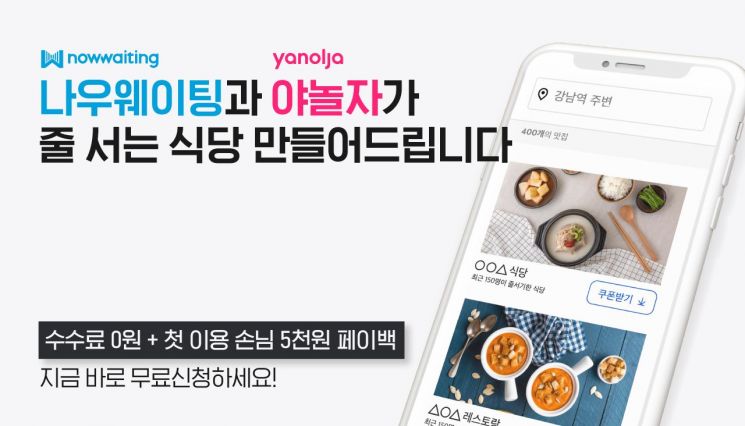
Nowbusking, the nation's leading waiting service company, announced it will implement a free restaurant promotion service indefinitely for dining business owners starting next month. To address the high platform commissions and declining customer visits faced by small restaurant owners, it partnered with accommodation app Yanolja. This is the first joint service since Nowbusking received a conditional investment from Yanolja in November last year.
By joining this service, restaurants can be promoted for free through the 'Restaurant Category' on the Yanolja app. Both entry fees and promotional commissions are free, encouraging customer visits.
Nowbusking CEO Jeon Sang-yeol said, "Nowwaiting has grown alongside the dining industry, especially small restaurant owners. Seeing more restaurants struggling to survive, we felt the need for a service that directly contributes to sales." He added, "Through the '0 commission' policy and exceptional benefits introduced with Yanolja, we aim to bring long lines back in front of restaurants. We will continue to expand services that help restaurants thrive."
Pay4U, a smart ordering service using QR codes, enables contactless ordering, payment, and pickup. Franchise owners can adopt the service without installation or membership fees. There is no need to install costly kiosks. Only a 1.5% commission per transaction is charged. Consumers do not need to download an app, sign up, or log in; they can simply scan the QR code with their smartphones to order easily.
A representative from PrimaryNet, which operates Pay4U, stated, "As non-face-to-face services become increasingly important due to COVID-19, we are promoting the expansion of this service to reduce the burden on small business owners struggling with sales and to foster mutual growth."
© The Asia Business Daily(www.asiae.co.kr). All rights reserved.
![Clutching a Stolen Dior Bag, Saying "I Hate Being Poor but Real"... The Grotesque Con of a "Human Knockoff" [Slate]](https://cwcontent.asiae.co.kr/asiaresize/183/2026021902243444107_1771435474.jpg)


















