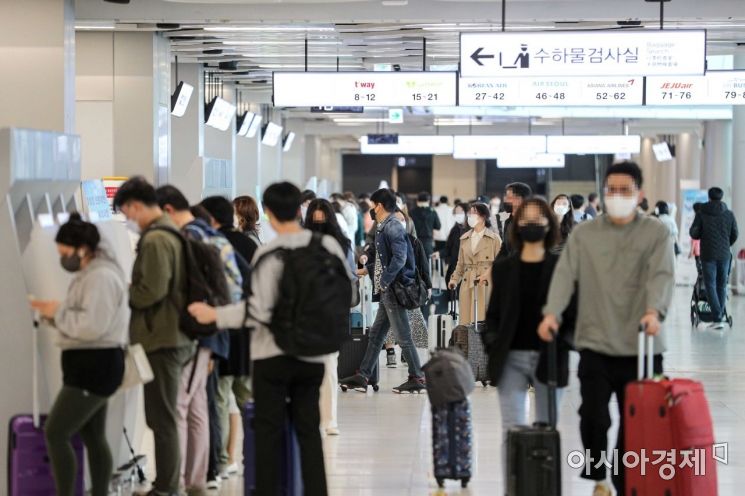
 On the 11th, with 614 new COVID-19 cases reported, marking three consecutive days of over 600 cases, Seoul Gimpo Airport's domestic terminal is bustling with travelers. Photo by Jinhyung Kang aymsdream@
[Asia Economy Reporter Dongwoo Lee] Despite the gradual recovery of passenger demand, the airline industry continues to face profitability deterioration due to low-cost price wars. These concerns are especially growing among low-cost carriers (LCCs), whose cargo transport business is limited.
According to the Ministry of Land, Infrastructure and Transport's Aviation Information Portal System on the 24th, last month, the number of domestic flights operated by Korean airlines was 17,166, and the number of passengers was 2,608,000, showing slight increases of 7.0% and 1.4%, respectively, compared to the same period last year before the COVID-19 pandemic. The industry interpreted this as a result of focusing aircraft on domestic routes due to the prolonged COVID-19 situation.
In fact, major airlines are attracting domestic passengers by offering ultra-low-cost airfares starting at 10,000 KRW. Jeju Air recently sold one-way domestic tickets at a total fare as low as 9,900 KRW over the past week, and Jin Air and T'way Air have also launched tickets priced in the 10,000 KRW range to compete.
Aero K, which started operating the 'Cheongju~Jeju' route on the 15th, also joined the passenger attraction by selling one-way Jeju tickets for 3,000 KRW (including fuel surcharges and taxes, total 9,200 KRW).
However, considering that over 80% of LCCs' pre-COVID-19 revenue was concentrated on international routes, there are criticisms that this forced price-cutting competition does not help improve profitability.
Experts warned that the longer this low-price competition continues, the more it could burden the financial structure. Despite the recovery of domestic demand in the first quarter of this year, the airline industry is expected to record operating losses of 65 billion KRW for Jeju Air, 42.3 billion KRW for Jin Air, and 31.4 billion KRW for T'way Air.
There are also concerns about rising debt ratios. Last year, Jeju Air's debt ratio increased by 87.5 percentage points from the previous year to 438.9%, and during the same period, Jin Air (467.4%), T'way Air (503.6%), and Air Busan (838.5%) also faced increased management burdens.
Experts pointed out that as debt ratios rise, credit ratings may decline, making it difficult to secure funding from financial institutions and potentially leading to disadvantages in policy fund support evaluations.
An LCC industry official said, "With the slow recovery of international routes, the atmosphere is to focus on domestic passenger demand during the peak season at least," adding, "Even if profitability improvement is difficult, this is a desperate measure to cover maintenance costs."
© The Asia Business Daily(www.asiae.co.kr). All rights reserved.
![Clutching a Stolen Dior Bag, Saying "I Hate Being Poor but Real"... The Grotesque Con of a "Human Knockoff" [Slate]](https://cwcontent.asiae.co.kr/asiaresize/183/2026021902243444107_1771435474.jpg)















