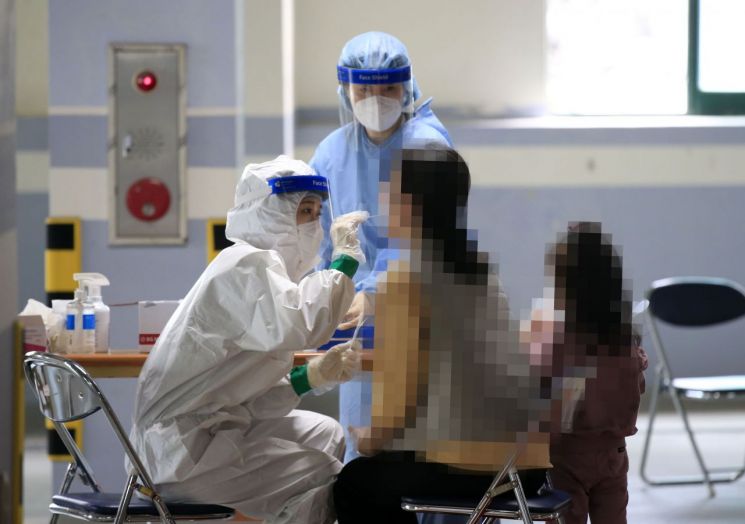
 On the afternoon of the 21st, a temporary screening clinic was set up at a large church in Nam-gu, Gwangju, conducting COVID-19 diagnostic tests for church members. [Image source=Yonhap News]
[Asia Economy Reporter Lee Chun-hee] The number of new domestic COVID-19 cases in South Korea has remained in the 700s for three consecutive days. This is the first time in about two and a half months since January 5-7 that daily new cases have stayed above 700 for three days in a row, and the nearly 800 daily cases mark the highest number since January 7, when 869 cases were reported, making it the largest number of confirmed cases in 106 days.
The Korea Disease Control and Prevention Agency (KDCA) Central Disease Control Headquarters announced on the 23rd at midnight that the total number of COVID-19 cases increased by 797 from the previous day to 117,458. Following 731 cases on the 21st and 735 cases on the 22nd, the daily new cases have remained in the 700s for three consecutive days, the first time since January 5-7 when 714, 838, and 869 cases were confirmed respectively.
The infection routes of the new confirmed cases were 758 local transmissions and 39 imported cases.
About 70% of the locally transmitted cases occurred in the Seoul metropolitan area. There were 198 cases (26.1%) in Seoul, 290 cases (38.3%) in Gyeonggi Province, and 10 cases (1.3%) in Incheon, totaling 498 cases in the metropolitan area, accounting for 65.7% of all confirmed cases.
Other regions reported new cases as follows: 63 in Gyeongnam, 38 in Ulsan, 33 in Busan, 29 in Chungbuk, 22 in Gyeongbuk, 16 in Gwangju, 15 in Gangwon, 12 in Daegu, 10 in Incheon, 10 in Chungnam, 8 in Jeonbuk, 6 in Jeonnam, 3 in Sejong, 3 in Jeju, and 2 in Daejeon.
The weekly average of daily local cases, a key indicator for adjusting social distancing levels, stood at 640, maintaining the 600s for 12 consecutive days.
There were 39 imported cases, with 23 detected during quarantine and 16 identified in the community. Among them, 14 were Korean nationals and 25 were foreigners.
The number of patients who have recovered and been released from isolation reached 107,071, an increase of 612 from the previous day. Among hospitalized patients, the number of critically ill patients increased by 2 to 127. The death toll rose by 3 to 1,811.
The total number of tests conducted the previous day was 88,106. At temporary screening clinics set up in the metropolitan area, 36,314 tests were conducted, confirming 128 new cases.
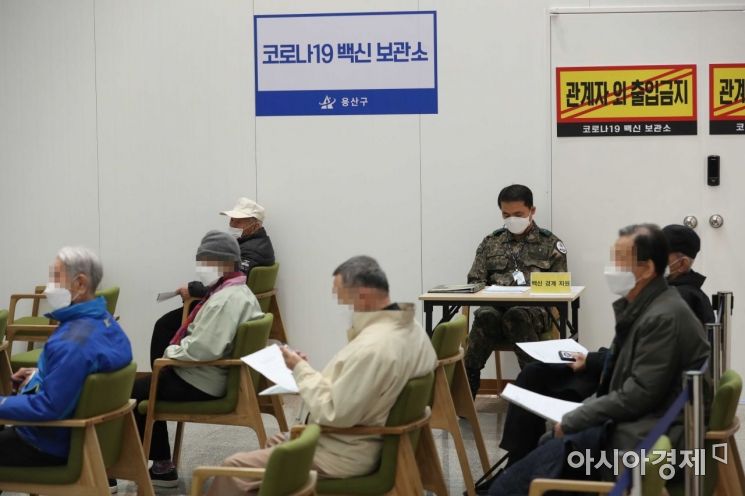 On the 16th, elderly individuals aged 75 and above who received the Pfizer vaccine at the vaccination center set up in Yongsan Art Hall, Yongsan-gu, Seoul, are waiting in the adverse reaction monitoring area. Photo by Mun Ho-nam munonam@
Meanwhile, as of midnight on the same day, 130,615 people received their first dose of the COVID-19 vaccine, bringing the total number of first-dose recipients to 2,035,549. It took 56 days since the first vaccination started on February 26 to surpass 2 million first-dose vaccinations, and 17 days since surpassing 1 million on the 5th. Among them, 1,194,718 received the AstraZeneca vaccine, and 840,831 received the Pfizer vaccine.
The number of people who completed the second dose of the Pfizer vaccine increased by 18,528 from the previous day to 79,151. The second dose of Pfizer vaccine saw a slowdown after the completion of vaccinations for COVID-19 treatment hospital recipients on the 10th, but the pace began to pick up starting on the 22nd as the second dose period for seniors aged 75 and older began.
Reports of suspected adverse reactions increased by 279 cases to a total of 13,011. Among these, one additional death was reported among Pfizer vaccine recipients. This brings the total number of deaths following Pfizer vaccination to 16, and the total deaths following all COVID-19 vaccinations to 53.
Additionally, one case of anaphylaxis was reported, along with one case of severe suspected reactions such as convulsions requiring intensive care unit admission, and one additional case of neurological reactions such as convulsions.
The remaining 275 cases were common adverse reactions after vaccination, such as muscle pain, headache, fever, chills, and nausea.
© The Asia Business Daily(www.asiae.co.kr). All rights reserved.
![Clutching a Stolen Dior Bag, Saying "I Hate Being Poor but Real"... The Grotesque Con of a "Human Knockoff" [Slate]](https://cwcontent.asiae.co.kr/asiaresize/183/2026021902243444107_1771435474.jpg)
















