Coal Power Utilization Rate of 5 Major Power Companies Drops 25%P in 4 Years of Moon Administration
All 5 Companies Recorded Operating Losses Last Year
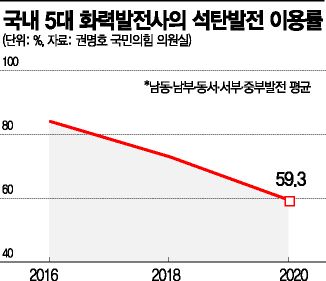
[Sejong=Asia Economy Reporter Kwon Haeyoung] The operating rate of coal-fired power plants of the five major domestic coal power companies has significantly declined under the current administration. President Moon Jae-in reaffirmed the coal phase-out policy by announcing the suspension of export financing for coal power at the Climate Summit held on the 22nd, and the impact on coal power companies is expected to increase further. Concerns are also emerging that the government’s rapid reduction of coal power, following the cheap power source of nuclear energy, and filling the gap with renewable energy will increase the burden such as electricity rate hikes.
According to the utilization rate data submitted on the 23rd by the office of Kwon Myungho, a member of the People Power Party, from the five major power companies under Korea Electric Power Corporation (Namdong, Nambu, Dongseo, Seobu, and Jungbu Power), the average utilization rate of coal power plants of the five companies dropped by 24.7 percentage points from 84% in 2016, before the current administration took office, to 59.3% in 2020. In the case of Nambu Power, the coal power utilization rate fell from 87.1% to 54.1% during the same period, a decrease of as much as 33 percentage points. The decline in utilization rate means that the number of power plants that stopped operating among all power plants increased.
The 25 percentage point drop in coal power utilization rates of the five major power companies over four years is due to the current administration rapidly reducing coal power plant operations while aggressively promoting energy transition policies centered on expanding renewable energy.
An industry official explained, "Since 2017, the government has temporarily suspended the operation of aging coal power plants and shut down power plants through the fine dust seasonal management system, which caused the utilization rate to decline," adding, "Last year, coal power utilization rates fell to the 50% range due to decreased power demand caused by COVID-19."
The promotion of coal phase-out policies is inevitable for carbon neutrality, a global trend. The issue lies in the speed. The government plans to reduce the share of coal power generation from 40.4% in 2019 to 29.9% by 2030. To this end, it has banned new coal power projects domestically, implemented a coal power generation cap system, and decided to stop supporting overseas expansion, which is the only source of profit. This has led to criticism that the coal power industry is being cornered by coal phase-out policies without even being given room to transition their business. All five power companies recorded operating losses last year. During this process, the Samcheok Thermal Power Plant, which received government permits, had its construction halted by the Ministry of Environment due to environmental pollution concerns. Since coal power accounts for the largest share of power generation domestically, there are calls to pursue policies that minimize damage by adjusting the speed of coal phase-out.
© The Asia Business Daily(www.asiae.co.kr). All rights reserved.
![Clutching a Stolen Dior Bag, Saying "I Hate Being Poor but Real"... The Grotesque Con of a "Human Knockoff" [Slate]](https://cwcontent.asiae.co.kr/asiaresize/183/2026021902243444107_1771435474.jpg)
















