Posted on SNS on the 22nd... "No toxic clauses harming medical publicness in the bill"
Judged that passing the Seobal Act can create quality jobs and high added value
Hong: "Time to end futile debates... Must legislate quickly even if excluding health and medical sectors"
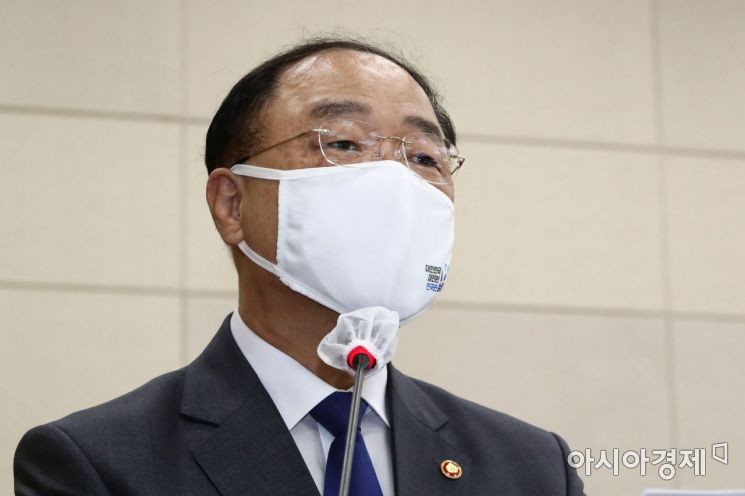 Hong Nam-ki, Deputy Prime Minister and Minister of Economy and Finance, attends the plenary meeting of the Planning and Finance Committee held at the National Assembly on the 22nd, making remarks related to the bill. Photo by Yoon Dong-joo doso7@
[Sejong=Asia Economy Reporter Moon Chaeseok] Hong Nam-ki, Deputy Prime Minister and Minister of Economy and Finance, emphasized on the 22nd that "the government can no longer delay the legislation of the Service Industry Development Framework Act (Seobalbeop), which was submitted to the National Assembly 10 years ago." He appealed that even excluding the Medical Service Act, Pharmaceutical Affairs Act, National Health Insurance Act, and National Health Promotion Act, the Seobalbeop must be passed as soon as possible to enable the creation of quality jobs and added value.
Deputy Prime Minister Hong explained the added value and employment share of the service industry on his social media (SNS) and demanded the National Assembly's prompt handling. Although concerns about damaging public healthcare have been raised, he believes that because the service industry plays such a significant role in our economy, prompt legislative action is absolutely necessary.
According to Deputy Prime Minister Hong, as of 2018, the share of added value of the service industry in South Korea was 62.4%, which is 17.4% less than the United States' 79.8%. The employment share in the service industry was also 70.8%, 9.1 percentage points lower than the U.S.'s 79.9%. Citing a 2019 study by the Korea Development Institute (KDI), he emphasized that simply raising the productivity of the service industry to the level of major countries could increase the growth rate by 1 percentage point and create about 150,000 jobs.
He mentioned the reality of face-to-face service industries such as retail, food, and accommodation, which were hit hard by COVID-19, as well as variables like the Fourth Industrial Revolution, non-face-to-face and digital transformation, and demographic changes. He described the Seobalbeop as a "solid stepping stone" that can reduce these risks. He also welcomed that legislative discussions are underway in the National Assembly based on the proposal by Lee Won-wook of the Democratic Party of Korea. Of the 28 articles, 22 articles excluding the general provisions cover governance, support systems, and infrastructure evenly.
Regarding claims that the enactment of the Seobalbeop would lead to damage to public healthcare, he flatly denied them. Deputy Prime Minister Hong said, "Legislation has not been realized for over 10 years due to concerns about damaging public healthcare, but in fact, there are no provisions or problematic clauses in the original Seobalbeop bill that would harm public healthcare." He added, "Nevertheless, to expedite legislation even by a day, the current pending bill excludes four health-related laws?the Medical Service Act, Pharmaceutical Affairs Act, National Health Insurance Act, and National Health Promotion Act?from the scope of the Seobalbeop."
Deputy Prime Minister Hong said, "Now is the time to end fruitless debates and demonstrate the wisdom of 'Ujikjigye' by changing our mindset to solve problems." He explained, "While I hope the Seobalbeop will include the health and medical sectors, since rapid legislation is urgent, I expect it to be enacted promptly even if it excludes the four health-related laws as in Representative Lee's proposal." The 'Ujikjigye' he mentioned is a phrase from Sun Tzu's Art of War, meaning a change in thinking that one should not only take the straight path but also know when to take a detour.
He said, "I earnestly appeal to both ruling and opposition parties to unite their efforts and ensure the passage of the Seobalbeop this time." He added, "If the Seobalbeop is enacted, the government will make every effort to use this as an opportunity to raise the competitiveness of our service industry to the next level and make the service industry a source of added value and job creation at the level of advanced countries."
© The Asia Business Daily(www.asiae.co.kr). All rights reserved.
![Clutching a Stolen Dior Bag, Saying "I Hate Being Poor but Real"... The Grotesque Con of a "Human Knockoff" [Slate]](https://cwcontent.asiae.co.kr/asiaresize/183/2026021902243444107_1771435474.jpg)















