6 out of 10 New Cryptocurrency Investors Are in Their 20s and 30s
High Volatility Is the Appeal of Cryptocurrency
Value of Small-Scale 'Altcoin' Has Recently Surged Nearly 5 Times
Success Stories of Coin Investment Also Fuel Investor Sentiment
"I Can't Become a Sudden Poor" - Growing Relative Deprivation
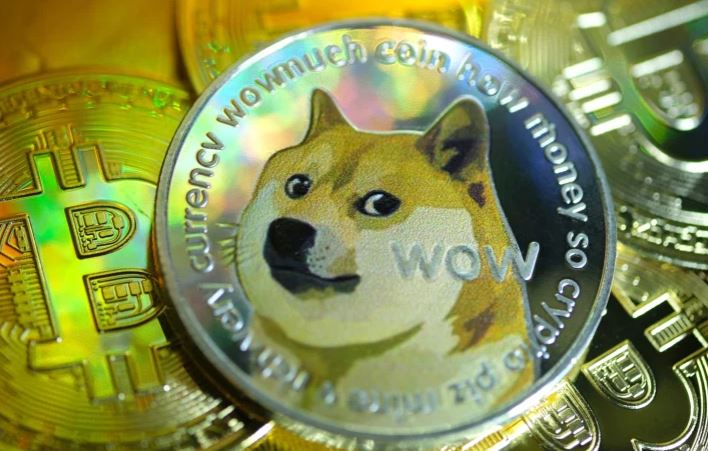
[Asia Economy Reporter Lim Juhyung] #Office worker Choi Mo (31) has recently been fully immersed in 'coin study.' Every day after work, he refers to famous investor blogs and YouTube videos to organize promising cryptocurrency information. As a so-called 'corin-i' (beginner cryptocurrency investor), Choi said the reason for investing in cryptocurrency is "because recently, when meeting friends or chatting in KakaoTalk chat rooms, everyone only talks about coins," adding, "Although there is a risk of principal loss, I feel anxious that I might miss out on a big money-making opportunity and fall behind."
Recently, the number of young people in their 20s and 30s interested in cryptocurrency investment has been increasing. They believe that through investing in highly volatile financial assets instead of saving, they can accumulate wealth in a short period. After hearing stories of others who have made so-called 'jackpots' through cryptocurrency, some feel a relative sense of deprivation and step into investment. Experts analyze that this psychological deprivation can act as herd mentality, expanding the investment craze.
The enthusiasm for coin investment among the 20s and 30s generation can also be confirmed by statistics. According to the status of investors at the four major domestic cryptocurrency exchanges (Bithumb, Upbit, Korbit, Coinone) disclosed by Assemblywoman Kwon Eunhee of the People's Party on the 21st, among the 2,495,289 newly established real-name accounts in the first quarter of this year (January to March), the proportions of people in their 20s and 30s were 32.7% (816,039) and 30.8% (768,775), respectively. In other words, 6 out of 10 new cryptocurrency investors belong to the 20s and 30s generation.
The reason the 20s and 30s generation focuses on cryptocurrency is 'volatility.' Among cryptocurrencies listed on the Upbit KRW trading market, excluding Bitcoin, the market capitalization of smaller coins, so-called 'altcoins,' has surged about fivefold from the beginning of this year to this month. During the same period, Ethereum rose more than twice, and Dogecoin, which has recently gained popularity, increased by nearly 700%.
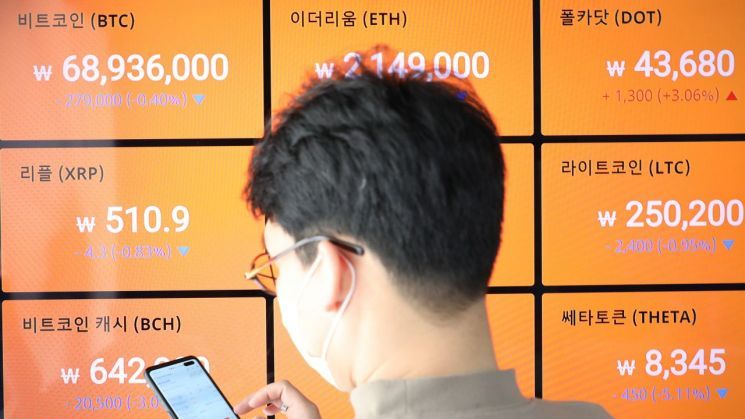 On the 15th of last month, Bitcoin information was displayed on the electronic billboard at Bithumb Gangnam Center. The photo is not related to any specific expressions in the article. / Photo by Yonhap News
These altcoins have relatively lower trading volumes compared to Bitcoin, allowing them to be purchased at relatively low prices, and their daily price fluctuations are very large. Because of this, there is an advantage that, with a bit of luck, one can earn a large amount of money with a small investment. For young people who have less capital prepared compared to the older generation, this offers a chance for a sudden fortune.
This coin craze among the 20s and 30s generation can also be seen in the internet slang term 'byeorakgeoji.' Byeorakgeoji means 'suddenly becoming a beggar,' which is the opposite of 'byeorakbuja,' meaning 'suddenly becoming rich.' It is a bittersweet trendy term used when people envy the success stories of those who made huge money overnight during the cryptocurrency bull market and lament their own situation.
On online communities and social networking services (SNS) related to cryptocurrency investment, posts from netizens deciding to invest in coins to escape the 'byeorakgeoji' situation are posted. They encourage each other with comments like, "I ignored Bitcoin as a bubble and missed the bull market. But I can't really become a byeorakgeoji after missing Dogecoin too," and "Get on (the coin) quickly before becoming a byeorakgeoji."
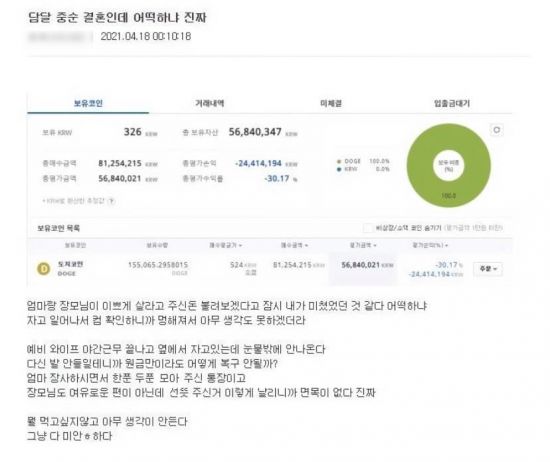 A post by a cryptocurrency investor who lost a large amount of money after investing in 'Dogecoin'. / Photo by Internet Community Capture
The problem is that due to the highly volatile nature of virtual assets, there is also a high possibility of suffering principal losses. Although less attention is paid compared to coin investment success stories, cryptocurrency-related communities often have complaints about "losing a lot of money after investing in coins."
One netizen posted on the 18th that they invested about 81 million KRW in Dogecoin but suffered about a 30% (24 million KRW) principal loss due to the currency's value collapse, saying, "The money was given by my mother and mother-in-law to live beautifully, but I think I was crazy for a moment. I will never step into coins again, so can't I somehow recover at least the principal?"
A famous YouTuber also posted a message implying an extreme choice, saying, "If the coin price doesn't rise to 180 KRW by 9 o'clock, I'll just XX," causing concern among viewers.
Young people confessed that they entered coin investment fearing they would fall behind the trend and be engulfed by 'relative deprivation.' A freelancer A (30) said, "Because my income is irregular due to the nature of my job, I have always been interested in investment," adding, "At first, I put a small amount into stocks, but now I have switched to coins. I feel that if not now, I won't have a chance to make a large sum through investment."
Office worker B (28) said, "When I see communities or SNS, there are countless stories and books about people making hundreds of millions through coin investment," adding, "Honestly, every time I read those, I can't help but feel anxious, wondering if I'm the only one missing out on making money or falling behind."
Experts analyzed that the herd mentality fearing becoming a byeorakgeoji has spread this investment craze.
Professor Kwak Geumju of Seoul National University's Department of Psychology explained, "Even without a clear purpose, people can jump into investment due to anxiety about 'Am I the only one being left out?'" adding, "This is because there is a fear that if you do nothing now and people around you make a lot of money, you will regret it."
She continued, "Especially when the economy worsens and workers' incomes decrease, this greed for sudden fortune can grow," urging, "We must prevent this psychology from leading to speculation and get-rich-quickism."
© The Asia Business Daily(www.asiae.co.kr). All rights reserved.
![Clutching a Stolen Dior Bag, Saying "I Hate Being Poor but Real"... The Grotesque Con of a "Human Knockoff" [Slate]](https://cwcontent.asiae.co.kr/asiaresize/183/2026021902243444107_1771435474.jpg)













