Last Year's Growth Rate -8.9% Due to COVID-19
Renewable Energy Development and Administrative System Efficiency Improvements
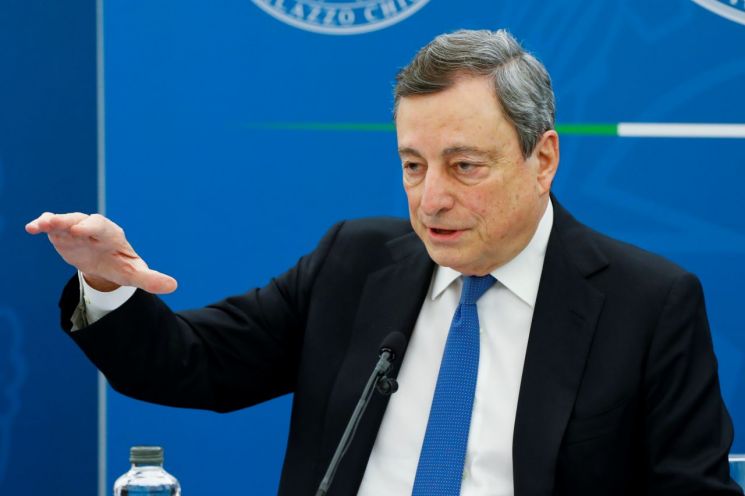
[Asia Economy Reporter Kim Suhwan] Italian Prime Minister Mario Draghi is investing 221 billion euros (approximately 300 trillion won) to rebuild the country's economy. Attention is focused on whether Italy's economic recovery project can succeed, as the country suffered the most severe economic damage among European nations during the COVID-19 pandemic and recorded the lowest economic growth rate since World War II.
According to major foreign media on the 21st (local time), Prime Minister Draghi is expected to announce an economic reconstruction plan worth 221 billion euros to the parliament next week. Italy will first raise 30 billion euros on its own, and the remaining 191.5 billion euros will be sourced from the European Union (EU)'s COVID-19 recovery support fund project, the 'Next Generation EU' fund.
Italy was the epicenter of the COVID-19 spread in Europe during the early stages of the pandemic last year and suffered the most severe economic damage among European countries. According to the Italian government, Italy's gross domestic product (GDP) growth rate last year was -8.9%, the worst since World War II in 1945.
In response, Prime Minister Draghi is expected to quickly realize economic recovery through a large-scale infrastructure development plan and pursue long-term goals to transition to a low-carbon, advanced technology society. The plan to be announced next week is reported to include investments in high-speed rail, renewable energy development, and digitalization of public administration. Additionally, plans to optimize the power grid to reduce electricity consumption and improve the energy efficiency of public buildings are expected to be promoted.
Furthermore, Draghi is also expected to push for reforms of various judicial and administrative systems that cause bottlenecks in national administrative procedures. Currently, due to an inefficient administrative system, it reportedly takes an average of over 1,100 days to conclude and implement corporate investment contracts in Italy. This has been a factor discouraging foreign companies from investing in Italy. The Draghi government plans to address these issues by promoting the digitalization of public administrative procedures to increase efficiency and implementing judicial reforms to shorten trial durations.
© The Asia Business Daily(www.asiae.co.kr). All rights reserved.
![Clutching a Stolen Dior Bag, Saying "I Hate Being Poor but Real"... The Grotesque Con of a "Human Knockoff" [Slate]](https://cwcontent.asiae.co.kr/asiaresize/183/2026021902243444107_1771435474.jpg)















