FKI Announces Analysis Report on 'Current Status and Challenges in the Field of Artificial Intelligence'

[Asia Economy Reporter Kim Heung-soon] South Korea's competitiveness in the field of artificial intelligence (AI) is estimated to lag behind advanced countries such as the United States by 1.8 years. There are also claims that urgent reforms in data-related regulations are needed to advance AI technology, which will be the foundation of the Fourth Industrial Revolution.
The Federation of Korean Industries (FKI) announced on the 22nd that, based on its analysis of the "Current Status and Challenges in the AI Field," investment, patents, and the number of core talents are insufficient compared to AI-leading countries. It stated, "It has been found that urgent reforms of individual laws restricting the use of data necessary for AI learning and institutional improvements for core personnel are required."
AI Market Size Growing at an Annual Average of 43.0%
Higher than Robots
South Korea's AI Competitiveness Trails Leading Country USA by 1.8 Years
According to the FKI, the global AI market size is expected to grow rapidly from $73.5 billion in 2018 to $898.5 billion in 2025, with an annual average growth rate of 43.0%. This is a higher level compared to the robotics industry, which is considered a next-generation growth engine and is growing at an annual average rate of 18.5%. Although the South Korean government presented visions and tasks through the AI research and development (R&D) strategy in 2018 and the national AI strategy in 2019, the domestic situation still shows a significant gap compared to AI-leading countries such as the United States and China.
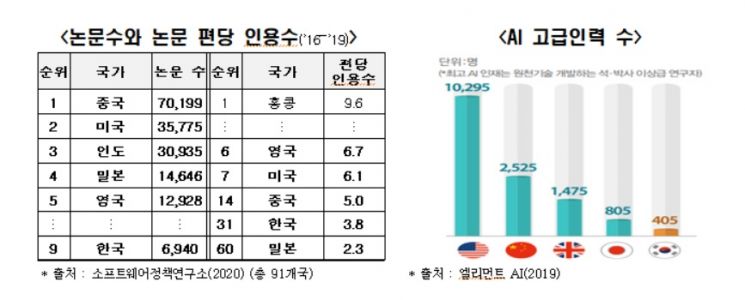
According to the Software Policy & Research Institute, South Korea ranked 9th worldwide with 6,940 AI-related papers published between 2016 and 2019, but this is only about one-tenth of China’s 70,199 papers, which ranked first. In terms of qualitative indicators, the number of citations per paper was 3.8, ranking 31st out of 91 countries. An analysis of the top 100 AI technology companies (research institutions) based on patent numbers showed that South Korea had only four research institutions?Samsung, LG, Hyundai Motor, and Electronics and Telecommunications Research Institute?far fewer than the 44 in the United States. According to an analysis by Canadian AI specialist company Element AI, the number of PhD and master's level researchers developing core technologies was only 405, which is 3.9% of the 10,295 in the United States.
The National IT Industry Promotion Agency, a government research institute, summarized these results by stating, "South Korea's AI competitiveness is at 80.9% of the United States' level, with a technology gap of 1.8 years." This contrasts with China, which, through national-level investment and support policies, rapidly caught up with the United States from 71.8% in 2016 to 85.8% in 2020.
Major Countries Actively Support Policies such as Data Infrastructure Construction
South Korea Faces Greater Restrictions and Uncertainty in Data Utilization
The FKI emphasized the need to refer to advanced countries that build AI infrastructure such as data and focus on financial support and talent development as national strategies. The United States concentrates government investment in public sectors such as defense, while the private sector is responsible for AI application industries. Since 2009, it has promoted big data utilization policies such as open data, creating an environment where data is easy to use in research and industry. As a result, big tech companies like Google, Apple, and Amazon lead the global ecosystem.
China has fostered the big data industry since 2015 by allowing extensive collection and use of personal information under government approval. The United Kingdom actively secures excellent talent by increasing the issuance of special visas for AI-related talent and improving immigration rules to facilitate settlement. It is also proactive in utilizing data such as medical information. Additionally, Japan revised its Personal Information Protection Law in 2017 to introduce a method for withdrawing consent after the fact, creating a favorable data infrastructure environment.
In contrast, South Korea amended the "Three Data Laws"?the Personal Information Protection Act, the Information and Communications Network Act, and the Credit Information Act?last year, but individual laws such as the Medical Service Act still require separate consent for personal information or restrict its use. Although excellent AI talents are leaving overseas, causing a shortage of talent, institutional improvements such as issuing special visas or establishing related academic departments to nurture talent are lukewarm compared to AI-leading countries.
Yoo Hwan-ik, head of the FKI Corporate Policy Office, said, "Although AI is attracting attention as a future growth engine, South Korea's competitiveness as an IT powerhouse falls short of expectations compared to major countries." He argued, "To facilitate the use of data, which is the foundation of AI, it is necessary to amend the Personal Information Protection Act to allow differentiated data use by industry and to revise related laws such as the Medical Service Act." He added, "It is also urgent to improve systems for core talents, such as concentrated financial support, easing visa requirements, and relaxing academic department enrollment regulations."
© The Asia Business Daily(www.asiae.co.kr). All rights reserved.
![Clutching a Stolen Dior Bag, Saying "I Hate Being Poor but Real"... The Grotesque Con of a "Human Knockoff" [Slate]](https://cwcontent.asiae.co.kr/asiaresize/183/2026021902243444107_1771435474.jpg)
















