Other Comprehensive Income Financial Assets Also Reach 114.3682 Trillion Won
Analyzed as Impact of Global Ultra-Low Interest Rates and Stock Price Surge
Some Opinions Question Whether Asset Uptrend Will Continue This Year
[Asia Economy Reporter Song Seung-seop] Last year, the scale of financial assets held by domestic commercial banks in South Korea expanded significantly. As domestic interest rates fell due to COVID-19, bond prices surged, and the bullish stock market further increased the valuation of companies in which they held equity.
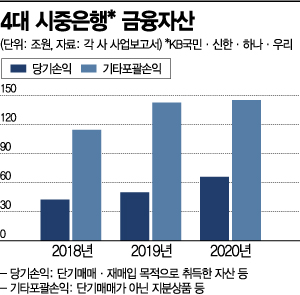
According to the business reports of the four major commercial banks (KB Kookmin, Shinhan, Hana, and Woori) on the 21st, the 'fair value through profit or loss financial assets' amounted to 65.802 trillion KRW. This is an increase of 15.8386 trillion KRW (31.70%) from 49.9634 trillion KRW last year.
Fair value through profit or loss financial assets are priced at a value traded between rational and independent parties. These assets, such as stocks and bonds, are evaluated based on market prices. If acquired for short-term trading or repurchase to gain profits, they are classified as 'profit or loss for the current period'; financial assets like subscription rights not intended for short-term trading are classified as 'other comprehensive income.'
Looking at individual banks, all recorded an upward trend in related assets. Shinhan Bank had the largest amount of securities classified under profit or loss for the current period at 21.8192 trillion KRW among the four major banks. This is an increase of 3.1021 trillion KRW compared to the previous year’s 18.7161 trillion KRW. Kookmin Bank and Hana Bank also held financial assets of 16.0423 trillion KRW and 15.5379 trillion KRW, respectively, marking increases of 15.69% (2.176 trillion KRW) and 45.10% (4.8296 trillion KRW) compared to the previous year.
Woori Bank had the smallest scale but the steepest growth. Financial assets, which were 6.6725 trillion KRW in 2019, increased by 85.87% to 12.4024 trillion KRW in one year. This was influenced by derivative assets rising 136.49% to 6.9085 trillion KRW and securities expanding 46.33% to 5.4354 trillion KRW.
Financial assets classified under other comprehensive income also saw a slight increase. Last year, the fair value through other comprehensive income financial assets of the four major banks totaled 144.9139 trillion KRW, an increase of 2.6318 trillion KRW from the previous year. Compared to 114.3682 trillion KRW in 2018, this represents a growth of 30.5457 trillion KRW (26.70%).
This is interpreted as a result of rising bond prices and stock prices. It means that banks significantly increased holdings of financial assets whose values rise through trading. Last year, the world maintained an ultra-low interest rate policy to overcome the shock of COVID-19. South Korea also lowered interest rates to a historic low of 0.50% in May and has maintained this level since. Generally, bond prices steadily rise when interest rates fall. Contrary to the real economy’s recession, the stock market formed a bullish trend. On the 20th, the KOSPI closed at a record high of 3,220.70 points.
Increased Valuation Gains from Equity and Bond Trading... Will Asset Prices Rise This Year Too?
Accordingly, banks are actively realizing profits through buying and selling equities and bonds, resulting in increased valuation gains. Shinhan Bank’s disposal gains on fair value through other comprehensive income financial assets nearly doubled from 107.6 billion KRW to 207.9 billion KRW in one year. Hana Bank also saw a sharp increase in gains on financial assets classified under other comprehensive income, rising from 48.3 billion KRW to 281.1 billion KRW.
Some banks earned profits through bond trading as well. Woori Bank’s bond trading gains increased by approximately 117.66% to 23.695 billion KRW last year, compared to 10.886 billion KRW the previous year.
However, there are concerns about whether the value of financial assets can continue to rise steadily this year as it did last year. This is because domestic bond yields may rise following increases in U.S. bond yields.
According to a report titled 'Review of Securities Firms’ Bond Valuation Loss Risks Due to Rising Market Interest Rates' by NICE Credit Rating on the 20th, the 3-year government bond yield surged by 16 to 20 basis points compared to December last year. Daishin Securities also forecasted earlier this month that domestic bond yields would continue a gradual upward trend.
Opinions on the stock market outlook are divided. While global investment bank Goldman Sachs set a KOSPI target of 3,700 by the end of this year, some domestic experts predict a decline.
Professor Kim Dae-jong of the Department of Business Administration at Sejong University analyzed, "In the long term, bond yields tend to decline steadily," but added, "Due to the rise in U.S. bond yields, bond prices may fall in the short term."
© The Asia Business Daily(www.asiae.co.kr). All rights reserved.
![Clutching a Stolen Dior Bag, Saying "I Hate Being Poor but Real"... The Grotesque Con of a "Human Knockoff" [Slate]](https://cwcontent.asiae.co.kr/asiaresize/183/2026021902243444107_1771435474.jpg)















