48.4% of Adolescents Responded Negatively About School Life
39% Believe Marriage Is Essential... 60% Say 'It's Okay Not to Have Children'
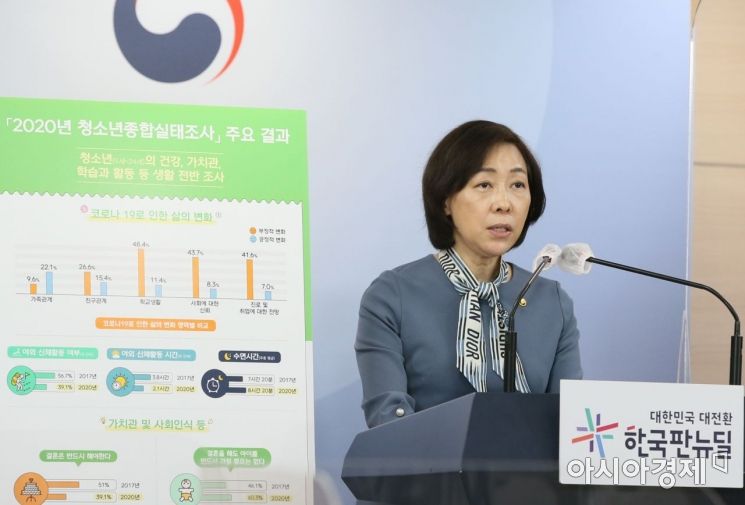 Kim Kyung-sun, Vice Minister of the Ministry of Gender Equality and Family, is announcing the results of the 'Comprehensive Survey on Youth'.
[Asia Economy Reporter Han Jinju] Half of adolescents reported that their 'school life' changed negatively due to experiencing COVID-19, and academic stress also increased.
On the 21st, the Ministry of Gender Equality and Family announced the results of the '2020 Comprehensive Survey on Youth' conducted on 7,170 youths aged 9 to 24. According to the survey, 48.4% responded that their 'school life' changed negatively due to COVID-19, followed by trust in society (43.7%) and outlook on career and employment (41.6%).
Nearly half of the youths (46.0%) answered that academic stress increased after COVID-19. The proportion of students in middle and high school who reported increased stress was particularly high. By age group, it was highest among those aged 13 to 18 (48.2%), followed by those aged 19 to 24 (47.2%).
A Ministry of Gender Equality and Family official stated, "The negative responses regarding school life seem to reflect difficulties with remote classes and dissatisfaction with not being able to form friendships," adding, "This year, efforts are needed to improve the quality of non-face-to-face classes and to develop youth activities in local communities that can be conducted online to reduce negative perceptions."
As in-person classes decreased, outdoor physical activity declined, but sleep time increased compared to the past. The average weekly physical activity time was 2.1 hours, down 1.7 hours from 2017. The average weekday sleep time was 8 hours and 20 minutes, an increase of 28 minutes compared to previous surveys.
Regarding the expansion of online school classes such as remote learning, 51.7% of youths and 48.3% of parents expressed support. Additionally, the rate of meal skipping among low-income groups increased due to COVID-19. The proportion of those who always eat lunch was 77.8%, a decrease from the previous survey. Especially among households with an income below 2 million KRW, 28.8% responded that they 'try to eat' lunch, the highest among income groups, while only 67.8% said they always eat lunch, the lowest rate.
With increased time spent at home, activities with parents also increased significantly. These included dinner time (85.6%), conversations about school life (48.4%), and leisure activities (42.3%). Among conversation times with parents, 76.2% of youths talked with their mothers for more than 30 minutes daily on weekdays, but only 40.6% had the same amount of conversation time with their fathers.
A Ministry official explained, "Despite increased time spent at home, the decrease in conversation time with fathers suggests that, despite reduced working hours, sufficient time for work-family balance or conversations with children has not been secured," adding, "We will expand family-related projects as part of family policy and share more information on communication methods and adolescent psychological information."
The proportion of youths who believe marriage is absolutely necessary also decreased significantly. Only 39.1% of youths answered that marriage is absolutely necessary, a decrease of 11.9 percentage points from the previous survey. The proportion of youths who think it is not necessary to have children increased significantly to 60.3%, up 14.2 percentage points from the previous survey.
Sixty-two point eight percent of youths responded that our society is a 'society that respects human rights,' a slight increase from 59.6% in 2017. The proportion of youths who consider society 'fair' was 47.6%, similar to 46.3% in 2017.
Based on the results of this survey, the Ministry plans to develop and expand digital-based activity programs and provide various activities and career experience opportunities to help youths develop their capabilities and find their aptitudes. To protect the rights of working youths, the Youth Labor Protection Center will be gradually expanded, and a youth labor rights textbook will be developed and distributed to expand labor rights education.
To support family relationships, which greatly affect youths' emotions, local family centers will be operated to provide family counseling, education, and care services tailored to family types and life cycles of family members.
Kim Kyung-sun, Vice Minister of the Ministry of Gender Equality and Family, said, "In response to environmental changes surrounding youths in the post-COVID era, we will promote policies that meet youths' perspectives and actively seek ways to develop and distribute non-face-to-face activity programs and improve youths' satisfaction with school life based on the survey results."
© The Asia Business Daily(www.asiae.co.kr). All rights reserved.
![Clutching a Stolen Dior Bag, Saying "I Hate Being Poor but Real"... The Grotesque Con of a "Human Knockoff" [Slate]](https://cwcontent.asiae.co.kr/asiaresize/183/2026021902243444107_1771435474.jpg)















