NASA Achieves 'Humanity's First' Powered Flight on Mars
[Asia Economy Reporter Kim Bong-su] "30 seconds, 3 meters of flight changed history."
The era of humanity roaming alien planets with flying machines has begun. The 'first powered flight' that the Wright brothers successfully achieved on Earth 117 years ago has been recreated on Mars. Although it appeared in science fiction movies, the idea of flying on an alien planet, once only imagined as "Will it ever happen?", has now become a reality.
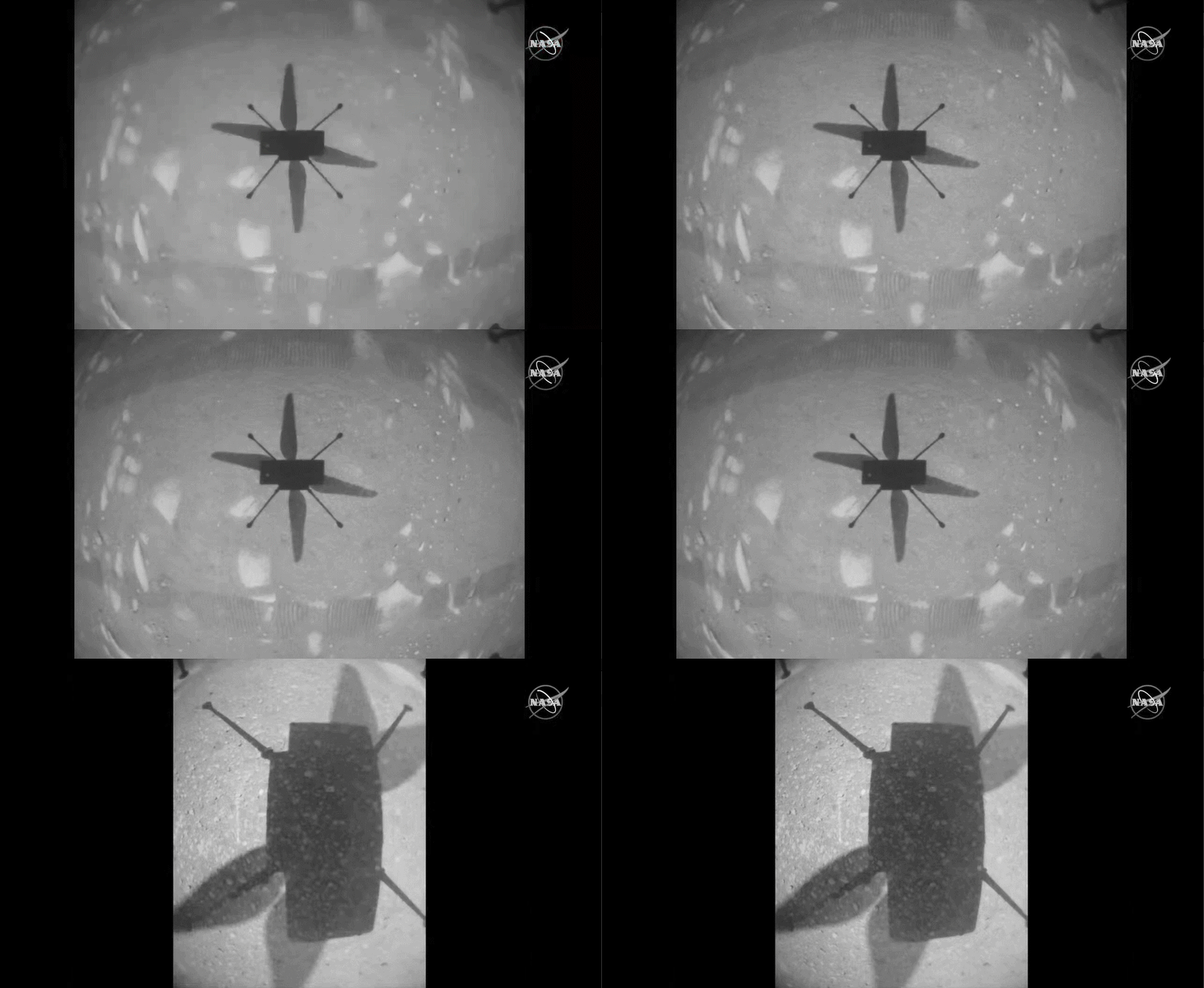
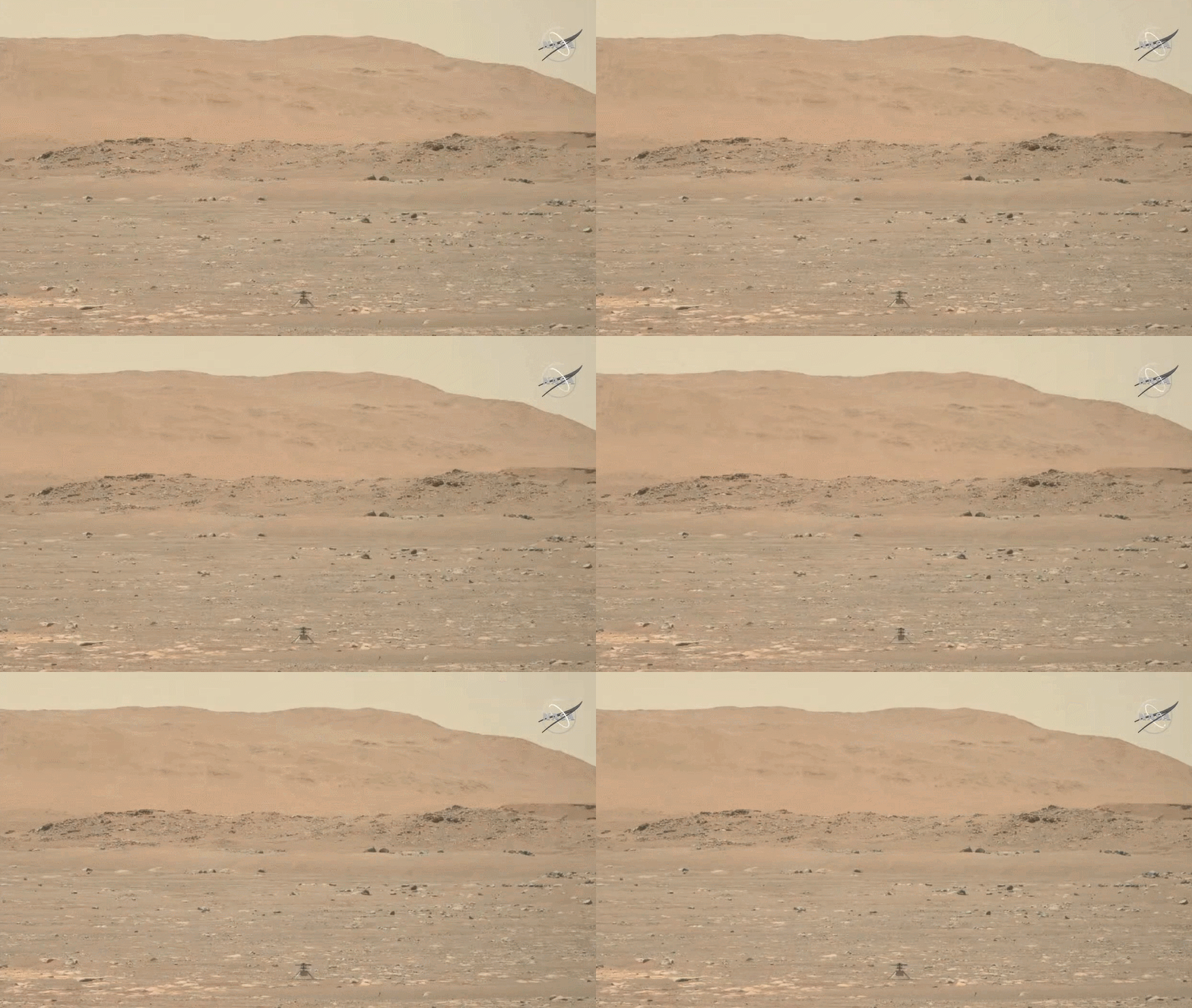
The U.S. National Aeronautics and Space Administration (NASA) announced on the 19th (Eastern Time) at around 3:30 a.m. that the autonomous drone Ingenuity successfully lifted off about 10 feet (3.48 meters) high for approximately 30 seconds in the Jezero Crater on Mars.
▲ The first powered flight beyond Earth
The small drone that took off from the Martian surface that day created new history. It was the first case of a powered flying machine flying by its own power outside Earth. It was a reproduction on Mars of humanity's first powered flight, which the Wright brothers succeeded in near Kill Devil Hills, Kitty Hawk, North Carolina, USA, in 1903. NASA attached a piece of the wing from the Flyer, the airplane the Wright brothers flew, to Ingenuity to give it symbolic meaning. NASA officials watched the flight with bated breath.
The flight was not easy. Due to the distance between NASA and Mars, direct control was impossible. NASA issued flight commands the day before from the Jet Propulsion Laboratory in California through the rover Perseverance, which serves as Ingenuity's mothership, and the commands were transmitted to Ingenuity located about 200 feet (70 meters) away. Also, confirmation of the flight's success could only be relayed to NASA three hours later via Perseverance and Mars orbiters.
Mimi Aung, NASA's project manager, said after the successful flight, "We flew together on Mars," adding, "We all now share the memory of the Wright brothers." NASA decided to commemorate the spot where Ingenuity succeeded in flying by naming it "Wright Brothers Field."
The New York Times (NYT) evaluated, "(Ingenuity) did not fly as long or far as the Wright brothers' first flight, but it showed 'what is possible.'"
This flight was not without difficulties. The first flight attempt on the 11th was halted due to a problem with the rotor speed during testing but later resumed after overcoming setbacks. NASA engineers made Ingenuity from very lightweight materials to enable flight in Mars' atmosphere, which has about 1/100th the density of Earth's. Although about 49 cm tall and weighing 1.8 kg, Ingenuity weighs only 0.68 kg on Mars due to its gravity being one-third that of Earth. The four carbon-fiber blades were designed to rotate at about 2,400 revolutions per minute, roughly eight times faster than a typical helicopter.
▲ A revolutionary method for exploring alien planets
Until now, NASA's exploration of alien planets relied on rovers, which faced severe terrain limitations. On the desert or rocky Martian surface, rovers moved very slowly, and their camera views were limited, causing frustration. However, from now on, flying machines will be able to traverse planets at high speeds, heralding a revolution. This is the first proof that flight is possible even in atmospheres with completely different density and composition from Earth's.
Michael Watkins, director of NASA's Jet Propulsion Laboratory (JPL), said at a press conference, "What the Ingenuity team has achieved gives us 'three dimensions.' They have freed us forever from surface-bound planetary exploration." The NYT commented, "If the Wright brothers' flight changed how humans and objects move around Earth, Ingenuity will provide a new mode of mobility for NASA's exploration of the mysteries of the solar system," adding, "Future robotic explorers may use new and different technologies following NASA's path."
Currently, NASA is not preparing another Mars exploration drone. However, Bob Balaram, NASA's chief engineer for Ingenuity, has revealed that they have "started designing a larger Mars exploration drone weighing 10 times more, capable of carrying 10 pounds (about 4.5 kg) of scientific equipment."
Ingenuity plans to conduct four more flights. Of the total five flights, including the one on this day, three are to test basic flight capabilities. The second test flight is scheduled for the 22nd. During the second test flight, Ingenuity will ascend about 16 feet (approximately 4.88 meters), move 50 feet (15.24 meters) sideways, and return. The third test will involve traveling about 160 feet (approximately 49 meters) and returning, testing more advanced flight capabilities. NASA plans to complete testing whether Ingenuity, which landed on Mars on the 3rd of this month, can fly up to 600?700 meters within 30 Martian days. NASA has invested $2.7 billion (about 3 trillion KRW) in developing Perseverance and $85 million (about 95 billion KRW) in developing Ingenuity.
▲ Achievements born from an 'appendix'
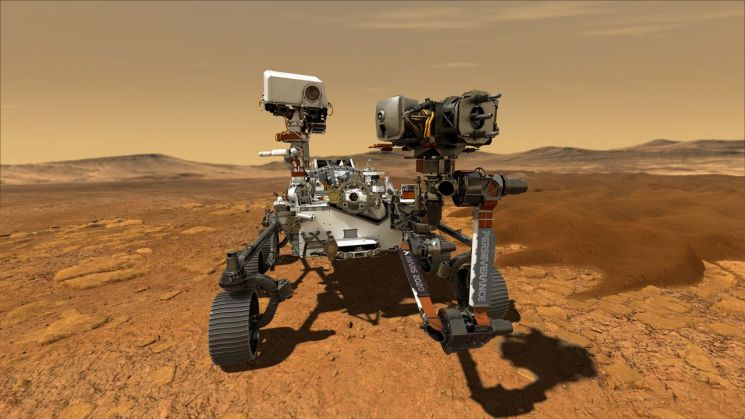
In fact, Ingenuity's flight success was part of NASA's fifth exploration rover Perseverance project but was not the core mission. Perseverance, which arrived on Mars in February, primarily aims to investigate whether life ever existed on Mars. This includes analyzing chemical components by breaking down Martian rocks and soil with lasers and testing whether carbon dioxide on Mars can be converted into oxygen. After completing its test flights, Perseverance is expected to leave Ingenuity behind and move along the edge of Jezero Crater to a delta region where traces of ancient life may remain.
Therefore, Ingenuity's test flights were somewhat an 'appendix' to the Perseverance rover's Mars exploration. Paradoxically, this situation became the key to the first-ever powered flight on Mars. The NYT reported, "Due to relaxed technical requirements, engineers could use off-the-shelf processors with more computing power than all previous interplanetary spacecraft combined," adding, "(These processors) were not suitable for harsh space conditions and vulnerable to radiation, but superior computational power was necessary to maintain stable flight."
© The Asia Business Daily(www.asiae.co.kr). All rights reserved.



















