Federation of Korean Industries and Korea Venture Business Association Hold Joint Seminar
Global Telemedicine Market Expected to Reach $185.7 Billion by 2026
"Active Adoption of Telemedicine in the US, Singapore, etc. Post-COVID"
Association to Promote Telemedicine Boom... Conducting Regulatory Survey
[Asia Economy Reporter Kim Bo-kyung] Voices from the industry have emerged calling for the introduction of telemedicine to secure the competitiveness of the 'K-medical industry.' The global telemedicine market size is expected to grow from $34.3 billion in 2018 to $185.7 billion by 2026. In line with global trends, it is necessary to ease regulations related to telemedicine while establishing mechanisms to support medical professionals and protect patients.
The Federation of Korean Industries (FKI) and the Korea Venture Business Association jointly held a seminar titled "Global Trends in Telemedicine and Korea's Response Direction" on the morning of the 20th at the FKI Hall. At this event, amid growing concerns over the fourth wave of COVID-19, opinions were expressed that regulations should be eased given the high positive public perception of telemedicine.
FKI Vice Chairman Kwon Tae-shin stated, "Since public perception of telemedicine is more positive than ever, it is time to consider easing related regulations on the premise of preventing side effects from its introduction." According to a survey conducted by FKI last year targeting the public, 62.1% expressed positive opinions about the introduction of telemedicine, more than three times higher than the 18.1% negative opinions.
Vice Chairman Kwon added, "While the spread of telemedicine is a global trend, there has been almost no discussion about allowing telemedicine in Korea recently. It is very regrettable that Korean companies, recognized for their technological capabilities to the extent of signing telemedicine service contracts with foreign governments, cannot even obtain business opportunities domestically."
Lee Joo-wan, CEO of Megazone Cloud and Vice Chairman of the Korea Venture Business Association, pointed out, "Currently, the Medical Service Act does not allow telemedicine, which suppresses investment and hinders industrial development, thereby weakening the global competitiveness of the K-medical industry." He emphasized, "If the stability and necessity of telemedicine have been verified through temporary allowance for infectious disease response, it is now time to fully allow telemedicine in line with the era's trend without delay."
Professor Baek Nam-jong of Seoul National University College of Medicine diagnosed, "Telemedicine should be approached from the perspective of patient convenience and future medicine, and it is an essential system for this. However, from the provider's perspective, telemedicine is also medical treatment but carries legal risks of medical accidents and has little profitability."
He added, "Concerns about commercialization and deterioration of medical service quality, protection of personal information, and reasonable insurance fees are challenges that need to be considered," and said, "A strategy to gradually expand applicable parts within the current medical system would be effective."
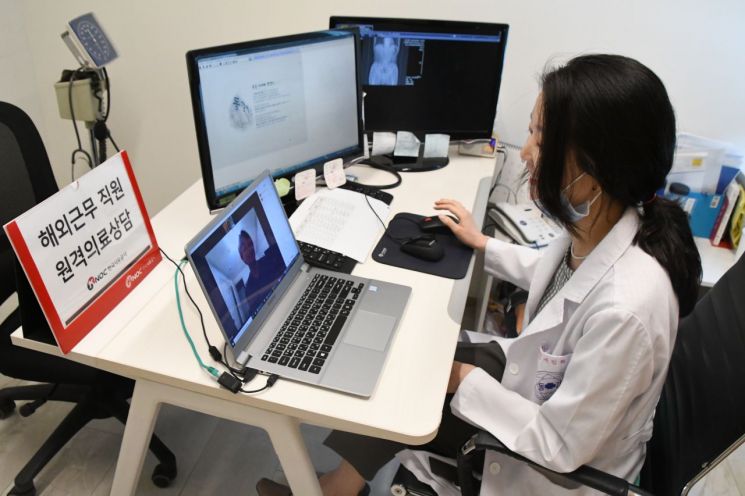
Kim Areum, Director of the International Medical Center at Inha University Hospital, explained in her presentation, "The global telemedicine market is expected to grow significantly from $34.3 billion in 2018 to $185.7 billion in 2026," adding, "The market size is largest in North America, followed by Europe, Asia-Pacific, Latin America, and the Middle East & Africa."
According to Director Kim, the United States has encouraged the application of the same insurance fees for 'telemedicine' and 'outpatient care' for diseases in the private insurance sector through the Telehealth Parity Law. After the COVID-19 outbreak, Medicare further relaxed restrictions, allowing video consultations even for first visits and providing fees for medical consultations via email or text messages. As a result, the share of telemedicine in outpatient care in the U.S. was 0.1% before COVID-19 but surged explosively to 14% by April last year.
Director Kim said, "In the Asia-Pacific region, China, Singapore, and Australia have had profit-driven companies lead platform development from the early stages of telemedicine introduction, and government support has been prominent before and after the COVID-19 pandemic." She added, "While these three countries actively adopted telemedicine due to the pandemic, Korea has been conservative in its adoption."
Ban Ho-young, CEO of Neofect, stated, "It is time to move beyond the pros and cons debate and seek ways to improve the efficiency of the National Health Insurance finances and normalize the medical delivery system through the institutionalization of telemedicine." He added, "It is necessary to establish mechanisms to protect medical professionals and the public by introducing appropriate licensing systems for services and products used in telemedicine and to prepare support measures for medical professionals."
Meanwhile, the Korea Venture Business Association has designated the easing of telemedicine regulations as a key task for 2021 and plans to carry out various activities starting with this seminar. Along with creating a telemedicine boom through seminars and forums, they also plan to conduct a survey on the current regulatory status that increases the burden on companies in the telemedicine field.
© The Asia Business Daily(www.asiae.co.kr). All rights reserved.


















