Pursuing Zero 'Flaring' of Byproduct Natural Gas... Expected Up to 10% Increase in Natural Gas Production
[Asia Economy Reporter Park Byung-hee] British oil company British Petroleum (BP) plans to invest $1.3 billion to equip facilities that capture and process natural gas generated during oil drilling, the Wall Street Journal (WSJ) reported on the 18th (local time).
WSJ said BP is scheduled to announce the related plan on the 19th, which concerns investment in oil drilling facilities in the Permian Basin spanning Texas and West Virginia in the United States. The Permian Basin is the region with the largest crude oil reserves in the U.S. Through this facility investment, BP plans to reduce greenhouse gas emissions and increase natural gas production.
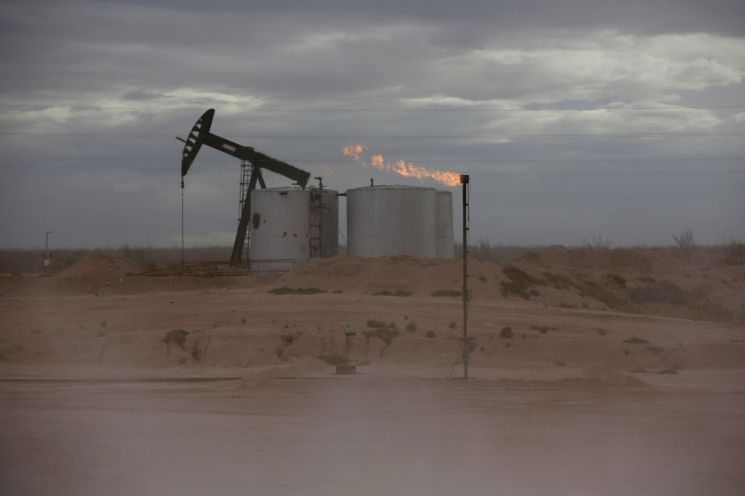
In the reservoirs where oil companies drill for crude oil, both crude oil and natural gas are stored together. Since crude oil is more economically valuable, oil companies treat natural gas as a byproduct and burn it off. Because natural gas poses an explosion risk, oil companies burn it off, a process that emits greenhouse gases.
The process of burning off natural gas is called flaring. Before the COVID-19 pandemic, the amount of natural gas combusted in the Permian Basin was worth $1.2 million per day. This was equivalent to the daily natural gas demand of Nebraska or West Virginia. According to the U.S. Environmental Protection Agency, the amount of greenhouse gases emitted during this flaring process was equivalent to the emissions from 6 million cars.
BP plans to capture and process the natural gas through facility investments and sell it. Ultimately, BP aims to convert all fossil fuels produced in the Permian Basin into marketable energy sources.
BP has already significantly reduced the amount of natural gas combusted. As of the second half of 2019, the flaring rate was 13%, but by the second half of last year, only 3.5% of natural gas was flared.
However, compared to competitors, BP’s natural gas flaring volume remains relatively high. As of the end of last year, ExxonMobil and Chevron flared only 0.4% and 0.9% of their natural gas, respectively.
Because of this, BP has earned the stigma of being the company that emits the most greenhouse gases through flaring in the Permian Basin. Recently, as corporate eco-friendly investments have been emphasized, natural gas flaring has become a target of regulatory scrutiny.
BP ultimately plans to reduce natural gas flaring in the Permian Basin to zero by 2025. By processing natural gas instead of flaring it, BP expects natural gas production to increase by up to 10%.
BP previously announced plans to reduce oil and gas production by 40% by 2030. Additionally, it aims to increase the sales proportion of renewable energy over oil and achieve net-zero greenhouse gas emissions.
© The Asia Business Daily(www.asiae.co.kr). All rights reserved.
![Clutching a Stolen Dior Bag, Saying "I Hate Being Poor but Real"... The Grotesque Con of a "Human Knockoff" [Slate]](https://cwcontent.asiae.co.kr/asiaresize/183/2026021902243444107_1771435474.jpg)















