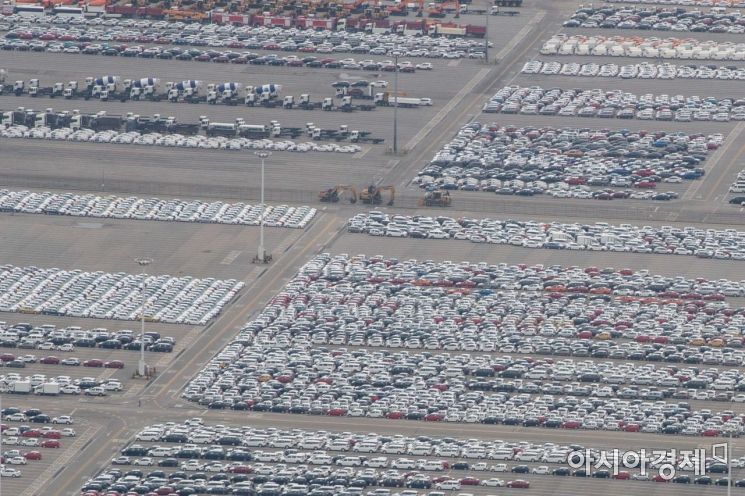
 Export vehicles are waiting to be loaded at Pyeongtaek Port in Gyeonggi Province on the 11th, two days before Chuseok, the biggest traditional holiday of the nation. (Aerial photography cooperation: Sergeant Lee Yong-gil, Aviation Unit, Seoul Metropolitan Police Agency; Inspector Park Hyung-sik, Northern Gyeonggi Provincial Police Agency) / Photo by Jin-hyung Kang aymsdream@
[Asia Economy Reporter Yu Je-hoon] The domestic eco-friendly (BEV, PHEB, HEV) commercial vehicle market is facing difficulties in both exports and domestic sales due to a lack of model diversity and price competitiveness, highlighting the need for policy support.
According to the report "Tasks for Revitalizing the Eco-Friendly Commercial Vehicle Market" published on the 19th by the Korea Automotive Technology Institute, the global eco-friendly commercial vehicle market, excluding China, has been steadily growing.
Market research firm SNE Research reported that sales of eco-friendly commercial vehicles outside China increased from 10,871 units in 2017 to 34,234 units last year, showing a high average annual growth rate of 46.6%.
However, in China, sales dropped by more than half from 258,538 units to 125,780 units during the same period. The Korea Automotive Technology Institute analyzes that this decline is likely due to reduced replacement demand following the large-scale government-led transition to eco-friendly commercial vehicles around 2017.
The Korea Automotive Technology Institute stated, "Last year, eco-friendly vehicles accounted for 8.0% of total vehicle sales and 0.8% of commercial vehicle sales. Although progress is slow, the market is steadily forming outside China."
The reason for the accelerating transition to eco-friendly commercial vehicles is that commercial vehicles emit more greenhouse gases per unit than passenger cars, making it necessary to comply with strengthening global environmental regulations. According to the government's 4th Basic Plan for Eco-Friendly Vehicles, annual greenhouse gas emissions from commercial vehicles are estimated to be 2.5 times higher for trucks and 16 times higher for buses compared to passenger cars.
Domestic automakers are focusing on expanding the domestic market by developing electric and hydrogen fuel cell-based commercial vehicles. For buses, Hyundai Motor Company has introduced the Elec City in electric and hydrogen fuel cell versions and the County Electric as an electric bus for city routes, while Daewoo Bus is selling models such as the BS110CN. For trucks, Hyundai and Kia offer the Porter2 EV, Bongo3 EV, and the large hydrogen fuel cell truck Xcient Fuel Cell, and DP Co. is developing and selling ultra-compact and light electric trucks.
However, the Korea Automotive Technology Institute points out that domestic automakers' commercial vehicle models lack diversity for export markets and are not price competitive compared to imports in the domestic market.
Export models are primarily developed for the domestic market and are not yet able to meet diverse overseas demands. For example, most electric buses produced by domestic companies are tailored to domestic driving conditions, making it difficult to find long-distance passenger models suitable for overseas markets. Trucks are mostly focused on 1-ton or ultra-compact and light electric vehicles, limiting exports to major countries with high demand for eco-friendly cargo vans and medium-to-large trucks.
On the other hand, the domestic market faces a double burden of lacking price competitiveness. Chinese electric buses, which dominate the global electric bus market, have entered the market with low prices, and electric trucks from Geely Automobile in the 2.5-ton and 3.5-ton classes are also preparing to enter the market, making the situation challenging.
The Korea Automotive Technology Institute analyzed that Korean brands account for only 1.2% of the global commercial vehicle market of 24.37 million units, and since 99.2% of vehicles are still internal combustion engine vehicles, eco-friendliness can also revitalize the automotive industry.
The Korea Automotive Technology Institute emphasized, "We need to actively develop the market by expanding demand through incentives for public commercial vehicles and replacement of old commercial vehicles, and by promoting exports through public-private cooperation focusing on hydrogen fuel cell commercial vehicles, which are in the early stages of the market. Additionally, continuous R&D is necessary to reduce the price and improve the reliability of eco-friendly commercial vehicle common parts, and clustering of related companies is needed to encourage small and medium-sized enterprises to challenge the development of diverse eco-friendly commercial vehicles."
© The Asia Business Daily(www.asiae.co.kr). All rights reserved.

















