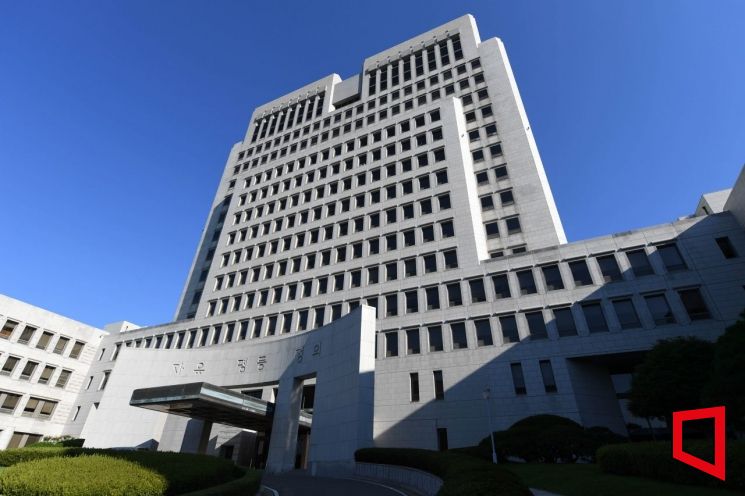
 Supreme Court, Seocho-dong, Seoul. Photo by Honam Moon munonam@
[Asia Economy Reporter Kim Daehyun] The Supreme Court has ruled that the application of seniority increment restrictions to educational public service workers at some public middle and high schools in Gyeonggi-do does not violate the Labor Standards Act.
On the 18th, the Supreme Court's First Division (Presiding Justice Park Jeonghwa) announced that it upheld the lower court's ruling, which dismissed the appeal filed by 74 educational public service workers including Mr. A against Gyeonggi-do in a wage claim lawsuit.
Mr. A and others, who were handling school accounting tasks, initially renewed their employment contracts annually and received wages based on the seniority system under the local government officials' salary regulations. However, when they were converted to indefinite-term contracts in 2007 and signed new employment contracts, a seniority increment restriction was applied, which prevented further increments once a certain seniority level was reached.
Mr. A and others argued, "There is wage discrimination depending on which school the worker is employed at," and claimed, "This violates the Labor Standards Act's prohibition of discriminatory treatment and is therefore invalid." Essentially, other school accounting staff performing the same or similar duties did not have seniority increment restrictions, but only they were subject to such limitations.
They filed a lawsuit claiming the difference between the wages they actually received and the basic salary, long-service allowance, and holiday leave pay they would have received if there had been no restrictions.
However, both the first and second trials dismissed the plaintiffs' claims. The first trial court stated, "It is difficult to conclude that the defendant treated Mr. A and others unfavorably without reasonable grounds compared to employees without seniority increment restrictions solely because only they are subject to such restrictions."
The second trial court also ruled, "It is difficult to view the wage system for the plaintiffs as a seniority system with regular annual increments as claimed, and therefore the defendant is not obligated to pay wages based on such a seniority system."
The Supreme Court agreed with this judgment. The court stated, "The lower courts did not err in interpreting or applying the law regarding the seniority system, discriminatory treatment, or collective agreements, nor did they violate Supreme Court precedents," and dismissed the plaintiffs' appeal.
© The Asia Business Daily(www.asiae.co.kr). All rights reserved.
![Clutching a Stolen Dior Bag, Saying "I Hate Being Poor but Real"... The Grotesque Con of a "Human Knockoff" [Slate]](https://cwcontent.asiae.co.kr/asiaresize/183/2026021902243444107_1771435474.jpg)














