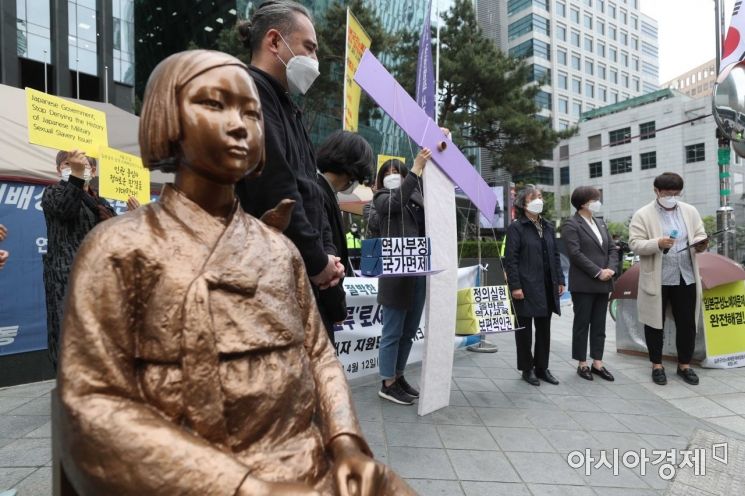
 The Network of Support Organizations for Victims of Japanese Military Sexual Slavery held a press conference on April 12 in front of the former Japanese Embassy on Pyeonghwa-ro, Jongno-gu, Seoul, demanding a just ruling in the lawsuit for damages against the Japanese government filed on April 21. Photo by Moon Honam munonam@
[Asia Economy Reporter Choi Seok-jin] Victims of the Japanese military sexual slavery who won a final judgment in a damages lawsuit against the Japanese government have filed a property disclosure application with the court, requesting confirmation of the list of properties owned by the Japanese government domestically.
The property disclosure application, stipulated in the Civil Execution Act and other laws, allows a creditor who can initiate compulsory execution based on an enforceable title for monetary payment to request the court to confirm the debtor's list of properties for debt collection purposes.
According to the legal community on the 17th, attorney Kim Kang-won, representing the plaintiffs of the first comfort women lawsuit including the late grandmother Bae Chun-hee, filed a property disclosure application against the Japanese government at the Seoul Central District Court on the 13th.
This measure aims to confirm the properties held by Japan domestically to collect the debt against Japan, which has not paid the damages even after losing the lawsuit.
The first trial court, the Civil Division 34 of the Seoul Central District Court (Chief Judge Kim Yang-ho), has not yet accepted the victims' application.
Earlier, 12 victims including grandmother Bae filed a lawsuit against the Japanese government, claiming 100 million won each in damages for each illegal act, and won in January.
Japan, invoking the principle of "state immunity" (sovereign immunity), which exempts sovereign states from the jurisdiction of other countries' courts, did not respond to the lawsuit and did not appeal the first trial loss, resulting in the judgment becoming final.
© The Asia Business Daily(www.asiae.co.kr). All rights reserved.
![Clutching a Stolen Dior Bag, Saying "I Hate Being Poor but Real"... The Grotesque Con of a "Human Knockoff" [Slate]](https://cwcontent.asiae.co.kr/asiaresize/183/2026021902243444107_1771435474.jpg)















