February Mobile Food Service Transactions Surge 70% to 1.8 Trillion Won
Barogo Utilizes Over 1,000 Branches... Expands Eco-Friendly Bike Distribution
Saenggakdaero Turns Profitable... Surpasses 16.74 Million Orders in December Last Year
Vroong Partners with GS... Builds MFC, Aggressively Invests for Faster Delivery
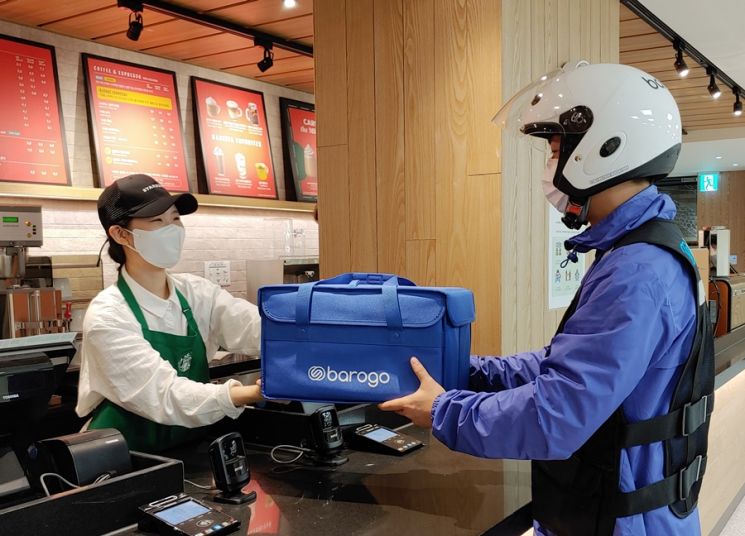
[Asia Economy Reporter Kim Bo-kyung] The delivery market is bustling due to the prolonged COVID-19 pandemic. Food delivery agencies are evolving into comprehensive logistics service companies, while the value of delivery drivers is rising amid the overwhelming volume of deliveries. As the contactless and digital transaction market expands, consumers increasingly demand faster and more diverse product deliveries.
According to Statistics Korea on the 17th, mobile shopping transaction amounts in February reached 9.7338 trillion KRW, up 20.2% (1.64 trillion KRW) compared to the same month last year. Among this, food service transaction amounts surged 69.5% (740.6 billion KRW) from February last year to 1.8068 trillion KRW. As the number of ‘thumb tribe’ shoppers using smartphones increases, the market for delivery food services, where food is prepared after online orders, is growing even larger. We examined the changing trends in the delivery agency industry through three companies with three different approaches.
◆Barogo, expanding infrastructure including eco-friendly bike distribution= Barogo is currently conducting a Series C investment worth 50 billion KRW, including signing an agreement in February for SK Telecom’s subsidiary 11st to acquire a 7.2% stake in Barogo for 25 billion KRW. With the secured funds, the company plans to expand its business scope beyond food and beverage delivery to include cosmetics and daily necessities delivery. Barogo operates with over 1,000 branches nationwide, 54,000 delivery drivers, and more than 100,000 registered store owners. Through this, it expects to enable fast delivery within 2 to 3 hours. Recently, it formed delivery agency partnerships with Starbucks, 7-Eleven, and No Brand Burger.
Going forward, Barogo plans to increase the supply of eco-friendly electric two-wheelers and create an environment where ordinary people can easily work as delivery drivers. Through the joint venture 'Moving' established with fintech security company Aton, it supplies electric two-wheelers to delivery drivers and installs electric two-wheeler shared battery charging systems (BSS) at major hubs nationwide to enhance convenience.
◆Naver investment ‘Saenggakdaero’… Mesh Korea builds urban logistics centers= Logiol, which operates the delivery agency service ‘Saenggakdaero,’ is a subsidiary of Inseong Data, which holds 80% of the domestic quick service market. Inseong Data received a 40 billion KRW equity investment from Naver, recognizing its technological capabilities. Established in January 2016, Logiol started as a latecomer in the delivery agency industry but rapidly grew, surpassing 16.74 million monthly orders in December last year. Logiol recorded sales of 32.3 billion KRW and a net profit of 700 million KRW last year, turning profitable. It has about 48,000 registered delivery drivers and 90,000 affiliated stores.
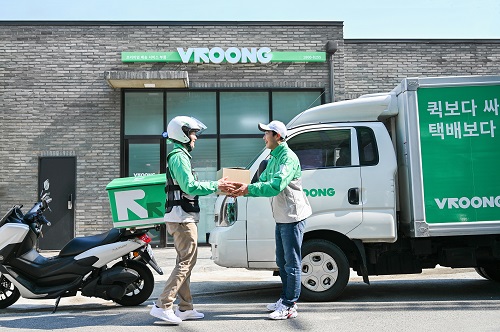
Mesh Korea, which operates the ‘Booroong’ service, established its first urban logistics center, the ‘Micro Fulfillment Center (MFC),’ in Gangnam, Seoul this month. It plans to aggressively invest despite rental burdens by building 50 centers in Seoul and the metropolitan area within the year. This is to enable fast delivery where customers receive products within 1 to 3 hours of ordering. Recently, GS Home Shopping acquired about an 18% stake in Mesh Korea, becoming the third-largest shareholder after Naver. GS Home Shopping, which is preparing to merge with GS Retail, aims to gain an advantage in delivery competition through its investment in Mesh Korea. Mesh Korea has 66,000 delivery drivers and about 450 logistics hubs and provides an AI transportation management system (Booroong TMS).
◆Is single-order delivery, one order at a time, always beneficial? As ‘single-order delivery’ becomes the trend among major delivery service companies like Baedal Minjok and Coupang Eats, changes are expected in the delivery agency industry as well. Baedal Minjok stopped new sign-ups for its ‘Baemin Riders’ service from the 12th. Instead, it will introduce the ‘Baemin1 (one)’ service from June, which delivers to only one household at a time. Baemin Riders was a system where Woowa Brothers directly recruited delivery riders through its subsidiary Woowa Cheongnyeon. An industry insider analyzed, "It must have been difficult to bear the labor cost of delivery drivers when orders concentrate only during peak times like lunch and dinner."
The delivery agency industry is closely monitoring the spread of single-order delivery. If cost burdens are passed on due to cutthroat competition among delivery service companies, both consumers and self-employed business owners (restaurant owners) could suffer. It also affects the labor environment of delivery drivers, who are platform workers legally classified as non-employees. A representative from the Rider Union stated, "If single-order delivery expands without sufficient increases in delivery fees, the labor intensity will inevitably increase," adding, "Delivery drivers will have to run more, longer, and faster, raising safety concerns."
© The Asia Business Daily(www.asiae.co.kr). All rights reserved.
![Clutching a Stolen Dior Bag, Saying "I Hate Being Poor but Real"... The Grotesque Con of a "Human Knockoff" [Slate]](https://cwcontent.asiae.co.kr/asiaresize/183/2026021902243444107_1771435474.jpg)

















