Korean Language Chooses Language and Media, Mathematics Prefers Probability and Statistics
Probability and Statistics Average 30.54 Points, Calculus 50.53 Points... 20-Point Gap
[Asia Economy Reporter Han Jinju] An analysis has emerged suggesting that there may be advantages and disadvantages depending on the elective subjects in the March academic assessment conducted in line with the 2022 College Scholastic Ability Test (CSAT).
According to the scoring results of the academic assessment held on the 25th of last month, the Korean language elective subjects showed 74% for Speech and Writing, and 26% for Language and Media. It is interpreted that students somewhat avoided Language and Media, which includes difficult grammar questions.
For mathematics subjects, Probability and Statistics accounted for 60.53%, Calculus 33.65%, and Geometry 5.82%. Among natural science students only, Calculus was chosen by 85.25%, and Geometry by 14.75%, showing a concentration in Calculus.
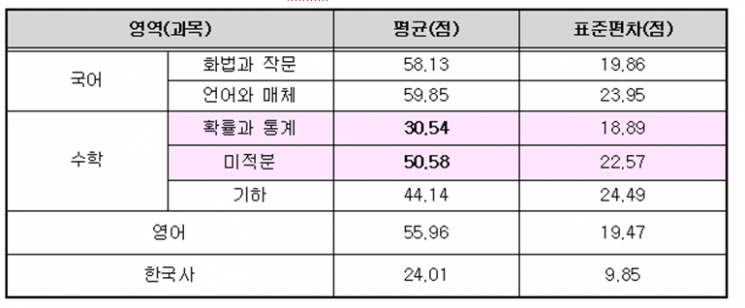
In particular, the average score for 'Probability and Statistics,' a subject mainly chosen by liberal arts students, showed a significant gap compared to the scores of subjects mainly taken by science students. Probability and Statistics had an average score of 30.54 points, Calculus 50.53 points, resulting in a 20.04-point difference. Geometry scored 44.14 points, which is 13.6 points higher than Probability and Statistics.
The highest standard score for the Korean language subject was 142 points, and for mathematics, it was 157 points, a difference of 15 points. Lim Seong-ho, CEO of Jongro Academy Haneul Education, said, "If top-ranking students perform poorly in mathematics, it will be impossible to compensate with Korean language scores, and the discriminative power of the mathematics subject has significantly increased."
The percentage of students achieving the top grade (Grade 1) in English was 3.67%, about a quarter of the previous year’s rate. Considering that the appropriate rate for Grade 1 is around 7-8%, it appears that the difficulty level of the English section in the academic assessment was significantly higher.
Kim Byung-jin, Director of the Etoos Education Evaluation Research Institute, explained, "It can be inferred that there may be many advantages and disadvantages depending on the elective subjects, but since elective subjects have different difficulty levels, in order to properly compare and analyze the advantages and disadvantages by elective subject, it is necessary to provide the average and standard deviation for each elective subject in the future."
Kim also stated, "Graduates are basically prohibited from taking the March academic assessment, so it is difficult to assume that the distribution and characteristics of test takers in this exam will remain the same until the CSAT. It is necessary to observe changes in the characteristics of the test-taking group along with students achieving their highest possible scores in subsequent exams."
Lee Man-gi, Director of the Uway Education Evaluation Research Institute, said, "In the ‘common subjects + elective subjects’ system, there are many variables such as the average and standard deviation of common subjects and elective subjects until the final standard score is calculated, so it is not easy to predict which elective subject will yield a higher score at what score range compared to the raw score, making it very difficult to use as a criterion for subject selection." He advised, "Unless one is excellent in mathematics, it is difficult for liberal arts students to choose Calculus without burden. One should consider their own interests, academic ability, intended major, and study volume."
© The Asia Business Daily(www.asiae.co.kr). All rights reserved.
![Clutching a Stolen Dior Bag, Saying "I Hate Being Poor but Real"... The Grotesque Con of a "Human Knockoff" [Slate]](https://cwcontent.asiae.co.kr/asiaresize/183/2026021902243444107_1771435474.jpg)















