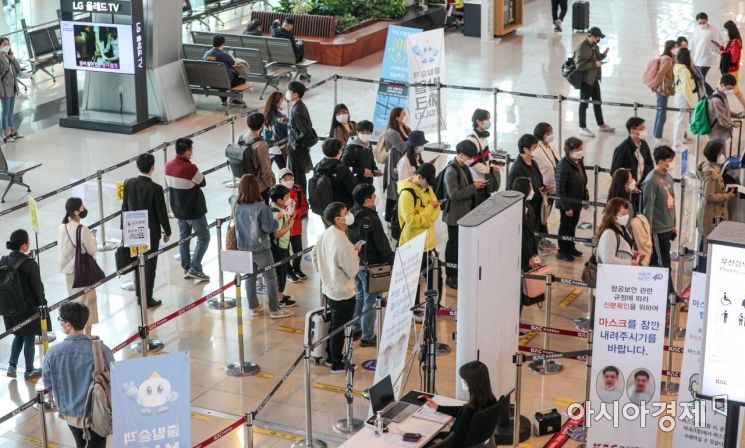
 On the 11th, with 614 new COVID-19 cases reported, marking three consecutive days of over 600 cases, Seoul Gimpo Airport's domestic terminal is bustling with travelers. Photo by Jinhyung Kang aymsdream@
[Asia Economy Reporter Dongwoo Lee] The domestic aviation industry appears to be experiencing a deepening polarization in performance this year. While full-service carriers (FSCs) continue to maintain profits by strengthening cargo transportation to compensate for reduced passenger demand, low-cost carriers (LCCs) have triggered warning signs in their financial structures due to deteriorating performance.
According to financial information provider FnGuide on the 17th, Korean Air is expected to maintain consecutive profits with consolidated sales of 1.7886 trillion KRW and operating profit of 92.9 billion KRW in the first quarter of this year, following the fourth quarter of last year.
They are defending profits by strengthening cargo transportation to offset the reduced passenger demand. Last month, the TAC index for air cargo freight rates on the Hong Kong-North America route was $5.48, a 35.9% increase compared to the same month last year ($4.03). During the same period, Korean Air’s cargo volume totaled 140,889 tons, more than 20% higher than the 114,547 tons in the same month last year. Industry insiders also expect Asiana Airlines to turn a profit in the first quarter of this year thanks to the cargo sector, after recording an operating loss of 21.2 billion KRW in the fourth quarter of last year.
NH Investment & Securities analyzed, "Last month, the total international air cargo volume at nationwide airports was 287,989 tons, a 21.5% increase compared to the previous year," adding, "Cargo demand increased across all routes including the Americas, Japan, China, and Europe, with Korean Air’s volume rising 27.1% and Asiana Airlines’ increasing by 8.1% year-on-year."
Lack of Offset Measures for Passenger Demand Decline in LCC Industry
In contrast, the LCC industry is experiencing delayed performance improvement due to limitations in preparing self-help measures to offset the reduced passenger demand.
Jeju Air, the leading LCC, is expected to report an operating loss of 62.9 billion KRW in the first quarter of this year. Although the deficit has decreased compared to the previous quarter (operating loss of 114.6 billion KRW), the financial structure is deteriorating, with the debt ratio on the rise.
Jeju Air’s debt ratio last year was 438.9%, an increase of 87.5 percentage points from the previous year. During the same period, Jin Air and T’way Air are also expected to continue operating losses of 42.3 billion KRW and 31.4 billion KRW, respectively.
As losses persist, the financial condition is worsening. Last year, Jeju Air’s debt ratio was 438.9%, Jin Air’s was 467.4%, T’way Air’s was 503.6%, and Air Busan’s was 838.5%.
Experts warn that as the debt ratio increases, credit ratings may decline, making it difficult to raise funds from financial institutions. Additionally, there may be disadvantages in policy fund support evaluations.
The LCC industry is attempting to improve financial structure by expanding capital through rights offerings and strengthening events and promotions such as no-landing sightseeing flights, but they acknowledge that these are only temporary measures if international routes recover slowly.
An LCC industry official said, "Unlike full-service carriers, it is difficult to secure revenue from the cargo sector due to aircraft conditions, and there are no concrete alternatives to recover performance," adding, "We are focusing on domestic routes, but even this is facing difficulties due to rising jet fuel costs and fare-cutting competition."
© The Asia Business Daily(www.asiae.co.kr). All rights reserved.
![Clutching a Stolen Dior Bag, Saying "I Hate Being Poor but Real"... The Grotesque Con of a "Human Knockoff" [Slate]](https://cwcontent.asiae.co.kr/asiaresize/183/2026021902243444107_1771435474.jpg)















