Korea to Continue Attracting Foreign Funds Due to Growth and Interest Rate Appeal
Potential Impact if Capital Concentrates in China and India

[Asia Economy Reporter Kim Eunbyeol] It is forecasted that funds flowing into emerging markets will be concentrated in China and India for the time being. This is because their economic growth conditions are favorable, and there is a possibility of further market liberalization. In the case of Korea, foreign capital is expected to continue flowing in steadily due to its stable economic growth rate and relatively high bond yields, but there is a risk to be mindful of as China and India may absorb these funds.
According to the International Finance Center on the 17th, about 27% (1.2 trillion dollars) of securities funds that flowed into emerging markets over the past 25 years were concentrated in China. In particular, funds flowing into BRICS (Brazil, Russia, India, China) accounted for 47% of the total, nearly half, and the expansion trend continues.
Hwang Yuseon, a senior researcher at the International Finance Center, stated, "Although BRICS countries are generally experiencing economic growth slowdown, China and India are expected to maintain steady interest due to the absence of new growth countries." Since both countries have large market sizes but relatively low foreign ownership ratios, and there is a possibility that these countries will further open their markets, a significant portion of emerging market funds could be concentrated in China and India. Measures such as foreign investment liberalization, inclusion in international indices, or increased weighting were cited as incentives for increased fund inflows.
Korea holds a special appeal among emerging markets. Despite being a high-grade country, it offers relatively high interest rates and has a low foreign ownership ratio of around 8%, so unless there are special negative factors, it is expected to maintain a buying advantage continuously. Foreign ownership of Korean stocks is high at 38% (KOSPI). However, Senior Researcher Hwang believes that the attractiveness of representative emerging market companies remains, preventing large-scale capital outflows, and thus steady bond inflows and robust capital inflows are expected for the time being.
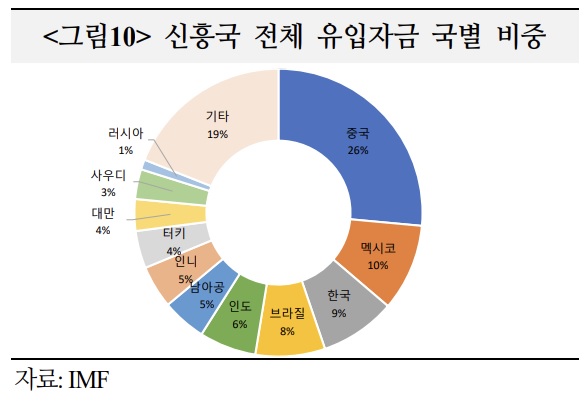
However, since China and India may become 'black holes' for emerging market funds as they open their markets, this is a matter to be cautious about. Senior Researcher Hwang said, "Depending on the speed of market liberalization in China and India, foreign portfolio allocation adjustments may proceed faster than expected, so the associated risks need to be continuously monitored."
Meanwhile, according to the International Finance Center's analysis, a cumulative total of 4.4 trillion dollars has flowed into 25 emerging countries since 1996, which is one-eighth the level of developed countries. Inflows into emerging market equities peaked at 166.4 billion dollars in 2009-2010 and have been steadily decreasing since. Bond fund inflows averaged around 60 billion dollars annually before 2008, and increased to 222.2 billion dollars during 2016-2020.
Senior Researcher Hwang stated, "Overall securities fund inflows into emerging markets are expected to continue declining as investment risks remain high and growth rate gaps are gradually narrowing." She added, "By asset type, bonds will continue to be preferred due to still low foreign ownership ratios and relatively high interest rates, which enhance investment attractiveness."
© The Asia Business Daily(www.asiae.co.kr). All rights reserved.
![Clutching a Stolen Dior Bag, Saying "I Hate Being Poor but Real"... The Grotesque Con of a "Human Knockoff" [Slate]](https://cwcontent.asiae.co.kr/asiaresize/183/2026021902243444107_1771435474.jpg)

















