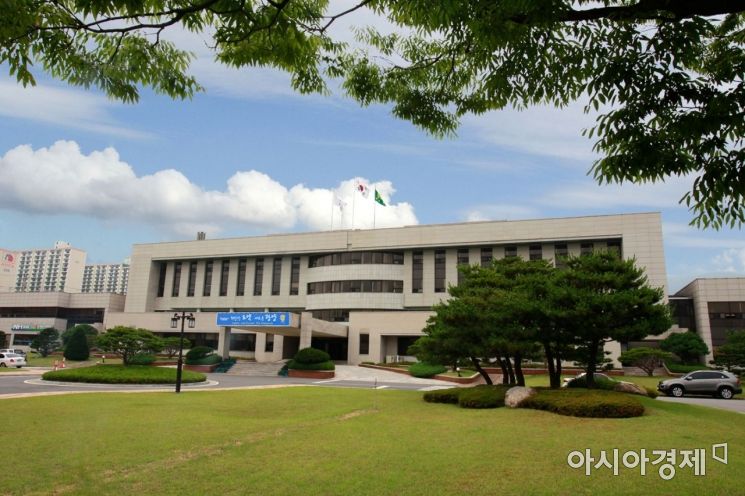
[Asia Economy Honam Reporting Headquarters Reporter Lee Hyung-kwon] Gwangyang City, Jeollanam-do (Mayor Jeong Hyeon-bok) stated on the 16th that the report by Gwangju KBS regarding the resident proposals for the Jungdong District urban development project is inaccurate, emphasizing that although procedures are being carried out according to relevant laws, it appears as if some businesses were given preferential treatment, which could undermine administrative credibility.
Additionally, the city strongly refuted each point of the Gwangju KBS report on the promotion of the Gwangyang Jungdong District project and announced plans to take strong measures such as requesting a correction report.
Regarding the claim that “the entry of large marts was blocked in 2012 due to the ordinance protecting traditional markets,” the city explained that following the amendment of the 「Distribution Industry Development Act」 on June 31, 2011, which expanded the traditional industry protection zone from 500m to 1000m, the Jungdong District urban development area is located within a 1km radius of Jungma Market, making the entry of large stores impossible.
Concerning the statement that “after 2012, landowners attempted to promote mixed-use complexes, but Mayor Jeong Hyeon-bok designated the area as a zone restricted to buildings under 20 floors, causing the plans to fall through,” the city clarified that the Jungdong District received approval for the urban development project implementation plan (including district unit plan decisions) from the Governor of Jeollanam-do in November 2009, completed the urban development project in February 2017, and that no mixed-use complex project plans have been submitted to Gwangyang City since completion.
Regarding the claim that “even applications for lot division for site sales were rejected,” the city stated that although the quasi-residential land was planned as a large block at the time of the district unit plan announcement in November 2009, the proposal in January 2018 involved dividing it into 23 small lots. Following the city’s urban planning committee’s advisory in September 2018, which expressed concerns about weakening the purpose of the district unit plan, changes to green spaces, urban landscape damage, and indiscriminate development, the proposal was rejected.
On the claim that “the floor limit was set below 20 floors, but after the business operator changed, conditional approval was granted to allow the construction of high-rise apartments,” the city explained that on January 25, a resident proposal was made to change the district unit plan to allow changes in building use for quasi-residential land. Following the city’s urban planning committee advisory on February 16, the proposal was conditionally accepted with requirements such as color plan improvements, nightscape review, and examination of sunlight and views for surrounding apartments.
The city further stated, “The report incorrectly suggested that conditional approval for apartment complexes was finalized and notified to the business operator,” clarifying that for the business operator to proceed with the apartment complex project, administrative procedures remain, including public inspection of plans by residents, review by the city’s urban planning committee, and review by the Jeollanam-do Architectural and Landscape Joint Committee under the 「National Land Planning and Utilization Act」, so the final project plan has not been confirmed.
Moreover, the city noted that during interviews, officials mentioned that related procedures must proceed, and the report’s portrayal of the process as if the apartment complex project approval had been granted is not the stance of a credible news organization.
Regarding the claim that “the position was reversed like turning over a hand with the change of the developer,” the city explained that the January 2018 proposal involved dividing a large block into smaller lots, whereas the January 25 proposal maintained the large block and planned to build apartment complexes, indicating the proposals differ.
On the claim that “a relative of the Gwangyang mayor is an executive of the new business,” the city stated that administrative agencies do not have access to personal information about business operators.
A city official said, “We will take all legal measures, including correction reports and actions against the spread of false information, to hold accountable those who have caused unnecessary distrust in local administration by reporting unverified information as facts.”
They also strongly demanded “fair reporting from the public broadcaster KBS.”
© The Asia Business Daily(www.asiae.co.kr). All rights reserved.
![Clutching a Stolen Dior Bag, Saying "I Hate Being Poor but Real"... The Grotesque Con of a "Human Knockoff" [Slate]](https://cwcontent.asiae.co.kr/asiaresize/183/2026021902243444107_1771435474.jpg)















