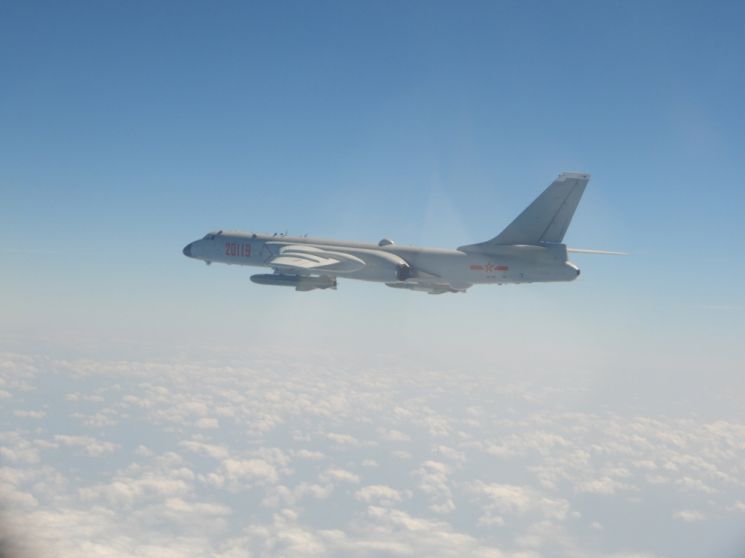
[Kim Daeyoung, Military Analyst] On the 12th, Taiwan's Ministry of National Defense issued a press release announcing that 25 Chinese military aircraft had violated its Air Defense Identification Zone (ADIZ). This incursion, the largest scale of Chinese military aircraft known to date, occurred in a specific airspace. The area, called the Southwestern Airspace by Taiwan, includes the airspace over Taiwan's main island and the Dongsha Islands (東沙群島).
The Dongsha Islands are small islands in the South China Sea under Taiwan's control. In addition, Chinese naval and air force aircraft formed a strike package to penetrate Taiwan's ADIZ. A strike package refers to a flight formation composed of aircraft with different capabilities to carry out a single attack mission. The Chinese military aircraft that violated Taiwan's ADIZ this time are reported to include 2 Y-8 maritime patrol aircraft, 1 KJ-500 airborne early warning and control aircraft, 4 J-10 fighters, 14 J-16 fighters, and 4 H-6K bombers.
Unlike the U.S. Navy and Air Force strike packages, electronic warfare aircraft and aerial refueling aircraft were absent, but maritime patrol aircraft with sea reconnaissance capabilities and airborne early warning and control aircraft that detect aerial threats in advance and command and control the strike package were included. Another notable feature is the flight direction toward the Bashi Channel. The Bashi Channel is a strait between Taiwan and the Batan Islands of the Philippines, known to be about 150 km wide, and is an important maritime route connecting the Pacific Ocean and the South China Sea. Since Taiwan's Ministry of National Defense first issued a press release on September 17, 2020, regarding incursions into its ADIZ, most Chinese military aircraft incursions have occurred in the Southwestern Airspace and toward the Bashi Channel.
So far this year, as of the 12th, Chinese aircraft have entered Taiwan's ADIZ on 86 out of 102 days, and since the 3rd of this month, the incursions have continued for 10 consecutive days. Why is the Chinese military focusing on the Bashi Channel? The Bashi Channel is known as one of the critical sea routes for Chinese naval vessels to access the Pacific Ocean. Moreover, in the event of a war with Taiwan, if the Chinese military quickly seizes this area, it can prevent U.S. military intervention in Taiwan. In fact, during the Third Taiwan Strait Crisis from June 1995 to March 1996, the U.S. dispatched two aircraft carriers and one amphibious assault ship to Taiwan, some of which stayed near the Bashi Channel to pressure China.
Coincidentally, on the day Chinese military aircraft violated Taiwan's ADIZ, the U.S. Navy aircraft carrier USS Theodore Roosevelt was conducting exercises near the Bashi Channel. Because of this, the recent Chinese incursion into Taiwan's ADIZ is seen as an attempt to increase the fatigue of Taiwan's air force while signaling an intention to preemptively strike U.S. aircraft carriers that might intervene in Taiwan in an emergency.
© The Asia Business Daily(www.asiae.co.kr). All rights reserved.

















