Environmental Fuel Recycling in the Cement Industry, Directly Tackling Environmental Issues and Building Social Consensus
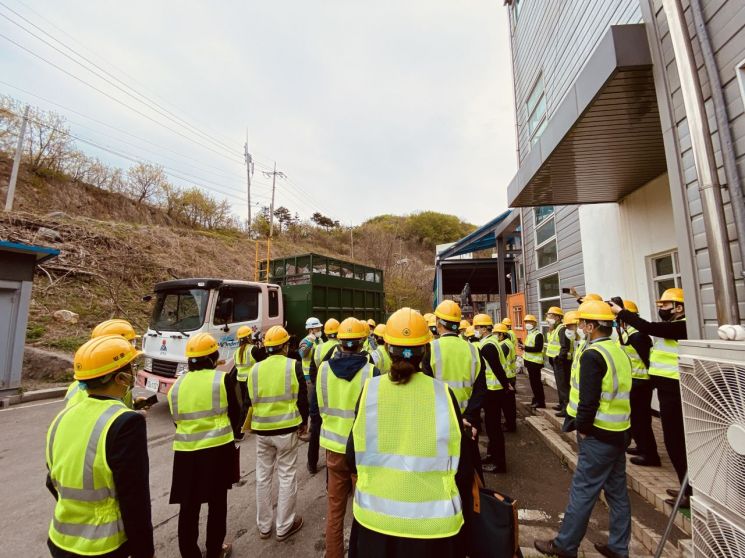 Local government officials and key figures visiting Sampyo Cement Samcheok Plant, touring the pretreatment facility for converting municipal waste into fuel.
 [Photo by Korea Cement Association]
[Asia Economy Reporter Kim Jong-hwa] As non-face-to-face consumption accelerates due to COVID-19, the world is suffering from a surge in waste plastics. In this situation, the cement industry is safely recycling waste plastics as environmental fuel, creating a social consensus to follow the cement industry’s example and directly tackle environmental issues.
In particular, the cement industry significantly contributed to resolving the waste tire crisis in the 1990s and the Uiseong waste mountain environmental problem earlier this year. With a focus on strengthening environmental projects through the use of waste plastics as environmental fuel and ESG (Environmental, Social, and Governance) management, it has attracted attention from various sectors.
On the 12th, the Korea Cement Association invited about 40 people, including Professor Kang Tae-jin, an emeritus professor at Seoul National University, academics, local governments, environmental NGOs, and workers from the plastic manufacturing industry, to the Sampyo Cement Samcheok Plant. They revealed the site where circulating resources such as waste plastics and waste tires are recycled as fuel instead of bituminous coal, which is entirely imported from overseas and is a major cause of greenhouse gas emissions.
The visiting group included Lee Man-ui, president of the Greenhouse Gas Reduction and Recycling Association (former Minister of Environment), Jo Eun-hee, mayor of Seocho District, and 15 officials from Seocho District Office, Incheon City, and Cheongsong County in Gyeongbuk Province, who are interested in fuel conversion of household waste in their jurisdictions.
The delegation visited the household waste fuel pre-treatment facility, which Sampyo Cement invested 2 billion KRW in and donated to Samcheok City after completion, to directly verify that separated and sorted household waste is not simply landfilled but transformed into fuel for cement manufacturing.
At the Sampyo Cement Samcheok Plant, they toured the cement manufacturing equipment, the kiln (KILN), and the circulating resource storage facilities such as waste plastics, observing the process where circulating resources that have passed strict management standards are used as fuel in cement production.
Professor Kang Tae-jin gave a lecture titled “Plastic Civilization Society and Environment” to the visiting group, introducing global companies’ ESG management cases worldwide and stating that the domestic cement industry’s ESG management capability is sufficient by using and expanding waste plastics as environmental fuel through cement kilns.
In particular, Professor Kang emphasized, “When environmental fuels such as waste plastics are combusted at ultra-high temperatures up to 2000°C, complete thermal decomposition occurs, and no pollutants are emitted. The use of coal (bituminous coal) also decreases, reducing greenhouse gases, making it a key industry that can greatly contribute to the government’s 2050 carbon neutrality goal.”
He also added, “If a waste plastic treatment system is established, environmental problems caused by plastics will be resolved within 10 years,” and “Collecting waste plastics from the Pacific garbage patch, which is seven times the size of the Korean Peninsula, and utilizing them in cement plants could also be a method.”
Furthermore, regarding some criticisms labeling cement made from recycled circulating resources as “garbage cement,” he stated, “Coal contains naturally occurring radioactive materials and heavy metals, whereas plastics have been distilled once to remove these, so they are cleaner.” He criticized, “It is regrettable from a scientist’s perspective that environmental activists without scientific knowledge incite people not to build apartments with garbage cement.”
After the lecture, the visiting group had an active Q&A session with Sampyo Cement officials regarding the recycling of circulating resources. A local government official who participated in the field tour evaluated, “The cement industry field tour was very helpful in confirming and understanding the safe recycling of waste plastics.”
© The Asia Business Daily(www.asiae.co.kr). All rights reserved.
![Clutching a Stolen Dior Bag, Saying "I Hate Being Poor but Real"... The Grotesque Con of a "Human Knockoff" [Slate]](https://cwcontent.asiae.co.kr/asiaresize/183/2026021902243444107_1771435474.jpg)















